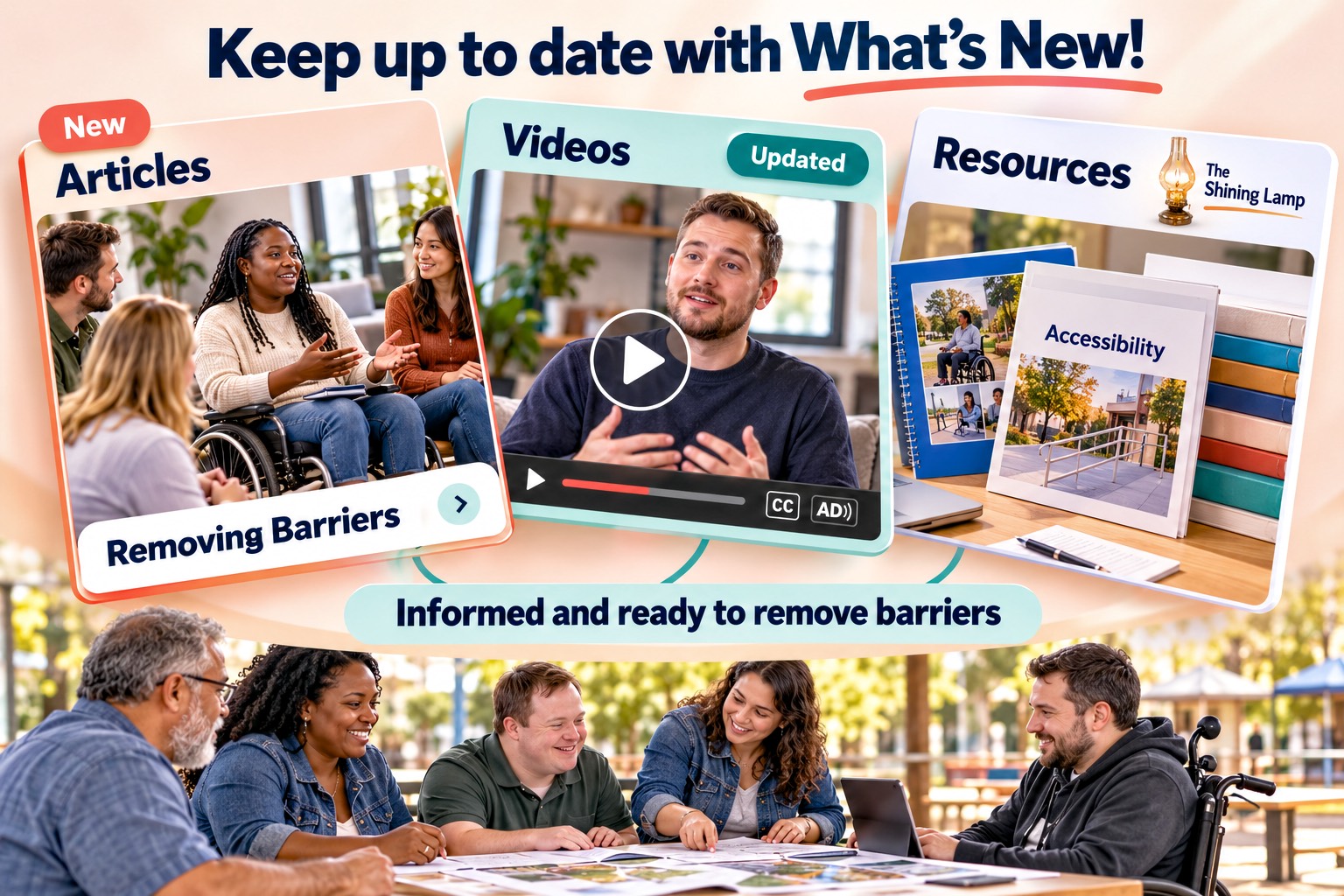

Infographic headed “Keep up to date with What’s New!” features article, video, and resource previews marked “New” and “Updated.” Below, a diverse group, including a wheelchair user, reviews materials together beneath the message “Informed and ready to remove barriers.”

What's New and Updated at The Shining Lamp?

Latest updates

  • Care and connection go together: a UC Health clinician listens to a patient’s heart, echoing the article’s call to design communities where people with developmental disabilities can belong and lead.

    America’s loneliness epidemic is even worse for people with disabilities

    New

    The Surgeon General warns that loneliness harms health like heavy smoking, and for people with developmental disabilities it’s driven by systems—not personal shortcomings. The piece argues that Disability Doesn’t Have To Mean Isolation: segregation in housing, day programs, and service models keeps people apart, so the public task is to redesign for connection and belonging. Cincinnati shows the stakes: adults with developmental disabilities experience some of Ohio’s lowest employment and participation rates because our systems prize placement over purpose. Employers, funders, and agencies…

  • Jeremy Smith, pictured for this piece about graduating from the Colorado Center for the Blind.

    Graduating from the Colorado Center for the Blind Means More Than Skills

    New

    Jeremy Smith opens with a clear turning point: on January 8, 2025, he walks into the Colorado Center for the Blind at 2233 West Shepperd Avenue. He names the cost of leaving Kentucky and traces early fear to years when retinitis pigmentosa wasn’t plainly explained—then sets a plain goal: rebuild the self he’s believed in. Instruction reads as craft with real stakes. Training lives in ordinary places—streets, stations, kitchens, conversations—so repeated practice and firm expectations steady his reactions. The deeper change is trust in himself; the tools of travel, tactile reading, and modern…

  • Portrait of Cindy Scott-Huisman, author of the article about audio description and touch tours in live theater.

    Equal Access to Live Theater: Opening New Worlds through Audio Description and Touch Tours

    New

    Audio description (AD) makes live and recorded performances come alive for blind and low-vision audiences. By narrating visual details—actions, settings, costumes, and more—it helps everyone fully experience theater, film, and other art forms. AD is now common in many movie theaters and on certain TV services, and it is gradually expanding into live theater. There, the description is often professionally produced and generally available for any performance once a show has been running for a while. These performances feature pre-recorded AD: individual sound clips carefully cued to match each…

  • A still from Guillermo del Toro’s Frankenstein. Photograph: AP

    Horror movies have an ableism problem. Isn’t it time we found new ‘monsters’?

    New

    Kathryn Bromwich states that horror still treats disability as shorthand for moral depravity. She names this pattern ableism. She cites Guillermo del Toro’s Frankenstein. It is a Venice hit that stars only non-disabled performers. Victor receives prosthetics and amputations. The film confuses message with spectacle. She then traces older and newer screen habits—facial scarring, wheelchair use, amputation, and prosthetics as menace—showing how these choices teach audiences to read “Disability” as threat. She lists recent examples: Longlegs, The Substance, Heretic, Weapons, and Nosferatu’s…

  • The essay confronts loneliness among People with Disabilities and calls communities to remove barriers and build belonging.

    Disability Doesn’t Have To Mean Isolation

    New

    Joni Eareckson Tada opens with Rebecca, an adult with cerebral palsy. Volunteers placed her with children at a family retreat. The error spotlighted something larger than one failure. Too many People with Disabilities are present in a room yet cut off from it. Tada asks communities to treat belonging as a shared responsibility. The article cites a national survey of working-age People with Disabilities in the United States. More than three in ten often lacked companionship. Over a third often felt left out. Nearly four in ten reported feeling isolated. The numbers describe neighbors…

  • NBC profiles Elana Meyers Taylor’s family life and public advocacy. The piece centers day-to-day disability experiences and her plans to expand that work.

    Elana Meyers Taylor is reshaping the world for her sons and the disability community

    New

    NBC profiles Elana Meyers Taylor as a parent and disability advocate. She and her husband, Nicholas Taylor, raise sons Nico and Noah. “My boys travel with me as much as possible… All season long, six months on the road, they’re with me.” She uses her platform “to grow awareness and show what disability looks like on a day-to-day basis.” “I think the biggest problem we have in this society is that we don’t value those who aren’t able to achieve as much.” She is “a full proponent of everyone having value regardless of what they achieve.” Her roles are public and specific. She served as 2019…

  • Kelly Boyd of Hamilton Township uses a wheelchair due to having severe rheumatoid arthritis and has experienced discrimination in health care settings.

    In NJ, people with disabilities face indignity, missed diagnoses, barriers to health care

    New

    New Jersey residents with disabilities report health care problems that damage safety and dignity. Kelly Boyd describes offensive comments, blocked entrances, and skipped weight checks during routine visits. These problems carry grave consequences. A 2022 World Health Organization report links higher illness and early death to unfair system factors and misattributed symptoms. Reporting documents patterns statewide: communication failures, too few clinicians accepting Medicaid, inaccessible equipment and rooms, and rushed appointments that miss warning signs. Some facilities are removing…

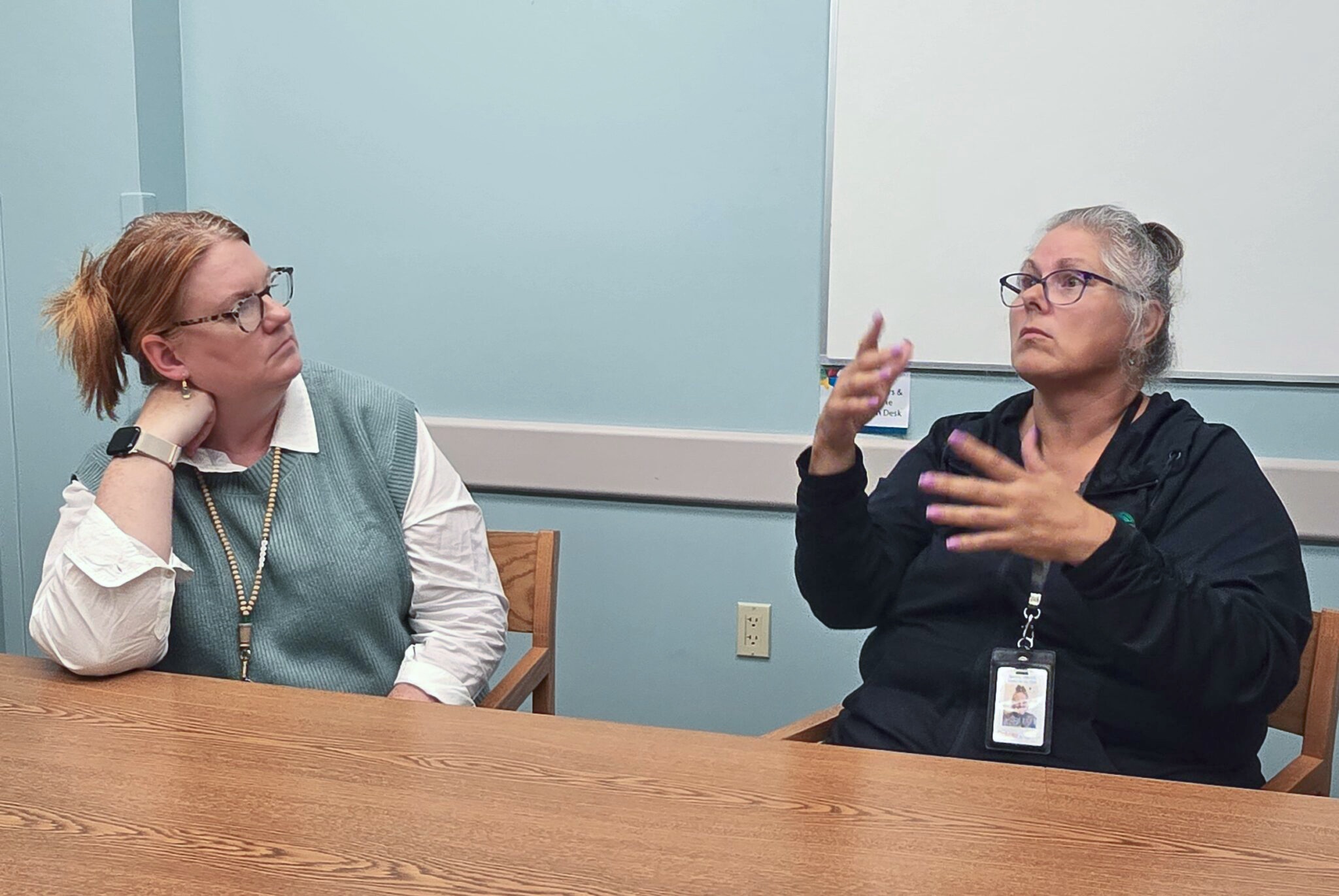
  • Tammy Derrick, right, communication and advocacy coordinator for the North Dakota School for the Deaf/Resource Center for Deaf and Hard of Hearing, signs to American Sign Language interpreter Lindsey Solberg Herbel during an interview on Sept. 18, 2025. (Photo by Michael Achterling/North Dakota Monitor)

    Lack of sign language interpreters in North Dakota a major barrier

    New

    A Deaf parent brought their child to a Bismarck hospital during a medical emergency. The hospital’s video service for sign language failed, and there was no on-site American Sign Language (ASL) interpreter at the start. This blocked critical information in real time and is a communication failure the institution was obligated to fix by removing barriers. The article describes the harms that follow: key facts are missed or delayed during “life and death” conversations. Substituting lip-reading, family members, handwritten notes, or unstable video is not equal to a qualified interpreter.…

  • Matthew Kayne broadcaster and disability-rights advocate featured in a NationalWorld profile about channeling life experience into music and advocacy.

    I live with cerebral palsy and survived bladder cancer — music is hope

    New

    NationalWorld profiles broadcaster and disability-rights advocate Matthew Kayne, who turns years of hospital routines and system barriers into a creative act: writing and releasing “Free Like a Bird,” a song about agency, dignity, and removing barriers. The core idea is clear: music became his way to organize experience into purpose, blending art with activism to challenge ableist assumptions and advance anti-ableism—without pity framing. Writing and recording happened alongside cancer-treatment schedules and administrative hurdles; responses from listeners affirmed the message, while his…

  • People connected with Active Impact mark 15 years of inclusion work at a Gloucestershire community event.

    15 Years Worth of Removing Barriers

    New

    Active Impact marks 15 years with a community celebration that showcases providers and families working together to remove barriers so children with disabilities participate can in local life alongside peers. Founded in 2010 by Jane Douch, Philip Douch and Paralympic cyclist James Brown after a Gloucestershire County Council programme, the organisation set out to grow providers’ capability so more groups offer inclusive activities instead of relying only on oversubscribed specialist options. Now a charity (since 2020) led by CEO Nicole Hastie and a part-time team with varied lived experience…

  • Comedian and actor Chris McCausland reflects on expectations around disability, success, and why he wants his blindness to be incidental to his work.

    Chris McCausland: “I don’t want to be in a show because I’m blind — my blindness is incidental.”

    New

    Chris McCausland recounts how losing his sight by early adulthood reshaped his path from software work to stand-up and television, and he argues that his career should be judged on craft and contribution, with representation in media framed as inclusion rather than exception. His core point: success isn’t perfection; it’s the connection you build. Strictly Come Dancing taught him to prioritise joy and rapport over scores, challenging the instinct to hold back work until it feels flawless. He traces milestones that reinforced this stance — a decade on CBeebies, a travel series, a Sky comedy…

  • The Sunflower Lanyard, 10 Years On: How the Travel Industry Is Supporting Neurodivergent Travellers

    Updated

    Editor’s Note: Can you identify the systemic ableism that creates the very problem a Hidden Disabilities Sunflower lanyard or badge is meant to “fix”? Focus on how default policies, design choices, or staff behavior cause barriers in the process — and name the concrete changes that would eliminate those problems for People with Disabilities, rather than relying on afterthought identifiers like lanyards. Condé Nast Traveller surveys the Sunflower Lanyard’s first decade and asks how airports and airlines are advancing neuro-inclusive travel for neurodivergent passengers, framing airports as…

  • Woman on a sofa accompanying coverage about the unpredictability of dynamic disabilities.

    I have a dynamic disability — here’s what I want you to know

    New

    Kit, a TikTok creator known as @moonlit_kit, shares that she lives with conditions including POTS, Hypermobile EDS, and MCAS, and explains what she wishes people understood about her dynamic disability. Her core point is that a dynamic disability fluctuates in severity and impact—unlike a static disability—so how a person feels and what support they need can change day by day or even hour by hour, making planning hard. She notes that these changes often invite stigma: People with Disabilities may use a mobility aid one day and not the next, or manage a task one day and struggle the next, yet…

  • A sensor-laden electric test car outside a neuroscience building illustrates the promise and accessibility problems raised by autonomous vehicles.

    Self-Driving Car Design Faces Accessibility Blind Spots, Study Warns

    New

    A new study reported by Forbes warns that self-driving car design still contains major accessibility blind spots—gaps that could exclude People with Disabilities, especially Blind/Low Vision riders, from safe, confident participation in everyday mobility. At its core, the message is simple: Accessibility is critical for the world's disability community, so autonomous vehicles must be co-designed with disabled riders from curb to interface—covering trip planning, hailing, boarding, seating, restraint operation, and clear nonvisual feedback. Researchers highlighted that disabled and…

  • Why Seat Belts And Public Seating Are Still Not Inclusive

    New

    The article argues that basic safety and comfort features—seat belts and public seating—remain exclusionary because standard designs and policies create barriers for People with Disabilities. It calls for planning grounded in inclusive design so equipment and layouts reflect real bodies, mobility, and sensory realities rather than a narrow default. Standard three-point restraints, hard-to-obtain extenders, and tie-down complexity shift responsibility onto disabled riders. The article points to a practical remedy: remove barriers by making adaptive restraints available by default and training…

  • How the new Disability Wellbeing Index can better inform policies for people with disability

    New

    The Disability Wellbeing Index (DWI) is presented as Australia’s first validated, disability-specific measure of wellbeing, developed by Monash University’s Centre for Health Economics with partners through extensive consultation with people with disability. It captures domains such as relationships, daily living, home, health, learning, work, finances, respect and dignity, safety, and participation, grounding policy measurement in lived experience. The authors explain that generic health tools have not reflected what matters to people with disability, creating an evidence gap that weakens…

  • The inclusion movement in Utah

    New

    Natalie Green, a 25-year-old advocate who has cerebral palsy, epilepsy and an intellectual delay, writes ahead of Utah’s Dignity Leadership Summit after asking 15 Utahns with connections to IDD what inclusion means to them. She frames inclusion as belonging and participation across daily life — from schools and workplaces to inclusive events — and shares where readers can find the full set of responses. Voices from Special Olympics athletes and coaches emphasize that inclusion is not token attendance but meaningful roles, leadership and friendship. Kyle “Pickles” Karren points to chances to…

  • A home where access is part of everyday life

    New

    This Brief But Spectacular segment features Micaela Connery reflecting on how a close family relationship led her to focus on homes and neighborhoods that welcome People with Disabilities as full neighbors, framing community as ordinary daily life shared in the same buildings, streets, and routines. She describes The Kelsey’s approach: mixed-income, mixed-ability housing where universal design, inclusive property management, and resident leadership are planned from the start to remove barriers that keep People with Disabilities out of typical apartments and community spaces. The segment…

  • First Peoples Disability Network launches national survey to drive reform

    New

    The First Peoples Disability Network has launched a national survey to surface everyday problems and priorities from Aboriginal and Torres Strait Islander People with Disabilities, aiming to turn lived experience into practical reforms. Responses will help map barriers in housing, health, education, transport, and justice so reforms start with community voice rather than assumptions; the approach centers cultural safety and disability pride. For Blind/Low Vision participants and others who prefer different formats, the call invites accessible ways to take part so stories are not lost to…

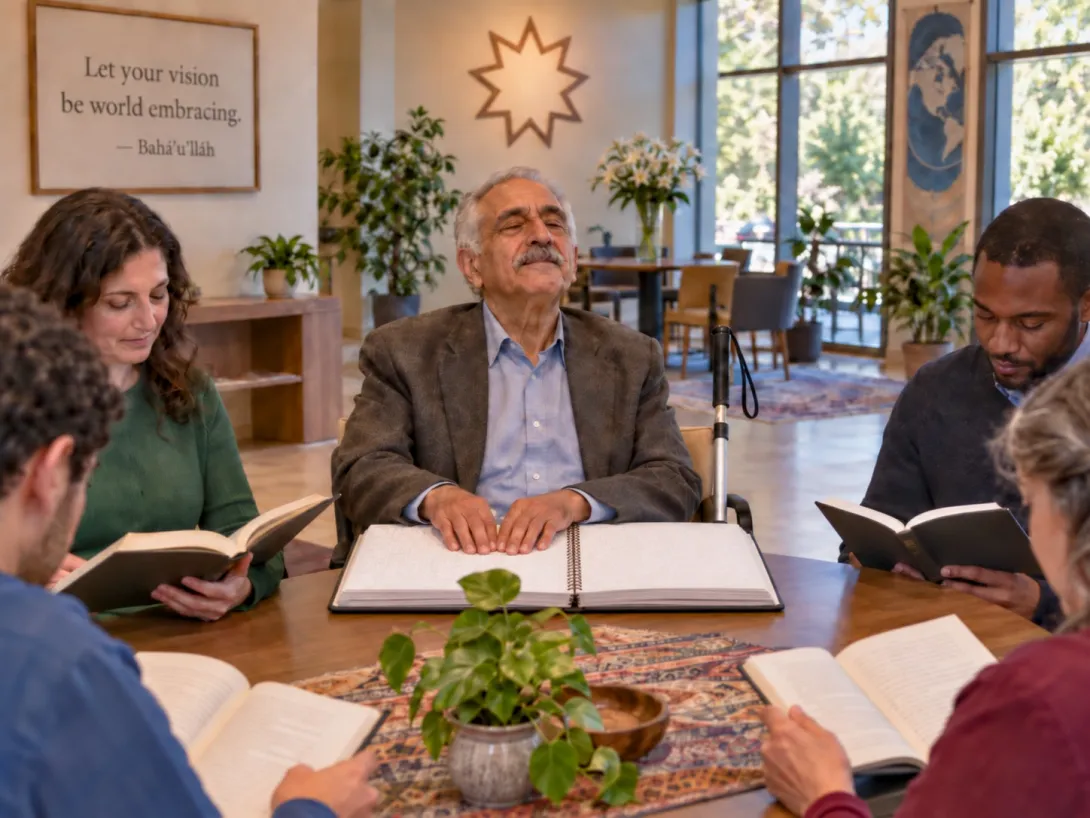
A Blind older Persian man with white hair and a mustache smiles as he reads a braille book at a round wooden table in a Bahá'í study circle. He sits in a chair with his white cane beside him. A woman with curly dark hair and a Black man read print books beside him. Two people in the foreground read print books. A framed quote on the wall reads "Let your vision be world embracing," by Bahá'u'lláh. A nine pointed star hangs on the wall, and a banner with a globe hangs by the windows.

Accessible materials are imperative and should always be prepared in advance so they are available at the same time as everyone else. Braille is fundamental to literacy!  However, accessible materials should be provided for Blind or Low Vision participants in their own preferred format.

Question: Is this example of inclusive practices the norm in your community? If not, what barriers need to be removed which prevent inclusive and welcoming participation?


"The challenge facing the friends serving at the grassroots is essentially the same in every place. They must be able to read their own reality and ask: what, in light of the possibilities and requirements at hand, would be fitting objectives to pursue in the coming cycle or series of cycles?"  -- December 30, 2021 UHJ to Conference of Counselors Introducing Nine Year Plan


Explore More Compelling Insights:

Learn about topics related to People with Disabilities, Accessibility, Anti-Ableism, Removing Barriers, and the Disability Community? Tap the Explore button to discover something new and intriguing with each tap!