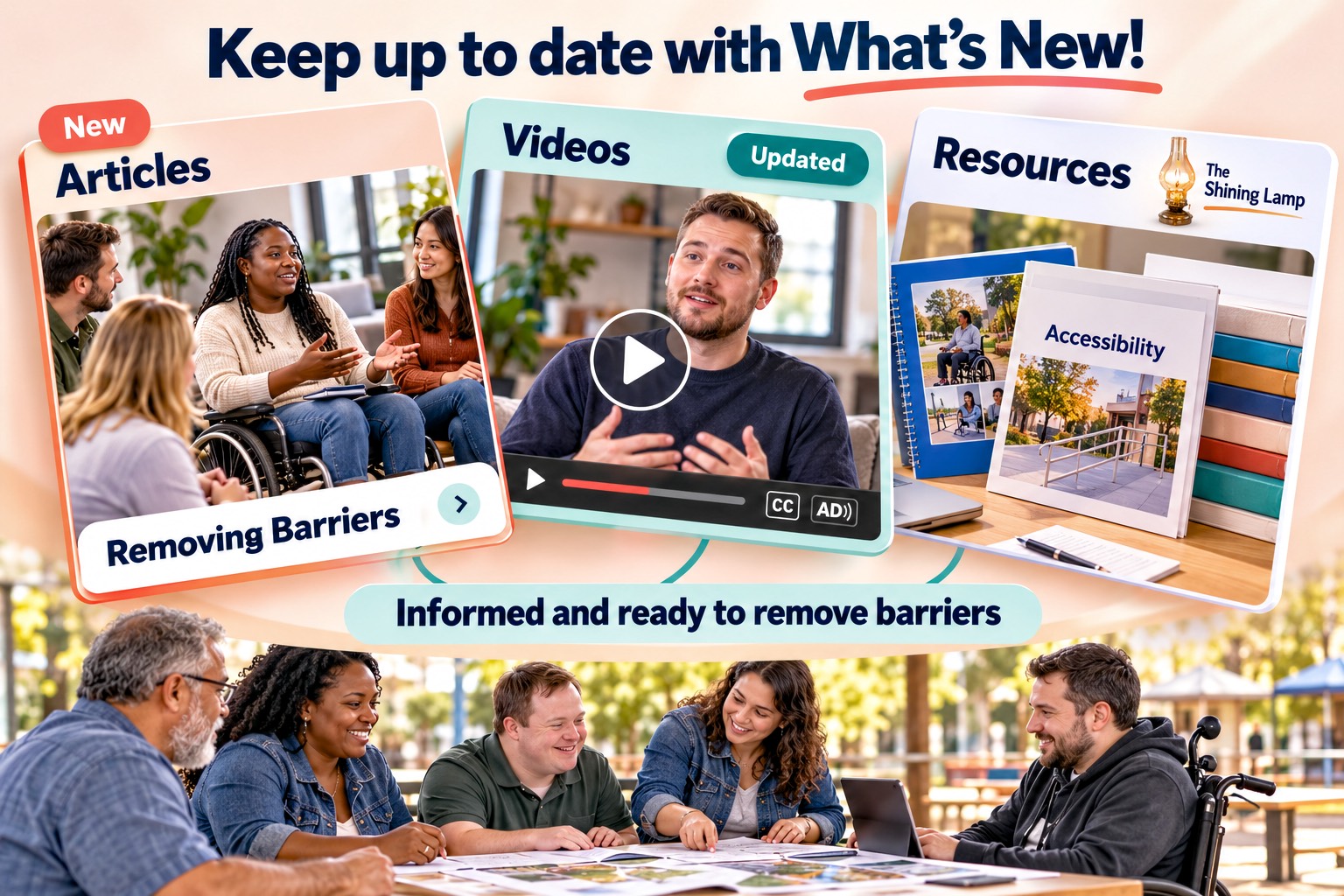

Infographic headed “Keep up to date with What’s New!” features article, video, and resource previews marked “New” and “Updated.” Below, a diverse group, including a wheelchair user, reviews materials together beneath the message “Informed and ready to remove barriers.”

What's New and Updated at The Shining Lamp?

Latest updates

  • 2025 campaign artwork highlighting the “Celebrating Value and Talent” theme for National Disability Employment Awareness Month.

    Building Inclusive Futures: National Disability Employment Awareness Month

    New

    October spotlights the contributions of People with Disabilities in workplaces across the country and calls employers to sustain inclusion beyond a single month. The piece connects today’s observance to its World War II–era roots and frames it as a moment to recommit to accessibility, equity, and culture change that lasts. The author explains how employment gaps persist because of ableism and structural barriers, not lack of talent. Employers are urged to align hiring, onboarding, and advancement with accessibility from the start, since organizations benefit when roles, tools, and policies…

  • October invites school communities to center disability inclusion and focus on removing barriers.

    October Disability Awareness

    New

    October is presented as a time for school leaders to celebrate disability diversity and recommit to inclusive school culture. The piece highlights both visible and non-apparent disabilities and encourages a month-long focus on belonging, with an emphasis that accessibility is critical to community life. A central thread is National Disability Employment Awareness Month, which the author connects to daily leadership practice. Concrete actions include inclusive hiring, ensuring accessible classrooms with adaptive technology, expanding career readiness and work-based learning for students with…

  • The white cane communicates a traveler’s presence and right to independent movement, helping motorists and pedestrians respond safely.

    White Cane Safety Day: A Symbol of Independence

    New

    The essay explains how a simple mobility tool came to represent self-reliance in public life. It begins by challenging praise that misunderstands the cane’s meaning and centers the observance that highlights its purpose, reflected in White Cane Awareness Day. It then traces national recognition: in 1963, organized advocates urged state proclamations; in 1964, Congress authorized an annual presidential proclamation that President Lyndon B. Johnson promptly issued. The text emphasizes the cane as a public signal and the shared responsibility for motorists to exercise special care toward…

  • Objects used in a disability-led preview for a Remote Access Hub—care signified by oranges alongside tools for sensory regulation.

    Rap beef, Chinatown resistance, accessibility and more inspire Nuit Blanche 2025 edition

    New

    The piece previews this year’s overnight contemporary art celebration, returning Oct. 4 at 7 p.m. for twelve hours of installations and performances across downtown (from City Hall to Chinatown), North York, and Etobicoke. Curators emphasize place-based work and collaboration with communities—an approach that pairs naturally with planning for an accessible event so more people can participate. Downtown, the exhibition titled “Poetic Justice” draws its name from a headline-grabbing rap rivalry and the 1990s film, framing art that engages reform, advocacy, and political resistance. The article…

  • Julie Deden explores raised-line and cut-paper techniques during tactile art training at the Colorado Center for the Blind.

    From Amoebas to Monuments: The World at Our Fingertips

    New

    As a child, the author could not picture a butterfly, a flock of geese, or the shape of a monument. She argues that touch can deliver that knowledge when society commits to removing barriers—especially through raised-line drawings and 3-D models that represent objects we can’t safely handle or physically reach. Public examples such as tactile exhibits and maps show how environments can support exploration instead of blocking it. The piece recounts a three-day Teach-In in Littleton, Colorado, designed to build a corps of instructors who can teach tactile literacy. Led by Ann Cunningham and…

  • Don’t look away—her missing left hand is visible. Choose accessibility, inclusion, and belonging for People with Disabilities.

    I Dare You To Stop Looking Away From People With Disabilities

    Updated

    The author shares a direct challenge: stop looking away from People with Disabilities. Drawing on her childhood experiences at a children’s rehabilitation hospital, she describes how confidence grows when difference is met with respect and real accessibility, not avoidance. She details how care and engineering work together—early myoelectric prosthetics, custom orthotics, and newer 3D-printed components—to fit a child’s body and goals. That collaboration moves ideas out of the lab and into daily life faster, from learning and play to sport and performance. The piece centers children who use…

  • A mom thanks a boy who modeled inclusion

    Mom Gets Question About Disabled Daughter—Unprepared for What Kids Do Next

    New

    A parent recounts a moment at a neighborhood playground when an older child’s curiosity became the spark for genuine inclusion. What began as a hesitant question quickly turned into an invitation to play, setting a hopeful tone for how kids can welcome a peer with a disability when adults respond calmly and clearly. After the parent offered a simple, age-appropriate explanation, the child returned to help with the slide and swing, then picked up hand cues like “more” and “all done,” teaching friends to do the same. The scene underscores how learning a few basics of American Sign Language can…

  • The case for describing race in alternative text attributes

    Updated

    by Tolu Adegbite Why it’s important in 3 examples Designers and developers have huge power in shaping societal norms (when was the last time you met a couple in their 20s who didn’t meet on a dating app?). We also have a huge impact in creating a story and crafting a sort of reality for people that consume the content we put out into the world. Alt text forms part of that storytelling of a designed reality. ... If you are white, you may not think about or talk about race often. If you are a person of color, and especially if you are Black (like myself), you probably think and talk about race…

  • Concrete changes—spanning community planning, tech, and culture—turn inclusive collaboration like this into standard practice.

    5 Practical Steps to Advance Disability Inclusion

    New

    Ready to move from good intentions to measurable action? This timely piece lays out five concrete moves any team can start on now—framed by the proven shift toward the social model of disability, which focuses on removing barriers rather than “fixing” people. You’ll get crisp guidance on rethinking roles, simplifying applications, and making interviews and onboarding accessible—plus tips to standardize what works. If you track progress, tools like the Disability Equality Index overview can help benchmark policies and identify gaps to close. People leaders, HR, and procurement teams will find…

  • Accessibility reviews often start by checking alt text, form labels, color contrast, and keyboard navigation—the very oversights this article warns can cost you.

    5 Web Accessibility Oversights That Could Be Costing You

    New

    Too many teams still tack on accessibility at the end—then wonder why forms fail, links confuse screen readers, and images hide meaning. This piece shows how that “afterthought” mindset quietly bleeds revenue and trust, and why making fixes part of the workflow pays off. For quick context on the broader landscape, see why digital accessibility must be a next priority. Mobile is where customers decide fast—so small touch targets, low contrast, and unlabeled buttons are conversion killers. You’ll get a practical snapshot of what to prioritize first (think input labels, focus order, and readable…

  • John Buettner scrambles up the netting of playground equipment he tested for accessibility for kids with disabilities. (Landscape Structures Inc.)

    Kids with disabilities are helping design inclusive playgrounds

    New

    Thirteen-year-old John Buettner grew up watching from his wheelchair as classmates played. That changed when he was invited to help design and test inclusive playgrounds, starting with Glen Lake Elementary in Minnetonka. He and other kids with disabilities brought firsthand expertise to make play spaces work for children who use wheelchairs and other mobility devices. The school effort began after students noticed peers “just sitting on the sideline.” Community fundraising took off—from bake sales and coin drives to a $50,000 gift from BMW—turning one planned piece of equipment into a fully…

  • A Brief But Spectacular take on embracing disability pride

    New

    In this Brief But Spectacular segment, Tiffany Yu traces how a childhood car accident reshaped her life and how choosing Disability Pride changed her future. She recalls years of silence and self-doubt, then describes the turning point of speaking directly to her younger self—“look at me now”—as permission to live openly. Yu connects that shift to founding Diversability and to centering disabled identity as a source of strength. Her story offers a concrete path: move from hiding to visibility, from shame to pride, and from isolation to community. Yu names the problem—everyday ableism—and…

  • This is Brett Boyer, who has been a leader in advocating for accessibility and technology equity for blind people. This image was published alongside his reflections in the Braille Monitor, where he discusses independence, leadership, and the ongoing work of removing barriers for the blind community.

    Screen Readers and Street Smarts: How Travel Taught Me Tech

    New

    Empowerment Through Structured Discovery

    Brett Boyer’s article reminds us that true independence for blind people isn’t about memorizing routes or keystrokes—it’s about learning to explore, problem-solve, and recover when things go wrong. He describes how Structured Discovery, first introduced in cane travel, gave him the confidence to navigate the world on his own terms. This same philosophy drives his approach to teaching screen readers: instead of training students to follow scripts, he empowers them to ask questions, troubleshoot, and take control. This perspective is critical for building Vibrant, Diverse, Inclusive, Accessible Communities, because independence fuels participation and shared contribution.

  • Disability rights movement sprouted in Colorado

    New

    The Americans with Disabilities Act became law 35 years ago. Coloradans reflect on our state's pivotal role and on the progress still to be made. Then, ahead of a special session of the state legislature, a look at a bad budget gap and some bad behavior. Plus, the season three premiere of Systemic, CPR's podcast about changemakers. “They blocked buses in Denver, busted up curbs, crawled up the US. Capitol steps. Activism that led to the Americans with Disabilities Act. 35 years later, it can still be a daily battle. Listen to the Podcast: Disability rights movement sprouted in Colorado -CPR…

  • Creativity, Persistence, and Hope: Reclaiming Our Stories through the Organized Blind Movement

    Updated

    Mark A. Riccobono’s 2025 National Federation of the Blind banquet address, Creativity, Persistence, and Hope: Reclaiming Our Stories through the Organized Blind Movement, is a powerful reflection on how Blind People have reshaped the narrative about blindness through collective action, critical thinking, and storytelling. By examining the history and reappropriation of the parable of the blind men and the elephant, Riccobono demonstrates how Blind People, through shared truth and determination, are reclaiming their role as creators of knowledge—not passive subjects in someone else's tale.…

  • Mary Azatyan-Witmeyer waits with friends at a Colorado Light Rail station during her training at the Colorado Center for the Blind, a key step in removing barriers to independence and building inclusive communities.

    Taking Back My Life: A Journey from Control to Freedom

    New

    Taking Back My Life: A Journey from Control to Freedom is a powerful firsthand account by Mary Azatyan-Witmeyer, a Blind woman whose early adulthood was shaped not by opportunity, but by legal and societal barriers rooted in systemic ableism. At the age of eighteen, Mary was forced into a conservatorship by her adoptive mother, despite her clear desire and ability to make her own decisions. This legal control—enabled by harmful assumptions about her blindness—stripped her of agency over her healthcare, finances, education, and even her housing. This unjust reality reflects a widespread…

  • At VidCon 2025, Peet Montzingo moderates a live panel titled "Accessibility for All: Creating Inclusive Spaces Online and IRL", joined by Imani Barbarin, Pat Valentine, and Briel Adams-Wheatley. Held at the Anaheim Convention Center, the conversation focused on removing barriers in media and amplifying the leadership of People with Disabilities in content creation and public discourse.

    Creators talk accessibility and building inclusive spaces at VidCon 2025

    New

    At VidCon 2025, Peet Montzingo hosted the panel Accessibility for All: Creating Inclusive Spaces Online and IRL, featuring Imani Barbarin, Briel Adams-Wheatley, and Pat Valentine of the Valentine Brothers. The conversation centered on removing barriers to full participation in online and offline creative spaces, and affirming the leadership of People with Disabilities in advocacy and storytelling. The creators reflected on how their lived experiences shape their content and drive efforts toward accessibility and inclusion. Imani Barbarin emphasized how accessibility is rooted in creativity…

  • Matan hosts the Lieberman Fellowship for Jewish Organizations Serving Young Adults at the Jewish Federation of Greater Washington and Bender JCC of Greater Washington in Rockville, Md., on Nov. 14, 2024. Avi Gerver

    Disability inclusion is Jewish inclusion — and we’re not done yet

    New

    Meredith Englander Polsky’s reflection on 25 years of advocacy with Matan underscores a powerful truth: removing barriers that prevent full participation for People with Disabilities is essential to building vibrant, diverse, inclusive, accessible communities. Jewish life must reflect the full spectrum of humanity, including People with Disabilities—who are also members of other historically excluded groups. While meaningful progress has been made through educator training and inclusive design, too many Jewish institutions still treat accessibility and inclusion as an afterthought, rather…

  • Michelle Guadalupe Felix Garcia, a Blind audio professional, leads a session at The Conference: Live at Lititz, demonstrating accessible sound editing using keyboard-driven screen reader navigation and WCAG-compliant production software to remove barriers in the music and event industry.

    Clair Global Backs Audio Accessibility Alliance

    New

    Michelle Guadalupe Felix Garcia, a Blind sound engineer from Mexico, has broken new ground in the live events industry by showing how accessible audio technology enables Blind People to participate and even compete. Supported by Clair Global, the Audio Accessibility Alliance (AAA) is an industry think tank focused on fostering conversations and driving change around disability in entertainment technology and live event production. This collaboration highlights the importance of striving to remove barriers that prevent us from building Vibrant, Diverse, Inclusive, Accessible Communities!…

An older Black couple looking at information together on a smartphone.

Publications, Communications, and Digital Content should use Responsive Design to ensure accessibility on small screens, especially as a growing number of people no longer own or use desktop computers and rely solely on smartphones for online access.

Question: Is this example of inclusive practices the norm in your community? If not, what barriers need to be removed which prevent inclusive and welcoming participation?


"The challenge facing the friends serving at the grassroots is essentially the same in every place. They must be able to read their own reality and ask: what, in light of the possibilities and requirements at hand, would be fitting objectives to pursue in the coming cycle or series of cycles?"  -- December 30, 2021 UHJ to Conference of Counselors Introducing Nine Year Plan


Explore More Compelling Insights:

Learn about topics related to People with Disabilities, Accessibility, Anti-Ableism, Removing Barriers, and the Disability Community? Tap the Explore button to discover something new and intriguing with each tap!