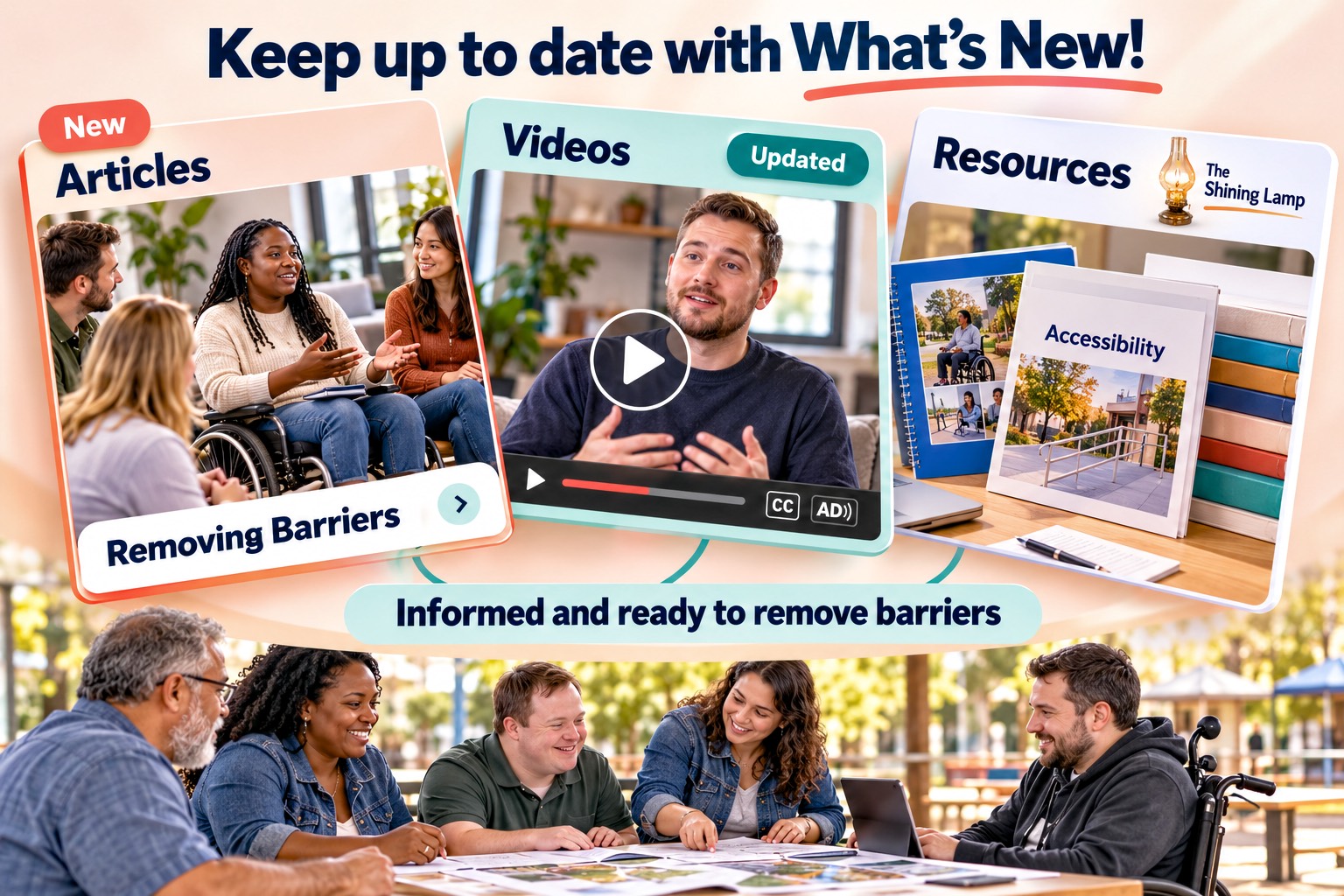
Infographic headed “Keep up to date with What’s New!” features article, video, and resource previews marked “New” and “Updated.” Below, a diverse group, including a wheelchair user, reviews materials together beneath the message “Informed and ready to remove barriers.”

What's New and Updated at The Shining Lamp?

Latest updates

  • I Worked Quite Well With My Disability. That Never Stopped Customers From Saying Wild Things To Me.

    New

    Emily Tisshaw's article, "I Worked Quite Well With My Disability. That Never Stopped Customers From Saying Wild Things To Me," offers a compelling insight into the daily barriers faced by a Person with a Disability in customer service. Born without a left hand, Emily has experienced a lifetime of stares and intrusive questions. Initially, she tried to hide her arm to avoid unwanted attention, but eventually chose to embrace her body and live confidently. Despite this, she still encounters shocking and misguided comments from customers under the guise of offering help. Emily shares anecdotes…

  • Down Syndrome: What I Wish You Knew

    Updated

    In a narrative that challenges entrenched stereotypes about Down syndrome, Sarah's life story exemplifies the importance of removing systemic barriers and embracing inclusive practices in community building efforts. From birth, medical professionals' dire predictions clashed with her parents' steadfast belief in equal opportunities. Despite early health challenges, including multiple heart surgeries, Sarah was nurtured with unwavering love and an unwavering commitment to inclusive education from the start. Sarah's educational journey was marked by encounters with ableism. In high school, an…

  • More Than Words

    Updated

    Caption: Ngauranga Kura Ranginiwa (at left) raised three mokopuna, or grandchildren, including Stevie-Rei Pokaia (at right). As a kaiako, or teacher, at a Kohanga reo-a school of Mãori language and culture-Ranginiwa helped teach her mokopuna. Following the path of her kui, or grandmother, Pokaia now works as a kaiako. Ranginiwa and Pokaia are shown on Ngãti Te Whiti land at Kawaroa, Ngãmotu, Taranaki. The Māori model for teaching language, particularly through Kohanga Reo schools, exemplifies how communities worldwide can reclaim and fortify their cultural identities. Ngauranga Kura…

  • 12 Ways to Celebrate Disability Pride Month

    New

    July is Disability Pride Month, a time dedicated to celebrating the resilience, diversity, and identity of the disability community. Originating with the passage of the Americans With Disabilities Act in 1990, this month commemorates the ongoing struggle for recognition and equality. It's a powerful affirmation that disability is not a limitation but a source of strength and identity, celebrated through parades, festivals, and events across cities. To honor Disability Pride Month authentically, education and awareness are crucial. Understanding Disability First language empowers individuals…

  • July is Disability Pride Month

    New

    Learn about and Celebrate Disability Pride Month Disability Pride Flag: The Disability Pride flag is a symbol of unity and visibility for the Disability Pride movement. Designed by Ann Magill, it features a black background with a diagonal band from top left to bottom right, comprising five parallel stripes in muted colors: red, gold, white, blue, and green. Red: Represents physical disabilities. Gold: Symbolizes neurodivergence. White: Signifies invisible and undiagnosed disabilities. Blue: Represents psychiatric disabilities. Green: Symbolizes sensory disabilities. The flag celebrates…

  • Top 9 Tips for Accessible Communications

    New

    Creating accessible content is crucial for ensuring inclusivity and removing barriers that prevent People with Disabilities from engaging with online information. The Web Content Accessibility Guidelines (WCAG), developed by the World Wide Web Consortium (W3C), provide a framework to make web content more accessible. These guidelines emphasize creating digital experiences that everyone, including Blind and Low Vision People, can access and enjoy. Think of accessibility like online content versions of wheelchair ramps or braille in printed materials. Statistics highlight the significance of…

  • Becoming Anti-Ableist: A Disability Justice- Informed Approach to Supporting the Disability Community

    Updated

    Produced by The Maryland Center for Developmental Disabilities at Kennedy Krieger Institute Community and Professional Development Training Program The guide titled "Becoming Anti-Ableist: A Disability Justice-Informed Approach to Supporting the Disability Community" offers a transformative pathway towards building inclusive communities and dismantling systemic barriers faced by People with Disabilities. Developed by the Maryland Center for Developmental Disabilities at Kennedy Krieger Institute, this resource provides comprehensive insights and actionable strategies for professionals and…

  • I’m a Nondriver—and There’s a Good Chance You Are, Too

    New

    Nearly a third of people in the US can't drive due to various reasons, such as disabilities, age, financial constraints, or lack of driving skills. This reality creates significant barriers for everyday tasks, transforming simple errands into lengthy journeys on public transport. From older adults who no longer drive to younger individuals who haven't reached driving age, many face problems in accessing essential services and participating in community life. The misconception that driving equals freedom disregards the diverse needs of nondrivers, including a significant number of Black…

  • Words Matter - Use Blind or Low Vision as opposed to visually impaired

    New

    In his insightful article "Words Matter," Michael Hingson delves into the significant impact language has on perceptions of people with sight loss. Drawing from his extensive experience with the National Federation of the Blind and his role as Chief Vision Officer at accessiBe, Hingson highlights the problems with the term "visually impaired." He argues that this terminology inaccurately suggests a visual deficiency and perpetuates the misconception that people with sight loss are less capable. Hingson emphasizes that the Blindness Community widely advocates for the use of the term "blind or…

  • Celebrating Global Accessibility Awareness Day 2024: A Call to Digital Inclusion

    New

    Global Accessibility Awareness Day (GAAD) 2024 is a pivotal event dedicated to promoting digital inclusion for People with Disabilities worldwide. Celebrated annually on the third Thursday of May, GAAD encourages crucial conversations and actions to remove barriers in the digital realm. The origins of GAAD trace back to a 2011 blog post by Joe Devon, co-founded with Jennison Asuncion, which has since grown into a global movement aimed at integrating accessibility into technology development. The significance of digital accessibility cannot be overstated, as it ensures that People with…

  • Topic Collection List

    Updated

    This is the Shining Lamp Topic Collection List of frequently accessed topics. Each link will offer a View of Topics Collected of articles and resources on the topic shown in the link title. The following links can easily be shared out in, "How To" documents and email messages. These are particularly useful in a "for more information, see:" section. If additional articles or resources are added to any of these topics in the future, links previously sent out will also automatically reflect those additions/changes. So, no need to keep updating people on new information related to these topics.…

  • The internet's accessibility problem -- and how to fix it

    Updated

    Clive Loseby, a passionate advocate for website accessibility, shares his personal journey and compelling insights in a powerful video aimed at changing the digital landscape, one website at a time. Following a life-changing car accident, Loseby's dedication to accessibility stems from his firsthand experience with the importance of inclusive design. With a touch of humor and profound sincerity, Loseby draws attention to the ubiquitous yet often overlooked issue of website accessibility, likening it to the familiar annoyance of cookie banners. He adeptly highlights the stark reality faced by…

  • Global Accessibility Awareness Day Continues!

    New

    On May 16, 2024, we celebrated the 13th Global Accessibility Awareness Day (GAAD). This day is dedicated to raising awareness about digital access and inclusion for people with disabilities. But the conversation doesn't have to stop there—join us in continuing to spread awareness and drive change. The GAAD Foundation, established in 2021 for GAAD's 10th anniversary, aims to revolutionize the tech industry by making accessibility a fundamental aspect of digital product development. Their mission underscores the importance of considering accessibility from the start, ensuring digital spaces are…

  • Avoid PDF for On-Screen Reading

    Updated

    Using PDFs for on-screen reading is a common practice that often leads to frustration and inefficiency for users compared to standard web pages. Despite the convenience of PDFs for printing, they are not optimized for online viewing, causing usability problems such as difficulty navigating, slow download times, and lack of accessibility features. As Jakob Nielsen and Anna Kaley emphasize, PDFs are meant for distributing documents for printing, not for online consumption. The heavy text and graphics in PDFs increase file size and hinder navigation, making it challenging for users to find…

  • Don't publish that PDF!

    Updated

    by Nishal Desai PDFs are a common go-to for sharing information online, but their use by public bodies often leads to accessibility barriers. Public sector websites frequently rely on PDFs for presenting information, especially about physical activities. This needs to change to ensure everyone, including People with Disabilities, has equal access to essential information. Moving away from PDFs to more accessible web technologies can help achieve this goal. Using PDFs can limit the reach and effectiveness of information dissemination. They are static, challenging to update, and often not…

  • Celebrating disability As part of human diversity

    Updated

    A life-long human rights activist, Catalina Devandas became the first United Nations Special Rapporteur on the rights of persons with disabilities in 2014. In her talk, Catalina will share important lessons she learned about the barriers that she, together with millions of other persons with disabilities face in their lives. She explains how the most difficult barriers are not those in buildings, streets or the physical environment, but those emanating from a system of social values that deem persons with disabilities as less worthy and unable to lead meaningful lives. She also explains how…

  • Raise awareness about accessibility

    Updated

    Accessibility: Essential for Some, Useful for All Elevate your awareness and knowledge by watching these videos, and then share them to promote accessibility within your organization: A frequent barrier to organizations embracing accessible practices is a deficiency in awareness. Many people within these organizations may possess limited knowledge or even be entirely unfamiliar with accessibility. Some may fail to recognize the significance of their own contributions to digital accessibility, while others might remain unaware of the advantages it offers. By offering a comprehensive…

  • Bahá’í Quotes on Disability

    Updated

    This is a collection of Bahá’í Quotes on Disability compiled by Susan Gammage, designed by Tim Freeman: https://bahaiquotes.com/subject/disability

  • Faith in Access: Bridging Conversations between Religion and Disability

    Updated

    "Congregations are a vital part of many people's lives, often the most important one, if only for social reasons. They serve all geographic and ethnic communities: Latino, African American, Jewish, Muslim, Baha'i, Buddhist and others. While ethnic and racial conceptions about disability certainly differ, minority and oppressed groups tend to share concern about social justice issues and exclusion. Yet the experiences and views of people with disabilities have received limited attention within multicultural movements. This lack of concern is noteworthy because people with disabilities are in…

An older Latino couple look at information on a smartphone together.j

Publications, Communications, and Digital Content should use Responsive Design to ensure accessibility on small screens, especially as a growing number of people no longer own or use desktop computers and rely solely on smartphones for online access.

Question: Is this example of inclusive practices the norm in your community? If not, what barriers need to be removed which prevent inclusive and welcoming participation?


"The challenge facing the friends serving at the grassroots is essentially the same in every place. They must be able to read their own reality and ask: what, in light of the possibilities and requirements at hand, would be fitting objectives to pursue in the coming cycle or series of cycles?"  -- December 30, 2021 UHJ to Conference of Counselors Introducing Nine Year Plan


Explore More Compelling Insights:

Learn about topics related to People with Disabilities, Accessibility, Anti-Ableism, Removing Barriers, and the Disability Community? Tap the Explore button to discover something new and intriguing with each tap!