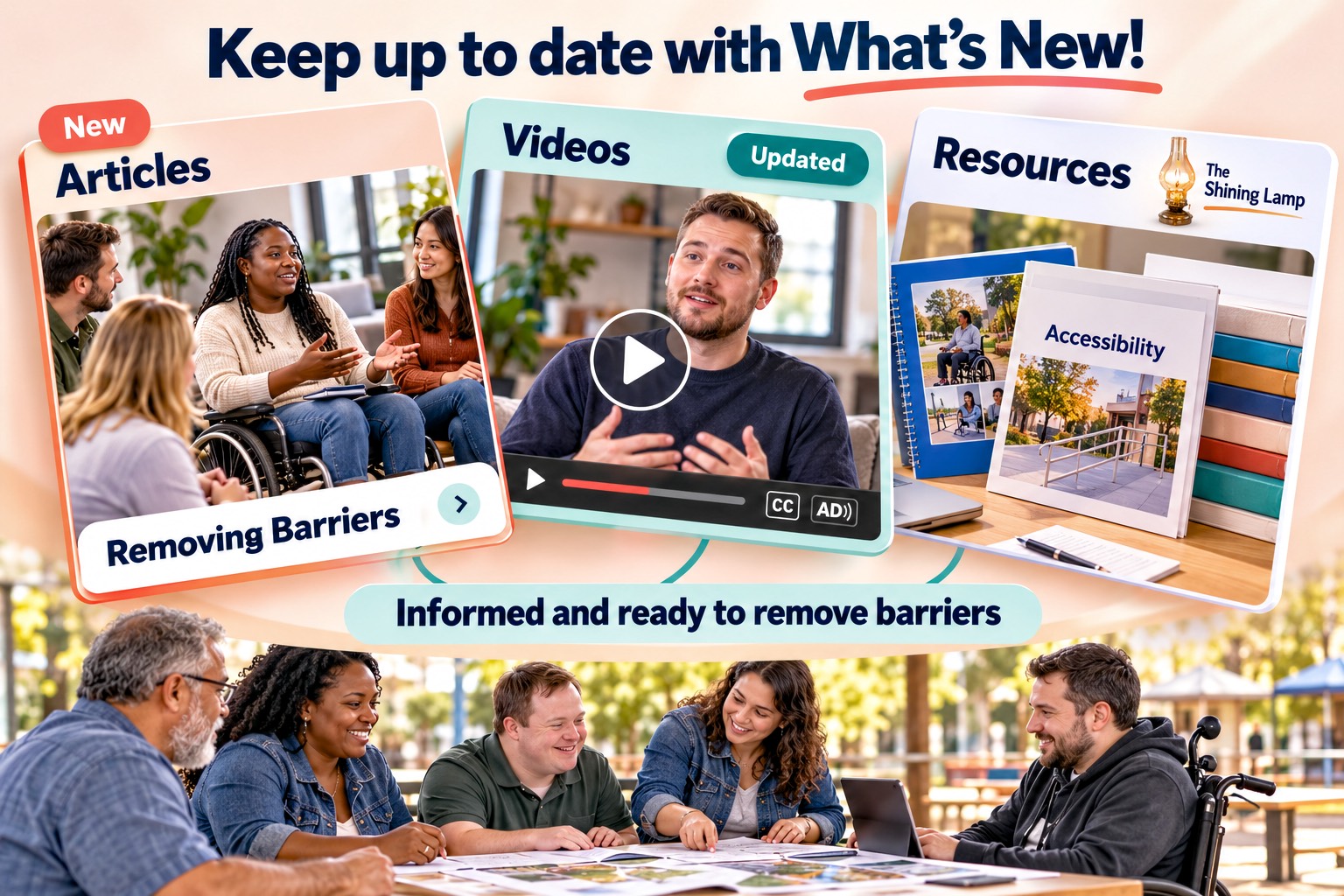
Infographic headed “Keep up to date with What’s New!” features article, video, and resource previews marked “New” and “Updated.” Below, a diverse group, including a wheelchair user, reviews materials together beneath the message “Informed and ready to remove barriers.”

What's New and Updated at The Shining Lamp?
Latest updates

  • Learn American Sign Language

    New

    This is a fun and Free resource for learning American Sign Language (ASL) at your own pace. It uses Video-based learning materials with interactive exercises, quick lectures and reviews. It is Time Efficient and focuses on learning the ASL most relevant to you with a modular curriculum. There are on-Line and Mobile Apps available. Learning to say even a few words or phrases directly to a Person who is Deaf and Speaks ASL and who belongs to your Community will help remove barriers and create a more Inclusive, Accessible Community Environment! Before you know it, you will be having entire…

  • American Sign Language (
ASL) Interpreters and Captioning Services

    Updated

    If you are planning a Baha'i event or gathering and you are in need of an American Sign Language ( ASL) Interpreter or Captioning Services, the first thing to do is contact the Deaf and Hard of Hearing Task Force for the Baha’i community. This Task force was appointed by he National Spiritual Assembly of the Baha’is of the United States. The task force focuses on two groups. One is the Deaf community, members of which belong to a unique culture with a unique language—American Sign Language (ASL) in the United States. For many Deaf people, English is a second language, so ASL interpretation is…

  • 5 takeaways from screen reader usability interviews

    New

    5 Takeaways From Screen Reader Usability Interviews | Jess Budd | Senior Front-End Engineer Specializing In Web Accessibility Editor: This article does an absolutely extraordinary job describing how screen reader users interact with websites. | Jess Budd: Earlier this year I worked on the re-development of my workplace's primary website navigation. We went from a simple, single-tier nav with no drop-downs to a two-tier nav with a drop-down mega menu. I was pretty confident we were ticking the major boxes of complying with the Web Content Accessibility Guidelines (WCAG), but I also know that…

  • 4 ways to design a disability-friendly future

    New

    Nearly fifteen percent of the world's population lives with a disability, yet this massive chunk of humanity is still routinely excluded from opportunities. Sharing her experience growing up with an autistic sister, disability inclusion advocate Meghan Hussey illuminates the path towards an inclusive future in four steps, and it starts with an attitude check on assumptions and stereotypes. Designing a world built for everyone is not a "nice to have," Hussey says -- it's critical to the fabric of society.

  • Nothing About Us Without Us -- Mantra for a Movement...

    New

    By Eli A. Wolff, Contributor and Dr. Mary Hums, Contributer Educator, Innovator, Advocate Professor of Sport Administration, University of Louisville Sep 5, 2017, 09:20 AM EDT Updated Sep 6, 2017 ... “Nothing about Us Without Us” emphasizes how people with disabilities must be valued as integral and essential contributors to every sector, industry and community including entertainment, fashion, education, sports, medicine, business and law. While people with disabilities need to be leaders of disability-focused organizations, that is not enough. We also need to be front and center in…

  • How to talk about disability sensitively and avoid ableist tropes

    New

    Disability can be difficult to talk about sensitively because of how embedded ableism is in our language, biases and perceptions of disability. Conversations about disability are slowly increasing, especially when it comes to ableist language and how disabled people are represented in the media. Disability advocate Talila A. Lewis' working definition of ableism is a "system that places value on people's bodies and minds based on societally constructed ideas of normalcy, intelligence and excellence." NPR spoke to Cara Reedy, the director and founder of the Disabled Journalists Association, and…

  • Nasa Added Amazing Alt Text Image Descriptions to James Webb Space Telescope Photos

    New

    Nasa Added Amazing Alt Text Image Descriptions to James Webb Space Telescope Photos There was a ton of excitement when the James Webb Space Telescope (JWST) was launched into space last month. What made the excitement exponentially larger was when NASA made the first few photos received from JWST public. The pictures were gorgeous and stunning, and the world was captivated by the sheer beauty of our universe as shown by these photos. These stunning photos, which are a feast for our eyes, were accompanied by something that made sure blind people enjoyed these photos as much as sighted people…

  • Why You Need to Stop Using These Words and Phrases

    Updated

    Language has long been used to dehumanize or marginalize people with disabilities. Ableist language shows up in different ways: as metaphors, jokes, or euphemisms. While ableism exists beyond the words we use, in structures and policies, our vocabularies can help us how we think and behave with people around us. We spoke to four disability rights activists to know why our words matter, how they influence our biases, thoughts, and behaviors and what we can do to check them. https://hbr.org/2020/12/why-you-need-to-stop-using-these-words-and-phrases

  • The Universal House of Justice 22 July 2020 - To the Bahá’ís of the United States - on Racism

    Updated

    A moment of historic portent has arrived for your nation as the conscience of its citizenry has stirred, creating possibilities for marked social change. It holds significance not only for the destiny of America anticipated in the Sacred Writings, but also for the mission entrusted to your community by the hand of ‘Abdu’l‑Bahá, who cherished you dearly and called you to a path of sacrifice and high endeavor. We are pleased to see that, led by your National and Local Spiritual Assemblies, you are seizing opportunities—whether those thrust upon you by current circumstances or those derived from…

  • Deaf and Hard of Hearing Task Force for the Baha’i community.

    New

    Deaf and Hard of Hearing people have a great deal to contribute to Baha’i activities, and with a few accommodations can more readily take part in them to everyone’s benefit. This is a message championed by the Deaf and Hard of Hearing Task Force for the Baha’i community. Appointed by the National Spiritual Assembly of the Baha’is of the United States, the national governing council, the task force has existed off and on since the 1980s. Today, it has four members—Naledi Raspberry, Tavoria Kellam, Jason Schwartz and Erin Salmon—who, with assistance from people like Austin Vaday, are working to…

  • Baha'i International Community Statement on Human Rights and Disability

    New

    Statement to the fortieth session of the United Nations Sub-Commission on Prevention of Discrimination and Protection of Minorities. Agenda item 7: human rights and disability GENEVA—6 August 1988 Until recently, the disabled have constituted a minority in obscurity. Unlike certain other groups that fall victim to discrimination, the disabled do not comprise a self-contained, close-knit social community. Instead, they populate every social sector, every class, every age group, every ethnic and religious community. And at every level, society has tended to ignore them, believing them incapable…

  • Tips on being a great host to a Blind Person

    Updated

    These are great tips for whenever you have the opportunity to include a Blind person at an event or in your home. But please remember, not all Blind people are the same. Always be sure to ask before taking a Blind Person's hand or arm in any way. They will let you know how they prefer to deal with any task at hand. Simply remember to respect personal space by asking first.

  • Ableism 101: What it is, what it looks like, and what we can do to to fix it

    Updated

    As buzzwords like social justice, equity, and inclusion permeate our collective consciousness, it’s essential for advocates of progress to remember another ‘ism,’ one that is frequently left out of conversations. Ableism. The world wasn’t built with people with disabilities in mind, and because of that, the world we live in is inherently “ableist.” So…what is ableism? Ableism is the discrimination of and social prejudice against people with disabilities based on the belief that typical abilities are superior. At its heart, ableism is rooted in the assumption that disabled people require…

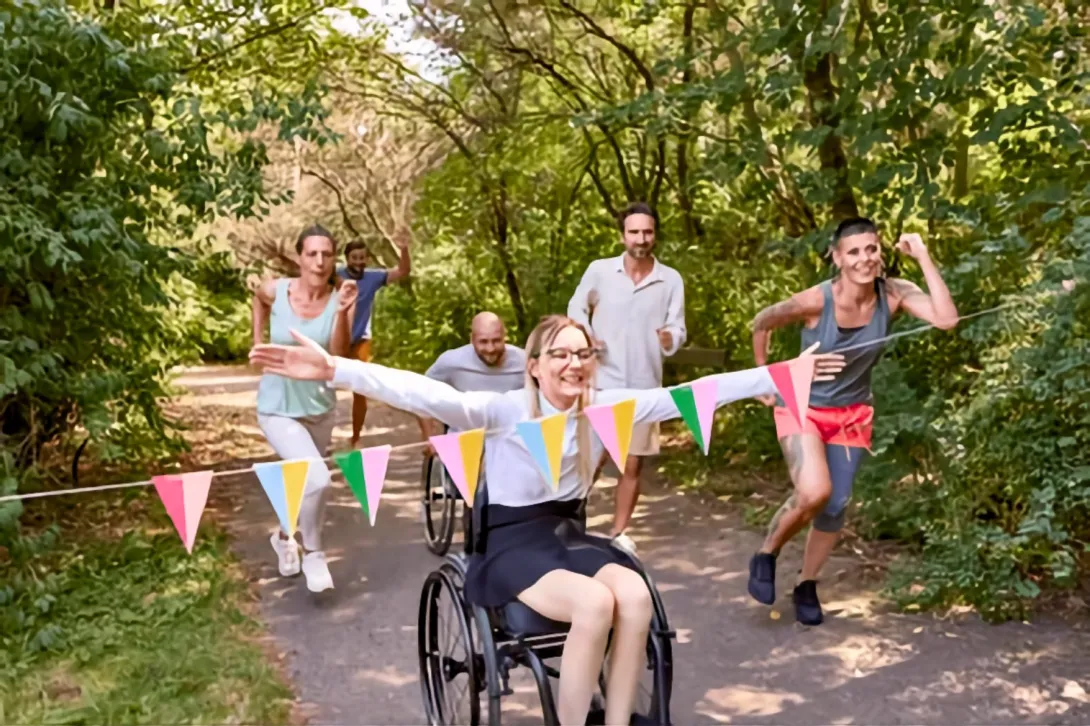
A white woman in a wheelchair crosses a bunting finish line on a wooded path, arms spread wide, as Black and white runners cheer behind her.

Consistently ensuring equitable participation of People with Disabilities in community gatherings and events by planning ahead for Accessibility transforms exclusion and discrimination into a culture of inclusion, respect, belonging, and value.

Question: Is this example of inclusive practices the norm in your community? If not, what barriers need to be removed which prevent inclusive and welcoming participation?


"The challenge facing the friends serving at the grassroots is essentially the same in every place. They must be able to read their own reality and ask: what, in light of the possibilities and requirements at hand, would be fitting objectives to pursue in the coming cycle or series of cycles?"  -- December 30, 2021 UHJ to Conference of Counselors Introducing Nine Year Plan


Explore More Compelling Insights:

Learn about topics related to People with Disabilities, Accessibility, Anti-Ableism, Removing Barriers, and the Disability Community? Tap the Explore button to discover something new and intriguing with each tap!