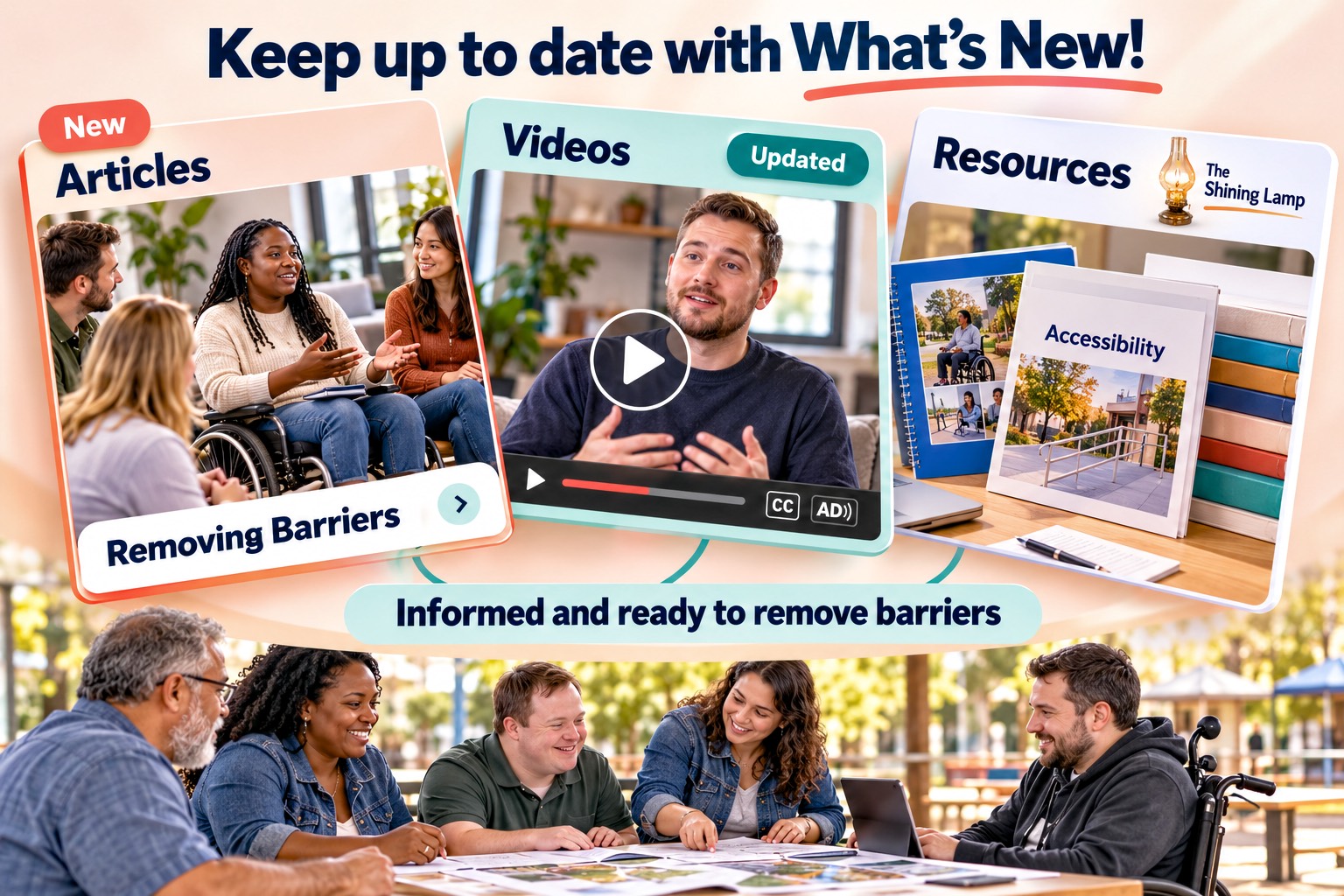


Infographic headed “Keep up to date with What’s New!” features article, video, and resource previews marked “New” and “Updated.” Below, a diverse group, including a wheelchair user, reviews materials together beneath the message “Informed and ready to remove barriers.”

What's New and Updated at The Shining Lamp?

Latest updates

  • Cover art for Jonathan Mosen’s Christmas song, now on streaming music services. The Perkins Brailler is a manual machine that writes Braille.

    A Place Beside the Fire — A Christmas Song About Blindness and Belonging

    Pinned

    Jonathan Mosen, a Blind and hard of hearing songwriter, wrote the Christmas song “A Place Beside the Fire” himself, shaped its arrangement and melody with Suno, an artificial intelligence (AI) music generator, and, because his hearing is degenerating, used AI to produce a sample of his voice. He invites Blind listeners to be glad the song exists and other listeners to learn what some Blind People hope for in a better world. We should add the song to our holiday playlists and share it far and wide.

  • Ruth Madeley Is Disability Rights Activist Judith Heumann in Powerful Being Heumann Teaser Trailer

    Pinned

    Apple TV has released the teaser trailer for Being Heumann, with Ruth Madeley playing the activist Judith Heumann in a film directed by Siân Heder and adapted with screenwriter Rebekah Taussig from Heumann's own 2020 memoir. Heumann contracted polio at eighteen months old in Brooklyn, New York, and no Wheelchair User had ever taught in a New York classroom before she did. In 1977, because the government had failed to pass Section 504 of the Rehabilitation Act of 1973, hundreds of people occupied a federal building in San Francisco for twenty six days, and nothing before or since has held one in this country that long. Section 504 bars any program funded by the federal government from discriminating against a Person with a Disability. Heumann went on working from inside government until 2017 and died at seventy five in 2023, and the film reaches select theaters on November 6 and Apple TV on November 13.

  • Access Living, where Ashley Eisenmenger serves as Director of Communications, published Ableism 101 on December 12, 2019, calling for People with Disabilities to hold a seat when decisions get made.

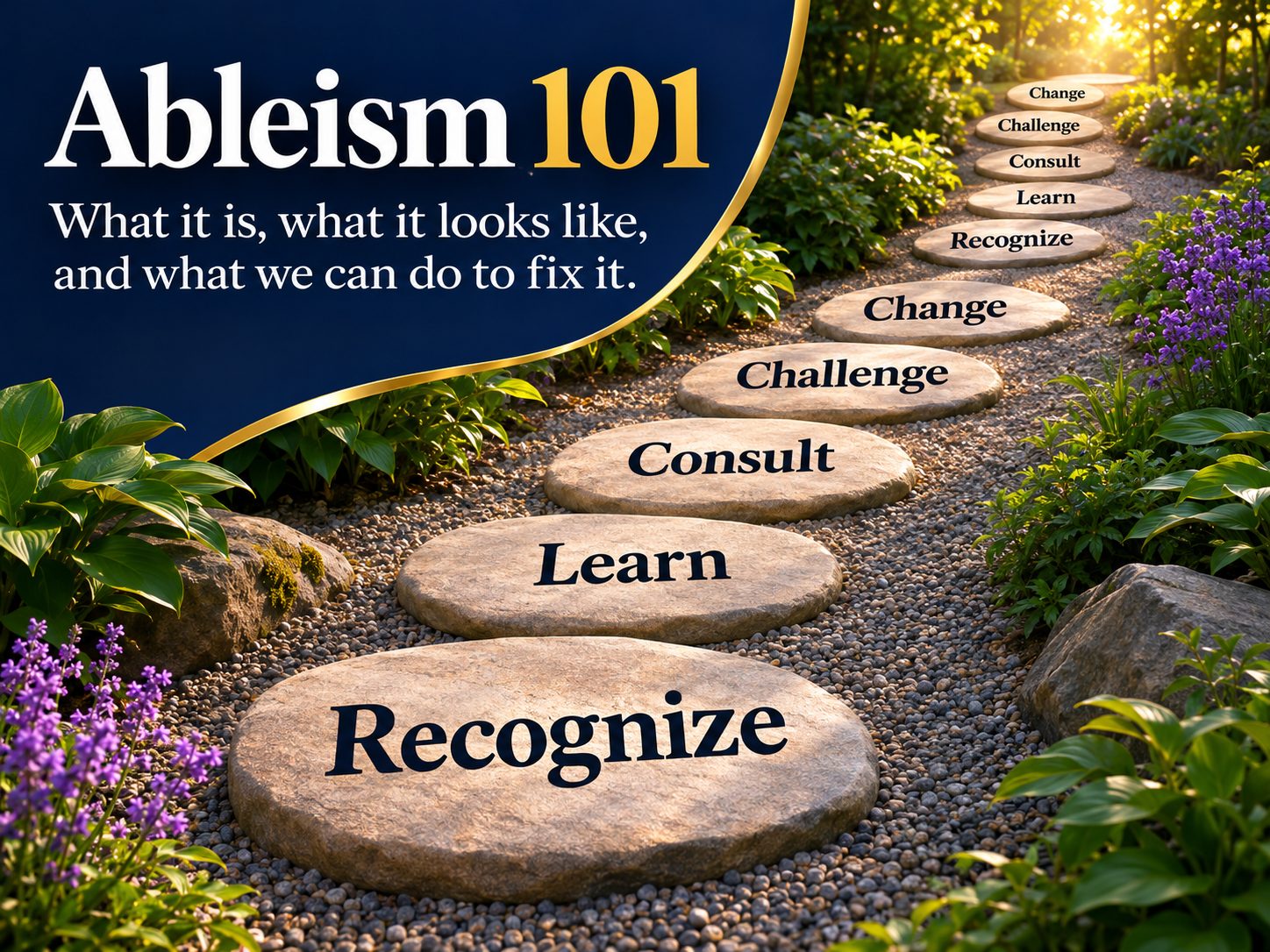
    Ableism 101: What it is, what it looks like, and what we can do to to fix it

    Updated

    Ableism, as Ashley Eisenmenger of Access Living explains, sorts People with Disabilities into a group seen as lesser and treats a disabled person as someone to fix. It shows up in separate schools, institutions, restraint and seclusion, and buildings and websites with no access, and in everyday slights, from using a mobility device as a footrest to talking down to a person or speaking for them. Pushing back means believing people, listening, keeping invasive questions to ourselves, and making sure People with Disabilities sit where decisions are made. We should start with the next program, service, event, or communication in planning.

  • Vilissa Thompson writes that she is a model for what approaching midlife as a Black disabled woman looks like. Stock photograph; the woman pictured is not the author.

    By exceeding my life expectancy, I’ve become a model for other Black disabled women

    Updated

    Vilissa Thompson was expected to die by the age of 8 and has now lived 30 years past that prediction. She writes about ableism and medical racism in health care, the grandmother who was her first advocate, and what it means to grow older as a Black disabled woman and become a model for others.

  • One of the first photos from the James Webb Space Telescope, shown here with the ALT text NASA published for it. Image: NASA, ESA, CSA, STScI

    Nasa Added Amazing Alt Text Image Descriptions to James Webb Space Telescope Photos

    Updated

    The National Aeronautics and Space Administration (NASA) published the first photos from the James Webb Space Telescope with alternative text, known as ALT text, and longer descriptions that Venkat, writing on Assistive Technology Blog, calls descriptive, poetic and scientifically accurate. The page shows how those image descriptions work and why ALT text should never be an afterthought.

  • Participants in the 2017 Disability Pride Parade in New York on July 9, 2017. Photograph: Rainmaker Photo/MediaPunch/IPX/AP Images

    As the ADA Celebrates Its 34th Anniversary, Digital Accessibility Must Be Our Next Priority

    Updated

    On the 34th anniversary of the Americans with Disabilities Act, Mark Pound of CurbCutOS writes that the law’s promise has not reached the digital world: a 2022 report found failures of the Web Content Accessibility Guidelines on 97.4 percent of the top one million home pages. He calls digital access a civil right and asks organizations and governments to build it in.

  • Sa’diyya Nesar, author of Hearts that Remember and Strength From Within. Photograph: Kelly Ho, Hong Kong Free Press

    Hong Kong writer Sa’diyya Nesar on the intersection of disability and faith

    Updated

    Sa’diyya Nesar, a Pakistani writer in Hong Kong who uses a wheelchair, writes poetry and memoir about disability and her Islamic faith and serves as a public policy adviser. She tells Hong Kong Free Press about pity, about people who talk past her, and about mosque stairs that keep her out, one of the ways ableism shows up in religious spaces.

  • Key art for Change, Not Charity: The Americans with Disabilities Act, an American Experience film that aired on PBS on March 25, 2025.

    PBS Documentary - Change, Not Charity: The Americans with Disabilities Act

    Updated

    Change, Not Charity: The Americans with Disabilities Act, an American Experience film from the Public Broadcasting Service (PBS), tells how disabled activists risked their bodies to win the Americans with Disabilities Act in 1990, and how the curb cuts, ramps and Braille signs now taken for granted came from that fight. Its trailer and first chapter are offered with extended audio description and American Sign Language interpretation.

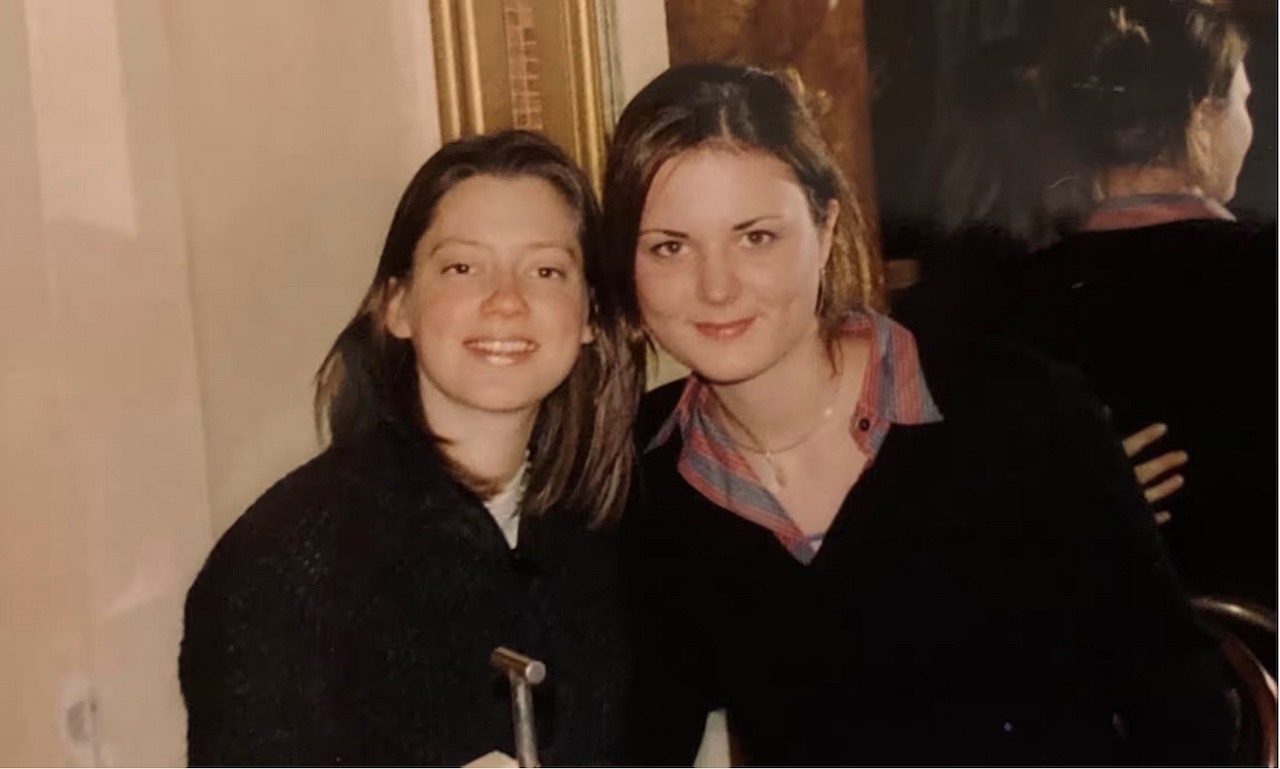
  • Rosie (left) and Sarah Marsh at university, where Rosie became the first person Sarah had met her own age who wore hearing aids. Photograph: Courtesy of Sarah Marsh

    A moment that changed me: I thought deafness was a flaw. Then I met clever, wise, funny Rosie

    Updated

    Sarah Marsh, who is Deaf, grew up thinking her deafness was a flaw until she met Rosie, another Deaf student, at university in 2001. Their friendship of more than twenty years taught her that she did not have to hide her hearing aids or who she was, and it showed her Deaf identity as part of who she is.

  • In 2025, the United Nations issued its sixth progress report on its Disability Inclusion Strategy, showing progress and where it has to move faster.

    Rethinking Work On International Day Of Persons With Disabilities

    Updated

    On the International Day of Persons with Disabilities, Keely Cat-Wells shows that disabled people in the United States are twice as likely to be unemployed and that attitudes, inaccessible systems and benefits cliffs keep them out of work. She calls for skills based hiring, routine access at work, flexible schedules and disabled leadership at every decision making table.

  • Rosa Parks’ refusal to surrender her seat reframed who gets to ride as a question of civil rights. Building on her example, American Disabled for Accessible Public Transportation (ADAPT) organizers blocked buses to demand wheelchair lifts and equal access, pressure that built toward the Americans with Disabilities Act (ADA).

    How Rosa Parks’ legacy inspired a new fight over who could ride the bus

    Updated

    In 1984, disabled activists from ADAPT, American Disabled for Accessible Public Transportation, blocked Chicago buses that had no wheelchair lifts, each wearing a name tag that read “My name is Rosa Parks.” Lauren Nutall of The 19th traces how Parks shaped the disability rights movement that won the Americans with Disabilities Act in 1990, and why activists such as Anita Cameron say the fight continues.

  • San Francisco, 1977: Catherine Dugan holds notes while Ed Roberts testifies at a congressional hearing on increased access and rights for People with Disabilities.

    The Radical Life of the Father of the Independent Living Movement

    Updated

    Ed Roberts, who became paralyzed after polio as a teenager, grew into the father of the independent living movement and spread centers run by disabled people across the country and the world. In an interview with Julia Métraux, Scot Danforth, author of a new biography, explains why Roberts’ story matters while disability rights are under attack.

  • Creativity, Persistence, and Hope: Reclaiming Our Stories through the Organized Blind Movement

    Updated

    In his 2025 banquet address to the National Federation of the Blind, President Mark A. Riccobono takes on the parable of the blind men and the elephant, a story that rests on the idea that blind people are foolish. He shows how the organized blind movement wrote a different story, rewrites the parable with Blind explorers who work together, and asks Blind People to reclaim their stories from the low expectations of the past.

  • Abdi Ali-Mumin, a certified orientation and mobility instructor in Colorado who runs his own business teaching cane travel.

    Blindness Beyond Borders

    Updated

    Abdi Ali-Mumin, a Blind orientation and mobility instructor in Colorado, trained at the Colorado Center for the Blind and now teaches cane travel in the United States and in Kenya, Uganda and South Africa. He writes that independence is a right for Blind People everywhere and that low expectations, not blindness, hold people back.

  • Noelle Pacl, a mother, Navy spouse and advocate who raises awareness of Sanfilippo Syndrome.

    How negative rhetoric toward People with Disabilities has a harmful record

    Updated

    Noelle Pacl, a mother and advocate, writes that public rhetoric calling disabled people burdens has grown, and she traces such words to the institutions of the past and to the Nazi T4 program that killed tens of thousands of disabled people. She asks us to speak out against harmful words and to model respect for children.

  • Joshua A. Miele has spent his career designing access technology for Blind People and other People with Disabilities.

    Imagine how disabled people can, rather than assuming we can’t

    Updated

    Blind scientist and designer Joshua A. Miele was told as a teenager that he could not study physics and later heard a recruiter doubt that a Blind person could be a designer. He shows that ableism, not missing tools, is the main barrier, and he asks us to learn about disability from disabled people and to imagine how they can.

  • Dov Marcus, who recited the blessings over the Torah at an inclusive Hanukkah service, prays with his uncle, Chaim Orlan. Photograph: Luis Andres Henao, Associated Press

    How Faith Communities Can Be Inclusive of Believers with Disabilities

    Updated

    Pastors, parents and disabled worshippers in an Associated Press report show how congregations can welcome people with intellectual and developmental disabilities, from a “Calm Christmas” to an inclusive Hanukkah service. They ask faith leaders to plan with disabled members, to invite them to serve and to fully include them in worship.

  • Mark A. Riccobono, President of the National Federation of the Blind, who gave this address in Orlando, Florida, on July 8, 2024.

    Dignity, Respect, and Determination: The Momentum of the Blind People's Movement

    Updated

    In his 2024 banquet address to the National Federation of the Blind, President Mark A. Riccobono says dignity is equal for Blind People and others, yet grabbing hands, inaccessible forms and low expectations threaten it every day. He asks Blind People and allies to uphold dignity through autonomy, choice and respect, and to carry that work forward through the organized blind movement.

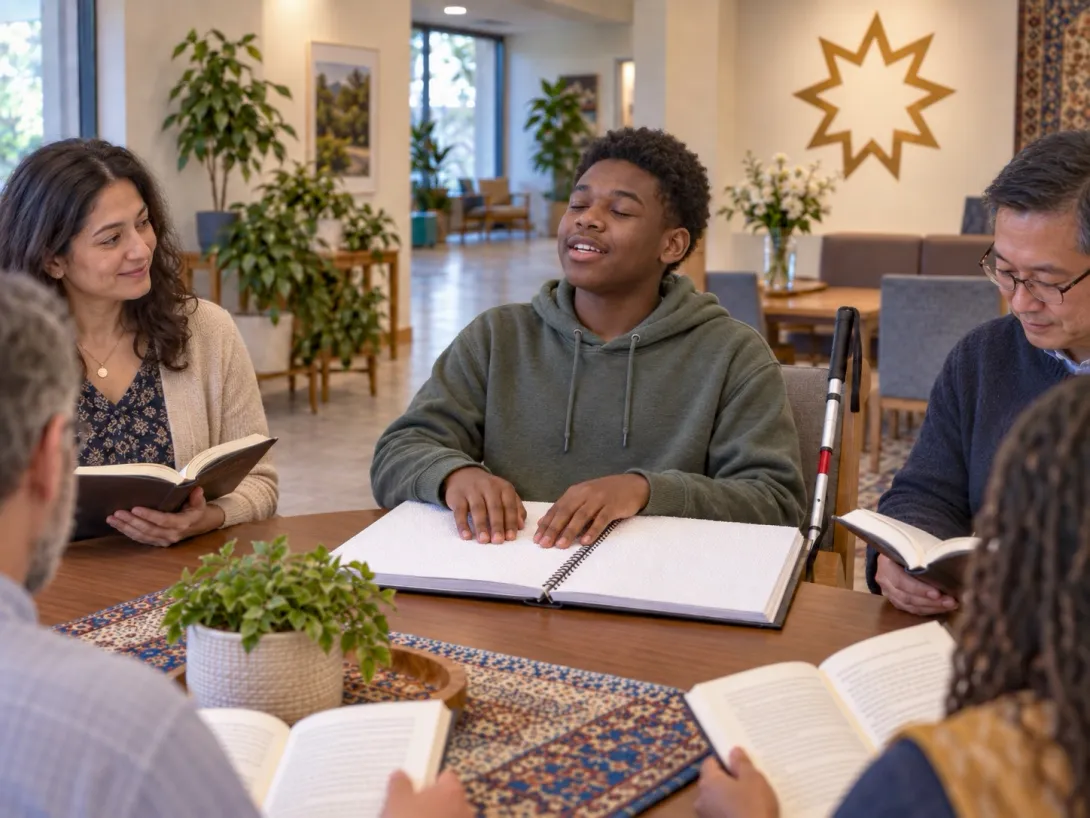
A Blind Black youth smiles and speaks as he reads a braille book with both hands at a wooden table in a Bahá'í study circle, his white cane beside his chair. A woman with long dark hair holds a print book and smiles at him. An Asian man with glasses reads a print book. Two people in the foreground read print books. A large nine pointed star is mounted on the wall of the bright community room.

Accessible materials are imperative and should always be prepared in advance so they are available at the same time as everyone else. Braille is fundamental to literacy!  However, accessible materials should be provided for Blind or Low Vision participants in their own preferred format.

Question: Is this example of inclusive practices the norm in your community? If not, what barriers need to be removed which prevent inclusive and welcoming participation?


"The challenge facing the friends serving at the grassroots is essentially the same in every place. They must be able to read their own reality and ask: what, in light of the possibilities and requirements at hand, would be fitting objectives to pursue in the coming cycle or series of cycles?"  -- December 30, 2021 UHJ to Conference of Counselors Introducing Nine Year Plan


Explore More Compelling Insights:

Learn about topics related to People with Disabilities, Accessibility, Anti-Ableism, Removing Barriers, and the Disability Community? Tap the Explore button to discover something new and intriguing with each tap!