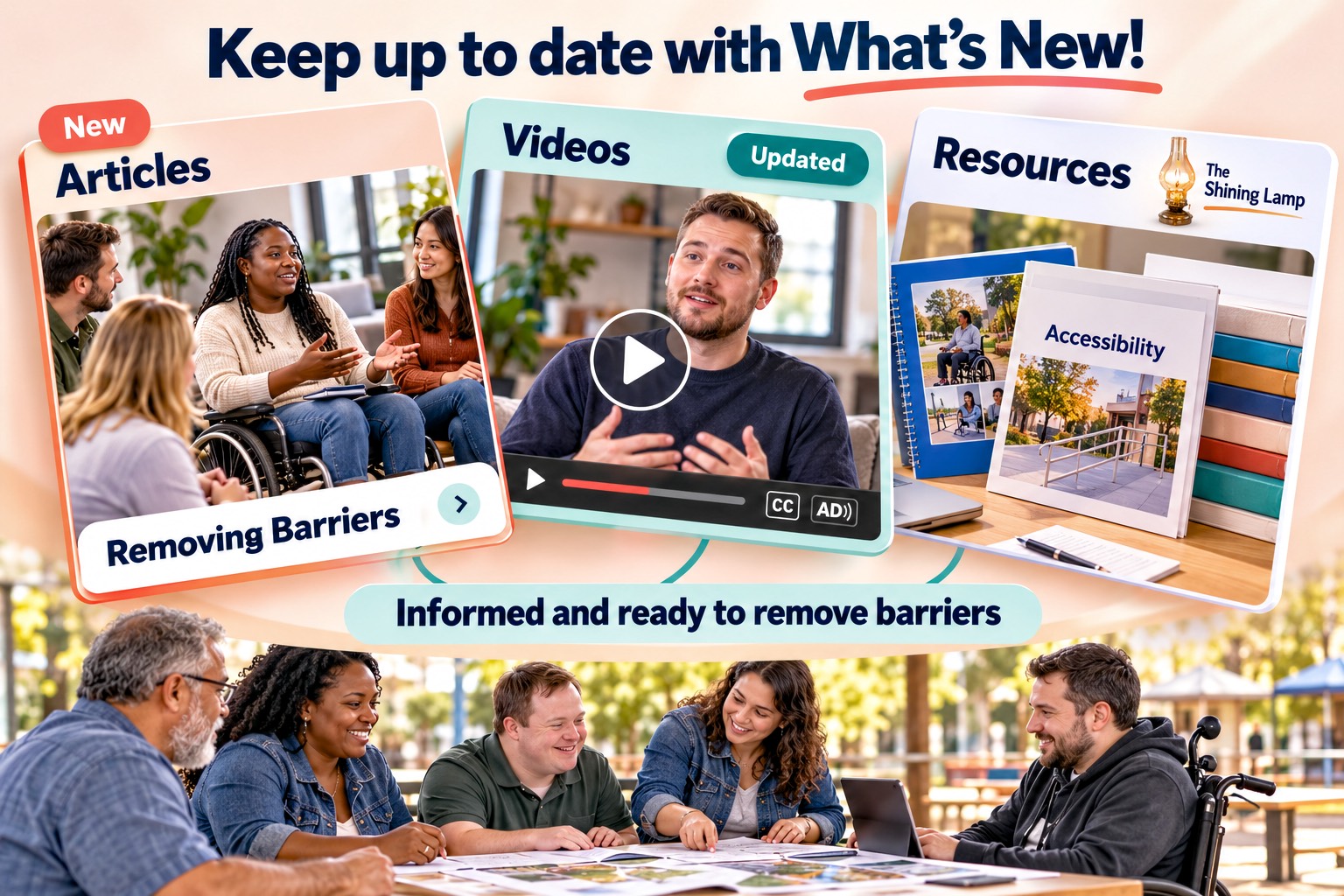

Infographic headed “Keep up to date with What’s New!” features article, video, and resource previews marked “New” and “Updated.” Below, a diverse group, including a wheelchair user, reviews materials together beneath the message “Informed and ready to remove barriers.”

What's New and Updated at The Shining Lamp?

Latest updates

  • HuffPost launches its new section by centering Samantha Figgins’s story and arguing that disability is strength, identity, visibility, and a voice that must come from inside the disability community.

    Introducing Voices of People with Disabilities

    New

    HuffPost launches this new section to center People with Disabilities as authors of their own lives, and the editor’s story about her best friend explains why that matters. At 23, her friend had a stroke, woke up in an Intensive Care Unit with locked-in syndrome, and endured months of paralysis, rehab, speech therapy, and other treatment before using eye-controlled technology to blog and write again. By rejecting inspiration porn and insisting that Telling our stories is resistance, the article makes clear that disability coverage must be led by truth, authorship, and power rather than pity.…

  • Cody Wass and Jordan McNeal work at Easterseals’ HB Threads as Illinois implements the Dignity in Pay Act to end subminimum wages and require minimum wage for People with Disabilities by 2029.

    Chicago company offers model as Illinois phases out subminimum wages

    New

    Illinois is in a multi-year rollout to ensure companies pay all workers a fair wage. Governor JB Pritzker signed the Dignity in Pay Act last year, requiring companies to pay workers with Disabilities at least minimum wage by 2029, putting an end-date on disability-based pay inequity in Illinois. The state law diverges from the United States Department of Labor’s 14(c) waiver program, which allows employers to pay less than minimum wage to workers whose disabilities, employers argue, limit their productivity. State Representative Theresa Mah, the law’s lead sponsor, rejected that framing at a…

  • Emma Sellars explains how living with an ileostomy stoma bag, a feeding tube, and Epilepsy can be dismissed as “invisible,” while public judgment and poor toilet conditions make it harder to safely take part in everyday life.

    My hidden disability means people judge me - it makes me anxious to go out

    New

    Laycie Beck reports on Emma Sellars, now 24, whose life changed at 16 when doctors diagnosed ulcerative colitis, a chronic inflammatory bowel disease, followed by years of medication, infusions, steroids and injections for flare-ups and severe pain. By 18, she says the side effects left her with “no choice” but surgery to form an ileostomy and remove her large bowel, leaving a stoma and a bag to collect waste, and she says the surgery “saved my life.” She has since undergone nine more surgeries and, since 2022, needed artificial nutrition through a feeding tube into her small bowel—realities…

  • A Jewish learning moment that aligns with the article’s message: accessibility must be the default—built in, clearly communicated up front, and treated as a year-round expectation rather than optional.

    From intention to expectation: The next phase of Jewish disability inclusion

    New

    Jennifer Laszlo Mizrahi argues that disability inclusion in Jewish life must shift from “good intentions” to expectation because People with Disabilities and their families have been pushed out of core community spaces. She writes that a beloved family member was excluded from Jewish life because Jewish organizations were “not willing or able” to include people with disabilities, and she adds that many other families experienced the same exclusion. Being “excluded from Jewish schools, camps and other experiences” is a direct denial of belonging that institutions can—and must—stop normalizing.…

  • Sign language interpreters at music concerts: ASL rock stars (Enable: The Disability Podcast)

    New

    Deaf and Hard of Hearing people are shut out of live music when concerts are built around hearing-only access, and the article shows how deaf and hard-of-hearing audience members get real access when interpretation is treated as a basic right, not a bonus. At major events like the New York State Fair, Lollapalooza, and the Super Bowl, Amber Galloway and Julian Ortiz interpret live music so Deaf community members can follow what’s being sung and performed instead of being left to guess.

  • A bakery operated by the Zayed Authority for People of Determination in Abu Dhabi, shown alongside an argument that disability inclusion must be designed as core business strategy with measurable outcomes.

    How hiring People of Determination can help companies thrive

    New

    Abdulla Al Humaidan argues that, for decades, disability inclusion has been framed as charity, compliance or corporate social responsibility, and that this framing keeps People with Disabilities stuck with “pilot programmes that never scale”, roles that “lack advancement”, and initiatives that “quietly disappear once the grant cycle ends”. He rejects symbolic participation that depends on temporary funding or branding cycles, warning that inclusion treated as a “moral gesture rather than an operational strategy” rarely survives market realities. The article’s first demand is structural: stop…

  • A What’s Mine is Yours Jewish adult-learning class meets around a conference table during a session designed for adults who have often been excluded from formal Jewish education.

    A new curriculum brings adults with intellectual disabilities into the heart of Jewish learning

    New

    Raffi Stein-Klotz, 24, is part of an adult Jewish learning series created specifically for people with intellectual and developmental disabilities at Jewish Association for Residential Care (JARC), where he and his housemates study Genesis, learn terms in Hebrew and English, and practice “boker or” and “boker tov.” The article makes clear why this matters: advocates say there are “few if any options” for formal adult Jewish education tailored to them, leaving adults pushed out of the learning that shapes Jewish life—until programs commit to providing “Jewish academic resources for adults with…

  • The Terzo Tempo choir’s Milan concert—held days before the Winter Paralympics at the Milan Cortina Games—was presented as a call to include People with Disabilities in shared parish and community life rather than separating people with disabilities.

    Milan church concert strikes a chord for inclusion ahead of Winter Paralympics

    New

    Days ahead of the Winter Paralympics—when athletes with disabilities will take center stage at the Milan Cortina Games—a choir from northern Italy performed a pop music concert inside Milan’s Sant’Antonio church, calling for harmony and inclusion—particularly of those with disabilities. The article’s core conflict is that visibility at major events does not automatically translate into belonging; People with Disabilities are still too often treated as an “add-on” audience instead of equal community members whose access and participation must be built into public life. The Archdiocese of Milan…

  • The can opener Chip left behind—an ordinary object that still carries the weight of an unexpected bond, shared access, and a kind of family the author didn’t see coming.

    My Friend Warned me Not to Move In with a Stranger from an Online Ad, But I Did and got the Surprise of my Life

    New

    Nancy Bischoff’s essay opens on a cliff edge of uncertainty: in her early 30s, after “running from a failed relationship,” she scans an online ad that reads, “Veteran with a disability needs helper. Free room and board, in exchange for light housekeeping.” Her best friend warns her off, but she goes anyway, chasing detachment and a reset in a new city. When she reaches the house, the risk hits her body—“warning bells were going off,” her hands are sweating—and then the door opens to an older, white-haired man using a wheelchair and connected to an oxygen tank. He is not asking to be pitied…

  • Colin Burnett says publishing his third book is a way to answer the teachers who laughed at his goal of becoming a writer and told him university would be too difficult.

    Midlothian author 'proud to prove teachers wrong' as he publishes third book

    New

    This Edinburgh Live article profiles Midlothian author Colin Burnett, a 35-year-old man from Bonnyrigg who has autism and also lives with dyslexia and dyspraxia, as he prepares to publish his third book while confronting how teachers tried to shut down his future. He says he was “laughed at” and discouraged at school, repeatedly told it would be “too difficult” for him to go to university, and remembers telling an English teacher he wanted to become a writer someday and she laughed in my face. The article does not treat this as a harmless memory: it shows how educators’ ridicule and low…

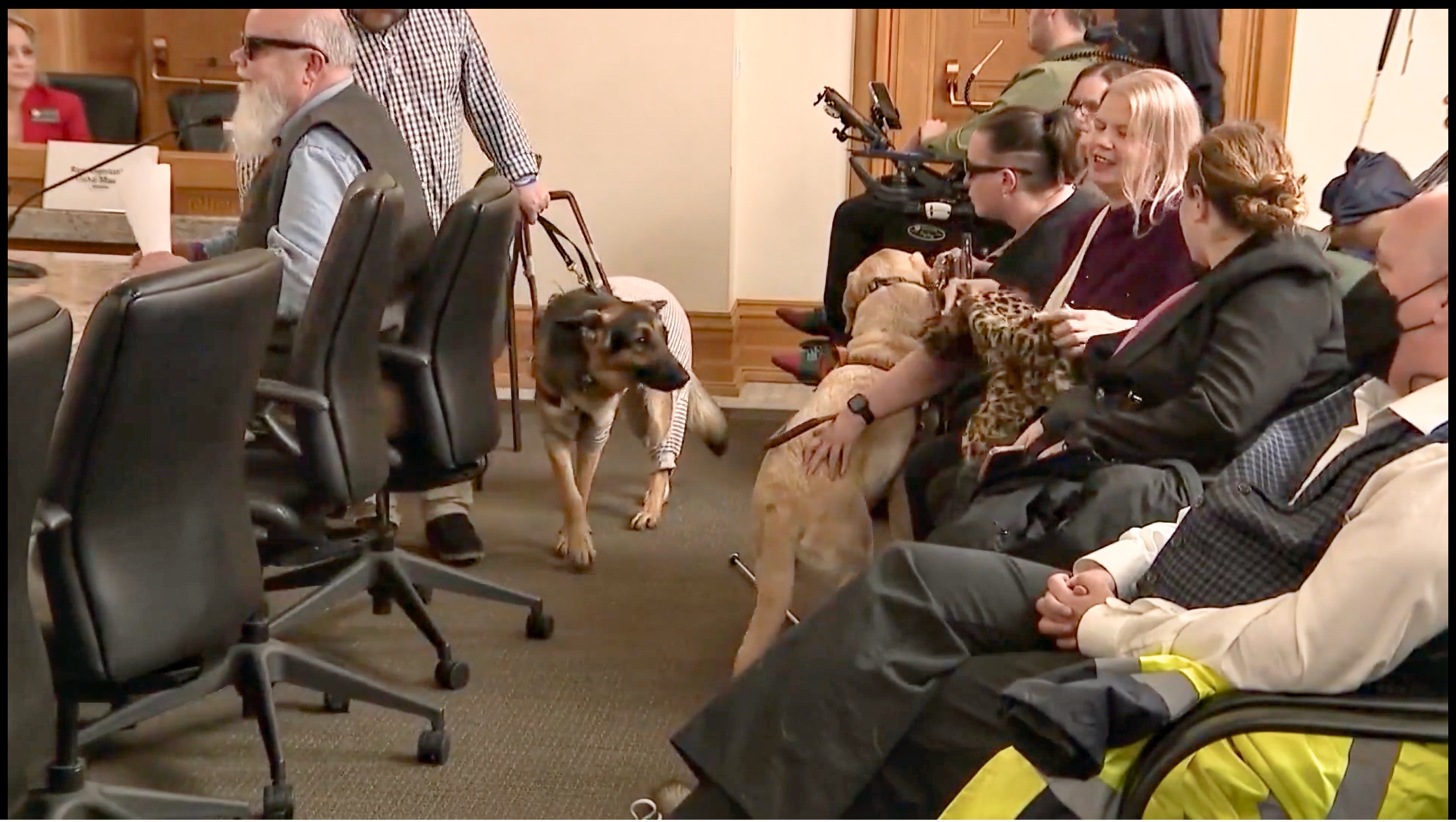
  • Blind/Low Vision Coloradans and their guide dogs attend a Colorado House committee hearing backing HB26-1043 to strengthen penalties and reporting for illegal rideshare ride denials.

    State lawmakers takes step toward increasing penalties for rideshare discrimination

    New

    Colorado lawmakers moved HB26-1043 forward when the House Business Affairs and Labor Committee passed it out of committee, a step meant to increase penalties for transportation network companies, or rideshare companies, when drivers discriminate against people with disabilities. The point is simple: discrimination in transportation isn’t a minor inconvenience—it blocks basic access and puts People with Disabilities at risk when they are trying to get home, get to work, or move through public life like everyone else. The hearing centered the lived reality of Blind/Low Vision People who rely on…

  • Kristen Dockendorff, a Blind technology mentor, shares access tools and peer support that strengthen community participation and accountability.

    Case Closed: The Story of Technology, a Blind Woman, and an Eyewitness Account to Solve a Mystery

    New

    Kristen Dockendorff’s article centers the rights and expertise of blind and low-vision people by showing how community-led access to technology confronts the barriers that keep Disabled people from information, equipment, and equal participation. At UR Community Tech Center, she and Michelle Puzzo run a support group and—through grant work—make it possible for people to test more than thirty-five devices, from electronic magnifiers to smart glasses, so access is not limited to what institutions decide is “enough.” The point is not charity or “help,” but removing barriers through real choices…

  • Author Gary Wunder argues that shifting what people say about blindness is not enough unless attitudes, expectations, and access change so People who are Blind can fully participate in community life.

    Changing Words, Changing Minds, Changing the World

    New

    Gary Wunder describes how People who are Blind are harmed by everyday disrespect: a sighted stranger may gush that independent travel is “inspirational,” or insist on doing what blind people can do perfectly well alone. He argues that Language does matter, but empty word-swaps do not stop discrimination—especially when the underlying belief remains that blind people cannot work, marry, or raise children. The real demand is not polite phrasing; it is the full acceptance that People who are Blind are equal participants in society. The article also names the long pattern of exclusion—People who…

  • Representative Kweisi Mfume, Ever Lee Hairston, President Mark A. Riccobono, and Senator Chris Van Hollen gather at the National Federation of the Blind Jernigan Institute to announce legislation designating the Museum of the Blind People’s Movement as a national museum.

    A National Home for Our Stories: Members of Maryland Congressional Delegation Introduce Legislation to Designate the National Museum of the Blind People's Movement

    New

    At the National Federation of the Blind (NFB) Jernigan Institute on December 5, 2025, members of Maryland’s congressional delegation announced legislation introduced in the House of Representatives (H.R. 6467) and the United States Senate (S. 3371) to designate the Museum of the Blind People’s Movement as the National Museum of the Blind People’s Movement. The article frames this as a civil rights moment grounded in “collective action,” insisting that blind people’s central role in advancing civil rights belongs in the nation’s official story—not treated as optional or “undershared.”…

  • The United Nations Disability Inclusion Strategy branding, representing a system-wide commitment to disability inclusion as a rights and accountability obligation.

    Disability Inclusion Strategy

    Updated

    The United Nations (UN) Disability Inclusion Strategy frames disability exclusion as a rights failure that institutions must stop normalizing, stating that “when we secure the rights of persons with disabilities,” the world moves closer to the core values and principles of the United Nations Charter. The article positions disability inclusion as a standard across peace and security, human rights, and development, making clear that leaving barriers in place is a structural choice that blocks People with Disabilities from full participation.

    The Strategy directly confronts institutional inaction by establishing a policy and an accountability framework with benchmarks to assess progress and accelerate change. It specifies that senior leadership must champion disability inclusion, strategic planning must take People with Disabilities into account, disability-specific policies or strategies must be developed, and expertise must be formally assigned. These requirements exist because exclusion persists when responsibility is vague and consequences are absent.

  • Medal-winning swimmers gather poolside at JCC Maccabi Access, part of the JCC movement’s push to turn disability inclusion into consistent practice across programs.

    Want to take inclusion from principle to practice? The JCC movement shows what's possible

    New

    The article insists the Jewish community cannot treat disability inclusion as “nice to have,” because excluding People with Disabilities and their families weakens Jewish communal life and blocks full participation. It points to a documented participation gap—People with Disabilities and their families show up at far lower rates in Jewish communal life than in secular counterparts—showing that stated values without barrier-removal still leave people out, and that Removing Barriers must be the standard, not a slogan. A central harm the article names is the mismatch between what Jewish…

  • A bat mitzvah rehearsal using Braille embodies the article’s message: access is core to Jewish life, not optional.

    Disability inclusion is ‘outside our scope’? Think again

    New

    The article rejects the exclusionary stance of “we don’t do disability,” showing that Jewish institutions already serve people with disabilities wherever they engage in education, social justice, poverty alleviation, community building or Jewish engagement. Framing disability as a niche excludes students, congregants, volunteers, co-workers and loved ones who are already present and entitled to belong. The author names the breadth of disability — visible and invisible, including mental health, neurodivergence, learning disabilities and chronic illness — and shows how exclusion compounds…

  • Change, Not Charity: The Americans with Disabilities Act*, a PBS documentary premiering **March 25, 2025**. This documentary explores the activism that led to accessibility features we recognize today—like curb cuts, ramps, and braille signage.

    PBS Documentary - Change, Not Charity: The Americans with Disabilities Act

    Updated

    From pity to progress: ‘Change, Not Charity’ chronicles the Disability Rights Movement Premieres March 25, 2025 This powerful documentary shares the movement that led to the passage of the Americans with Disabilities Act (ADA) in 1990. The film highlights the collective efforts of People with Disabilities who worked to remove barriers in transportation, employment, and public spaces. Many accessibility features recognized today—such as curb cuts, ramps, and braille signage—were the result of dedicated advocacy. This documentary is essential viewing for those committed to building Vibrant…

  • In Austin, Vietnam War veteran Bob Kafka — an organizer with ADAPT (American Disabled for Attendant Programs Today) — pressed for rights through direct action; the obituary recalls how his protests aimed to change laws and everyday lives for People with Disabilities.

    Disability rights advocate Bob Kafka dead at 79

    New

    Bob Kafka’s death at 79 is a loss precisely because his life centered rights over charity. A Vietnam veteran with a disability, he organized with ADAPT (American Disabled for Attendant Programs Today), insisting that public life be accessible and using direct action at protests to challenge exclusion named in the article. After paralysis from a 1973 car crash, Kafka and his wife, Stephanie Thomas, prioritized dignity and practical support for People with Disabilities — from helping someone tie shoes or eat to guiding people through new lives — proving that independence and belonging are…

Five diverse young friends enjoy an inclusive aquarium outing at an accessible touch tank, smiling and exploring sea stars and other marine life together, including a blind youth and a wheelchair user.

Consistently ensuring equitable participation of People with Disabilities in community gatherings and events by planning ahead for Accessibility transforms exclusion and discrimination into a culture of inclusion, respect, belonging, and value.

Question: Is this example of inclusive practices the norm in your community? If not, what barriers need to be removed which prevent inclusive and welcoming participation?


"The challenge facing the friends serving at the grassroots is essentially the same in every place. They must be able to read their own reality and ask: what, in light of the possibilities and requirements at hand, would be fitting objectives to pursue in the coming cycle or series of cycles?"  -- December 30, 2021 UHJ to Conference of Counselors Introducing Nine Year Plan


Explore More Compelling Insights:

Learn about topics related to People with Disabilities, Accessibility, Anti-Ableism, Removing Barriers, and the Disability Community? Tap the Explore button to discover something new and intriguing with each tap!