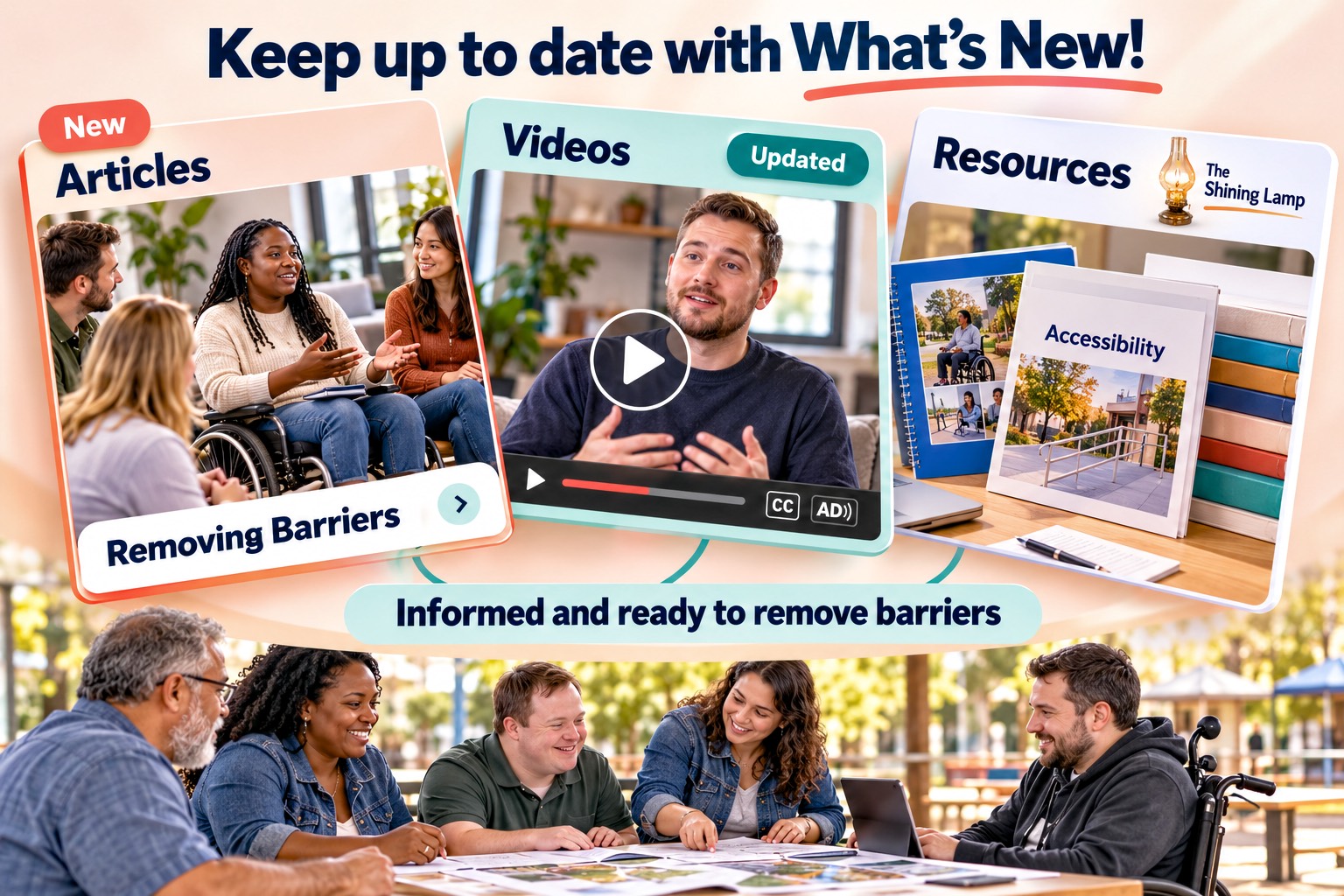
Infographic headed “Keep up to date with What’s New!” features article, video, and resource previews marked “New” and “Updated.” Below, a diverse group, including a wheelchair user, reviews materials together beneath the message “Informed and ready to remove barriers.”

What's New and Updated at The Shining Lamp?

Latest updates

  • Ed Roberts—disability-rights leader—used a ventilator while organizing for access across higher education, community services, and public policy; his life and work are the focus of Scot Danforth’s An Independent Man: Ed Roberts and the Fight for Disability Rights (University of California Press).

    Ed Roberts, hero of Berkeley’s disability rights movement, gets his first biography

    New

    Berkeleyside’s books column leads with Scot Danforth’s first full biography of a Berkeley organizer whose work helped define disability rights: An Independent Man: Ed Roberts and the Fight for Disability Rights. The piece situates Roberts’ leadership in campus and city history and names his role in building what became widely known as the independent living movement. Danforth traces how a small cohort of UC Berkeley students—often called the Rolling Quads—built services run by and for people with disabilities, pressed university and state officials, and formed coalitions. The column…

  • Apple’s short film presents diversity, disability, and accessibility as ordinary campus life—showing people with disabilities using built-in features as everyday tools, not exceptions.

    “I’m not Remarkable” reminds us that accessibility should be a core value of all tech, and not just of Apple

    New

    The article opens with the line “At Apple, accessibility is a core value,” and describes Apple marking the International Day of Persons with Disabilities by releasing a short film that presents accessibility as part of everyday life rather than something exceptional. The 170-second film, directed by Kim Gehrig, follows a diverse group of students in ordinary campus scenes while the song “I’m Not Remarkable” rejects inspiration porn; people with disabilities are present as part of the group, not as a spectacle. Accessibility features are shown in routine use—VoiceOver and Braille Screen Input…

  • Caption: Too few wheelchair-accessible taxis in Scotland leave people with disabilities waiting—an avoidable barrier highlighted in a Holyrood debate marking the International Day of Persons with Disabilities.

    Decline in wheelchair accessible cabs for passengers with disabilities

    New

    Scotland’s Parliament heard renewed criticism of transport provision for people with disabilities after Members of the Scottish Parliament raised concerns that too few accessible taxis are available. The debate, held on the International Day of Persons with Disabilities, highlighted mobility barriers that persist despite longstanding commitments to provide access. Speakers described long waits routinely faced by people who use wheelchairs when trying to book accessible taxis. A Member told the chamber that people with disabilities are forced to wait excessive periods because the supply of…

  • Community brief: Edwardsville NAACP’s Dec. 13 disability information fair at the public library invites neighbors to connect with providers and learn practical ways to remove barriers.

    NAACP to host disability awareness information fair Dec. 13

    New

    Edwardsville’s NAACP will host a public disability information fair on Dec. 13 at the Edwardsville Public Library, connecting neighbors with local resources and wellness providers while encouraging everyone to help remove each Community Access Barrier that keeps People with Disabilities from fully participating in civic life. Timed to December’s observance of the International Day of Persons with Disabilities, the fair emphasizes inclusion grounded in The Social Model of Disability—the idea that many limits come from fixable barriers in our environments, not from people themselves. Organizers…

  • Community inclusion is built through relationships and shared responsibility — a point echoed throughout the piece.

    Opinion | America is abandoning people with disabilities It doesn’t have to be this way.

    New

    For fifty years, the U.S. moved from warehousing people with intellectual and developmental disabilities toward community life, but cracks are widening again as supports stall and expectations are lowered; confronting systemic ableism in how services are designed and managed is part of moving forward. Community living rises or falls with the people who make it possible: direct support professionals, educators, and clinicians; rebuilding and respecting this workforce with training, pay, and a real career path is a practical step to advance disability inclusion so individuals can live, learn…

  • Alice Wong is remembered for holding anger alongside love and turning both toward access, care, and community; this remembrance follows her words, organizing, and the networks that continue her work.

    The Afterlife of Alice Wong

    New

    Alice Wong died in San Francisco on Nov. 14 at age 51. The remembrance opens with her pairing of anger and love—quoting her final message to the community—and follows how readers recognized their own rage during COVID disruptions and chronic pain. Staying with Wong’s words (“I feel very alone w/ so much rage”), the piece treats anger as truthful and connective, a force that moves people out of isolation and toward collective care. The essay then grounds that feeling in her life story: born in 1974 in Indianapolis to Hong Kong immigrants; an early diagnosis with a form of muscular dystrophy…

  • The photo shows a single access fix — a ramp into a van — while the article documents that many Jewish institutions are lagging behind secular ones and still lack the staffing, policies and budgets that would make comparable access reliably available.

    New study shows Jewish groups lagging behind secular community on disability inclusion

    New

    The article reports a clear finding: a new study by the disability-inclusion nonprofit Matan — released on the International Day of Persons with Disabilities — shows that Jewish organizations are **lagging behind** secular ones on access. The study calls the gap “very solvable,” yet warns that failure to act continues to push people out of community life. Based on surveys, interviews and focus groups across 15 U.S. communities from 2018–2025, the study found that in each community 20–25% of people identified as having a disability, but supports in Jewish settings are thin. Less than one-third…

  • Rosa Parks’ refusal to surrender her seat reframed who gets to ride as a civil-rights question. Building on her example, American Disabled for Accessible Public Transportation (ADAPT) organizers blocked buses to demand wheelchair lifts and equal access — pressure that helped build toward the Americans with Disabilities Act (ADA).

    How Rosa Parks’ legacy inspired a new fight over who could ride the bus

    New

    Rosa Parks’ refusal didn’t just spark a boycott — it modeled rights-based advocacy that treats transit access as a question of power and policy, not charity. Her example offered later organizers a practical playbook: identify the barrier, confront the rule, and insist that public systems serve the whole public. By the 1980s, the disability rights movement had policy wins and new visibility, yet many riders were still shut out of buses by steps, narrow doors, and segregating paratransit. True accessibility meant boarding the same vehicles, on the same routes, with the same schedules — not…

  • Inclusive teams thrive when leaders remove barriers and invest in AI skills, care supports, and accessible processes.

    3 Ways Leaders Must Rethink Disability, AI, And Care

    New

    Leaders face a real paradox: the skills gap is widening while millions of talented people remain sidelined. Centering inclusion as a business strategy—not charity—means investing in disability employment and removing barriers across hiring, tools, and policy so participation becomes the norm. Data shows many disabled workers are already “AI power users,” leveraging AI-enabled tools like voice-to-text and predictive workflows to boost problem-solving. Prioritizing equitable access to training and advancement sustains this momentum and helps organizations keep their most agile adopters.…

  • Ugandan Sign Language alphabet painted on the wall of Kamurasi Demonstration School in Masindi, Uganda—reminding us that communication access is part of inclusion. Photo: UNICEF/Uganda/Barbeyrac.

    International Day of Persons with Disabilities, 3 December

    New

    The 2025 theme—“Fostering disability inclusive societies for advancing social progress”—asks the world to replace pity framing with rights, access, and leadership by persons with disabilities. That means moving beyond charity toward design choices that make schools, workplaces, healthcare, transport, and civic life work for People with Disabilities. The UN details stubborn barriers: higher poverty rates, wage gaps, overrepresentation in informal work, and social protection that often ignores extra disability-related costs. Turning promises into practice starts with practical steps—accessible…

  • Families across New York’s Capital Region are demanding that schools remove barriers so students with disabilities participate in clubs, dances, and after-school life as an expected part of belonging—without delay or exception.

    Math, yes. Lego club? There's no plan for disabled children to attend

    New

    Mervin Rodriguez loves music and movement. At a community baseball banquet in 2023, “They had a disc jockey (DJ) and it was like nothing else mattered. You couldn’t peel him off the dance floor.” His family took him to a live concert this summer—same joy. Yet when a school dance comes up, they can’t send him because there is no plan for participation: no way to signal for bathroom help, no clear wayfinding at drop-off and pick-up, and no designated person to respond when a nonverbal child tries to get support.

  • Rep. Lateefah Simon speaks at a rally, underscoring that disabled students’ rights are civil rights. Photo: Gent Shkullaku/ZUMA.

    This Disability Education Law Turned 50 Today. Disability Advocates Want More.

    New

    Fifty years after Congress passed the Individuals with Disabilities Education Act (IDEA)—born in 1975 as the Education for All Handicapped Children Act—the takeaway isn’t nostalgia, it’s the need for enforcement. Students with Disabilities are still owed full access to public schools, learning alongside peers with services delivered as rights, not favors. As Rep. Lateefah Simon warns, “Our civil rights are not up for negotiations.” Mark the milestone with action that honors 50 years of the disabilities education act. The article is explicit: stop treating access as a medical problem. The…

  • Denver, Wheel the World accessibility retreat. Lachi (Melissa Ulachi Ulanma Offoha), a blind Black touring artist, stands with her jeweled “glam cane” beside Álvaro Silberstein, founder of Wheel the World. The street scene highlights mobility, access, and celebration.

    Her bedazzled cane helps her travel the world (and spark change)

    New

    Blind singer Lachi calls her colorful, bedazzled “glam cane” a statement and a tool. Also known as a white cane, it signals her right to move independently, helps her navigate, and often serves as a conversation starter on the road.

  • Kristen Boucher, here with her son John, is the mother of four and a longtime special ed teacher.

    Special ed parent, teacher on 50 years of disabilities education act

    New

    “Nothing prepared me,” writes Kristen Boucher — a special-education teacher who taught “from birth to age 26” in urban and suburban districts — as she faces the system **as a parent** and is shocked by “how many laws were being overlooked.” That jolt pushes her to “advocate for change” with the Michigan Education Justice Coalition so families have the information, resources, and support they need. On the 50th year of the Individuals with Disabilities Education Act (IDEA), she recounts sitting “on the other side of the table” and not being treated as an equal partner. Parents need an “equal…

  • After separate attacks left them both Blind, Hareem and Jonesti became parents and—despite criticism—worked out their own alternative approach to parenting.

    We were attacked and left blind - now we’re parents but people say it’s wrong

    New

    Editor's Note: Under Title II of the ADA, Section 504 of the Rehabilitation Act, and Colorado’s HB18-1104, parents and prospective parents with disabilities have the right not to be discriminated against in any child welfare, adoption, foster care, guardianship, or family law proceeding. Disability alone cannot be a basis to deny or restrict custody, parenting time, or placement - U.S. Dept. of Justice Also See: https://nfb.org/our-community/blind-parents After welcoming their first baby together, Blind couple Hareem and Jonesti were met with judgment—“people say it’s wrong”—and criticism…

  • Alice Wong—writer, organizer, and founder of the Disability Visibility Project—worked with community to remove barriers so People with Disabilities can be include and belong.

    I Know We Can Transform the World: Remembering Disability Rights Activist Alice Wong

    New

    Alice Wong is remembered as a disability rights activist, a writer, and an organizer whose community work shaped policy conversations and culture. The remembrance traces how she built the Disability Visibility Project to share disability culture and storytelling, how she organized with others to identify and remove barriers, and how her approach—grounded in community care and shared responsibility—made room for People with Disabilities to participate in public life on equal terms. The article situates Wong’s leadership in the first months of COVID-19 through practices already common in…

  • Alice Wong (1974–2025)—MacArthur Fellow and founder of the Disability Visibility Project—centered disabled leadership and culture in the U.S. Photo: Allison Busch Photography/Disability Visibility Project.

    Disability rights activist and author Alice Wong dies at 51

    Updated

    Alice Wong, an author and organizer who founded the Disability Visibility Project, died at 51 of an infection at the University of California, San Francisco (UCSF), according to activist Sandy Ho; her family remembered her as “a fierce luminary in disability justice.” Wong’s work focused on naming and dismantling ableism while amplifying disabled people and culture through media and community organizing. Born in 1974 to immigrants from Hong Kong and raised near Indianapolis, Wong was diagnosed at birth with muscular dystrophy and described being one of few disabled and Asian American students…

  • A cashier uses American Sign Language to ask a young customer his name, reflecting everyday access and respect for Deaf culture described in the article.

    She took her deaf son out to eat, what the server did left her stunned

    Updated

    A California family’s lunch turned into a reminder that removing communication barriers is everyone’s job. When a cashier at a busy counter noticed a young customer was communicating in American Sign Language, he met the child in his language instead of expecting the child to adapt. Callie Foster describes how her son Luca was identified with hearing loss as an infant and how their family committed to language access from the start. Learning ASL together wasn’t instant or perfect, but each new sign strengthened connection at home and centered Luca’s identity rather than the barrier. That…

  • Mixed-media works on view in Arapahoe Community College’s Shared Visions Exhibition, a multi-sensory show presented with the Colorado Center for the Blind. Photo: Isabel Guzman/Littleton Independent.

    Appreciating art beyond sight at the Shared Visions Exhibition

    New

    Arapahoe Community College’s Shared Visions Exhibition, in partnership with the Colorado Center for the Blind (CCB), is the 11th annual multi-sensory show inviting visitors to engage through touch, sound, taste, and smell. Running until Dec. 3, with the gallery closed Nov. 24–30, it features a brightly knitted wall piece, bumpy, half-baked clay cups, music, jelly bean tasting, and a walk-in simulation of a night in the mountains in New York; this year’s gallery includes works from about 30 ACC art students and about 10 CCB artists.

Five diverse young friends enjoy an inclusive aquarium outing at an accessible touch tank, smiling and exploring sea stars and other marine life together, including a blind youth and a wheelchair user.

Consistently ensuring equitable participation of People with Disabilities in community gatherings and events by planning ahead for Accessibility transforms exclusion and discrimination into a culture of inclusion, respect, belonging, and value.

Question: Is this example of inclusive practices the norm in your community? If not, what barriers need to be removed which prevent inclusive and welcoming participation?


"The challenge facing the friends serving at the grassroots is essentially the same in every place. They must be able to read their own reality and ask: what, in light of the possibilities and requirements at hand, would be fitting objectives to pursue in the coming cycle or series of cycles?"  -- December 30, 2021 UHJ to Conference of Counselors Introducing Nine Year Plan


Explore More Compelling Insights:

Learn about topics related to People with Disabilities, Accessibility, Anti-Ableism, Removing Barriers, and the Disability Community? Tap the Explore button to discover something new and intriguing with each tap!