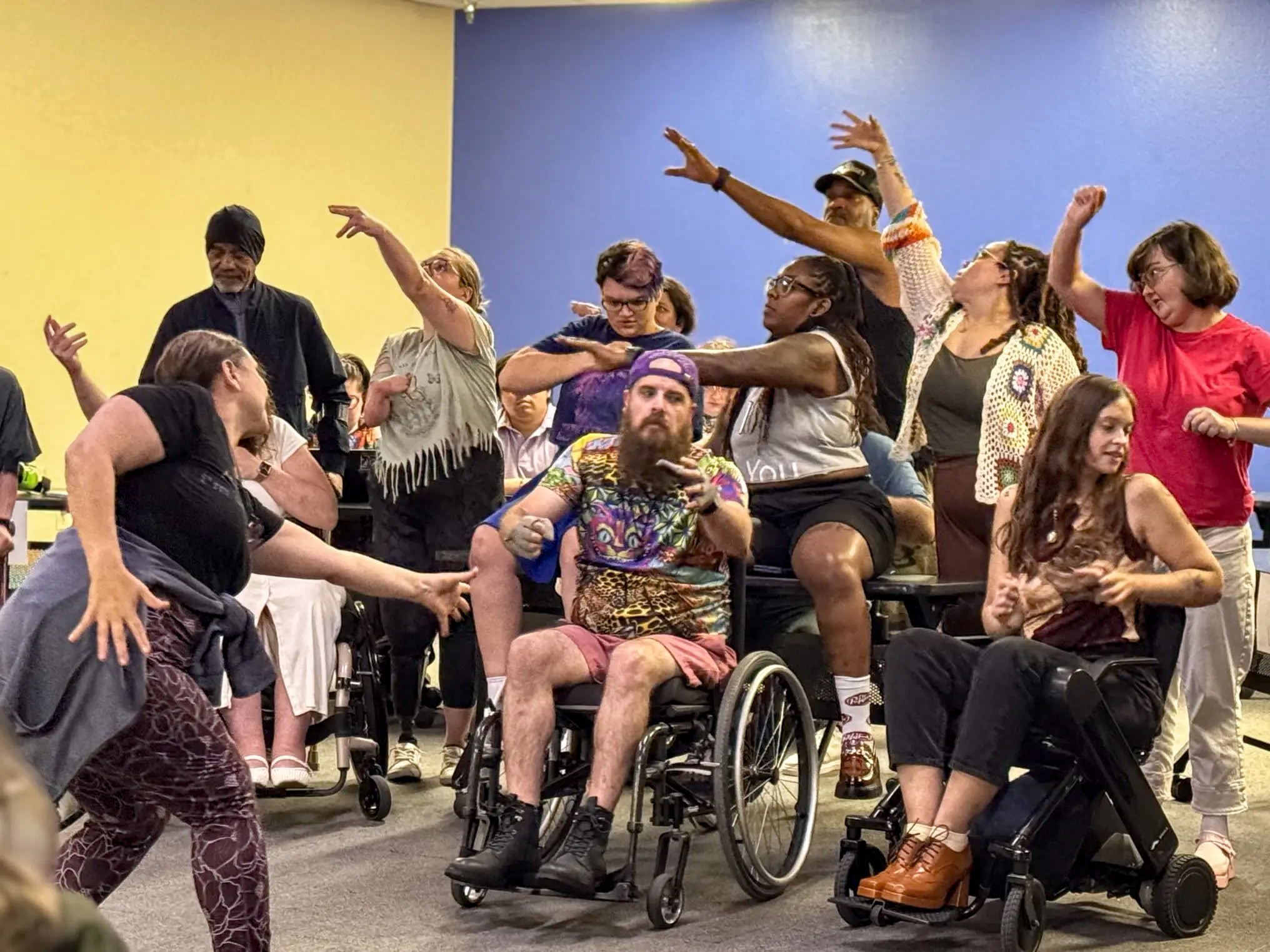
The cast of 504: The Musical during a rehearsal for the world premiere opening August 8 at the Kilstrom Theatre in the Denver Performing Arts Complex. Phamaly Theatre Company has cast Performers with Disabilities exclusively for more than 37 years. Photo by Dallas Padoven.
Nearly five decades ago, People with Disabilities occupied federal buildings across the United States. They refused to leave until officials wrote the rules that would put Section 504 of the Rehabilitation Act of 1973 into force. That civil rights protection established that programs paid for with federal money may not shut People with Disabilities out. The San Francisco occupation held for 25 days, backed by the Black Panther Party and the Butterfly Brigade. It drew together organizers with different disabilities, different politics and different ideas about protest, among them Kitty Cone, Brad Lomax, Corbett O'Toole, Hale Zukas and Judy Heumann. Those same guarantees are being taken back now, as three states press to undo the promise that People with Disabilities receive services where they live instead of inside institutions. Phamaly Theatre Company opens its world premiere of "504: The Musical" in Denver against that backdrop. The writer calls the reversal shocking and upsetting, and says that the victory which made the Americans with Disabilities Act (ADA) possible mattered enormously but that the fight was never over.
The show reached the stage because a company built for this work already existed. For more than 37 years Phamaly Theatre Company has made professional theater with casts drawn entirely from Performers with Disabilities. Rehearsals are shaped around the artists in the room, rather than asking those artists to bend themselves to an industry constructed without them. Book writer and lyricist Abbie Goldberg, who is neurodivergent and a Person with a Disability, met this history while organizing at an independent living center. Goldberg wrote the show with composer Mason McDowell because so few stories placed People with Disabilities at the center or offered substantial parts to Performers with Disabilities. Goldberg also remembers songs welcomed into New York cabarets where the performer had no route up onto the stage, a barrier the venue created and never removed. Denver has run differently. Leonard Barrett, who joined the company in 2004, calls it home, and the cast asked for every note rather than freezing the script early. This is what changes when Performers with Disabilities shape the work they perform.
The musical refuses the flattened celebration that often stands in for a disability story. Its director rejects a hip hip hooray treatment of disability outright. One song follows Heather, a character who is Black, Korean and a Person with a Disability. She is closeted, and she carries the fatigue of identities that each single her out. A second song works from access intimacy, an idea developed by Mia Mingus, who writes on disability justice. The writers hold the politics of 1977 next to what disability communities discuss today, including internalized ableism and differing views on strategy. Goldberg wanted the work complicated and nuanced rather than a surface level account of a fight against the government. Goldberg also wanted the show shaped by the community it represents, and that is what makes the portrait honest.
The occupation ended because People with Disabilities outlasted the officials waiting for them to give up. The company staging that history says it is describing the present rather than the past. That record leaves a plain instruction for anyone who plans gatherings, programs or services in their own community. Whether a Person with a Disability takes part in what we organize is never settled by that person's disability. It is settled by whether we planned for access first. A room reached only by stairs excludes a person using a wheelchair through our decision, not theirs. This article shows the failure exactly, because work was welcomed onto a stage the performer had no route to reach. Our own programs repeat it whenever we fix the venue, the format and the date first and treat access as a later adjustment. So plan the access before you set the date. Walk the path a participant would take, from the parking space to the seat to the microphone, and confirm a Person with a Disability can reach every place someone may be asked to speak, perform or serve. Ask on the invitation what each person requires, and hold every response in confidence. Have each requested service in place before anyone arrives. Invite People with Disabilities to shape the program while it can still change. That is how Vibrant, Diverse, Inclusive, Accessible Communities for People with Disabilities get built.
Learn about topics related to People with Disabilities, Accessibility, Anti-Ableism, Removing Barriers, and the Disability Community? Tap the Explore button to discover something new and intriguing with each tap!