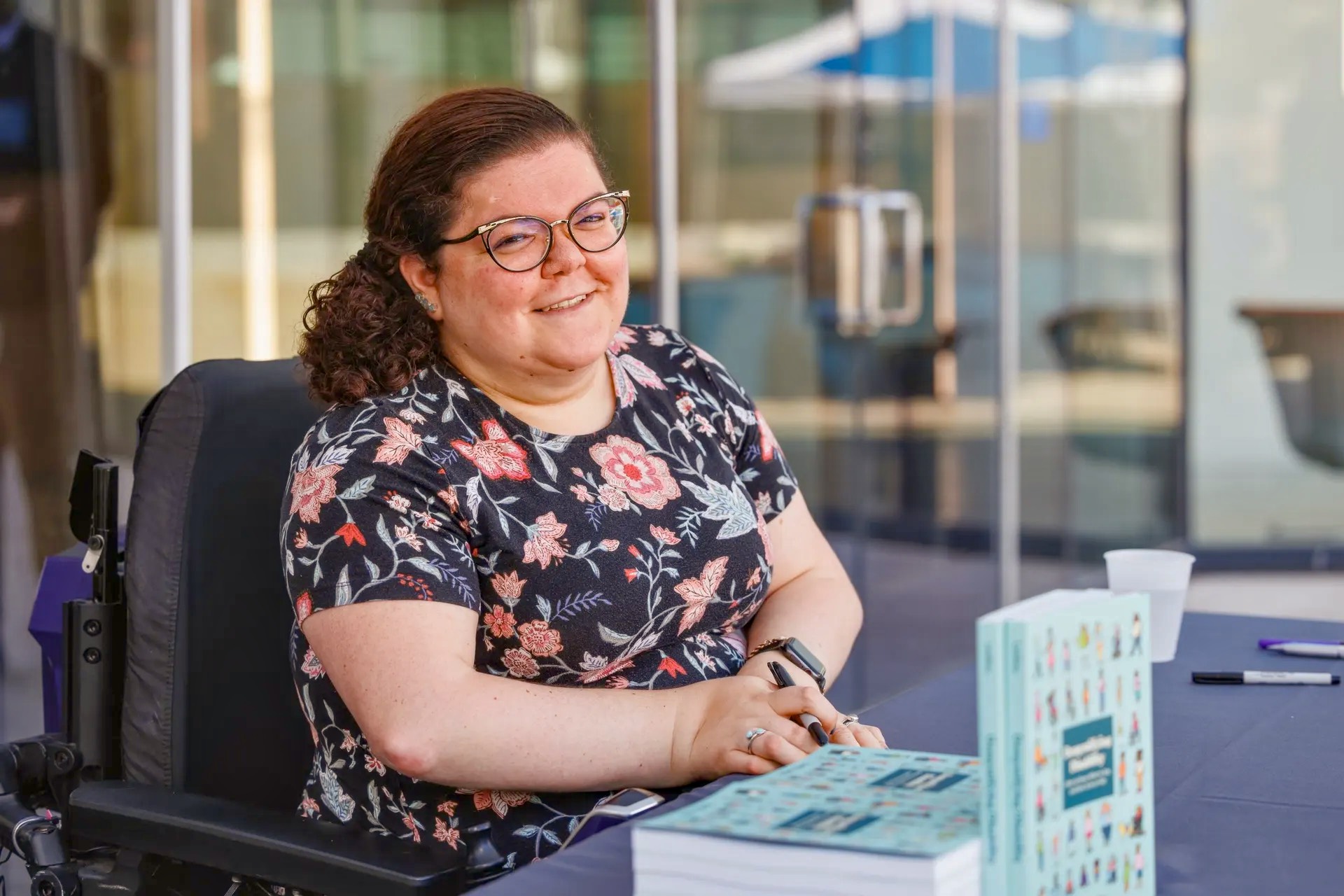
Emily Ladau signs Demystifying Disability, whose revised edition from Penguin Random House arrives in October as the stakes for People with Disabilities rise.
Emily Ladau's Demystifying Disability reached readers in 2021, and a revised edition from Penguin Random House arrives this October because understanding disability has grown more urgent. Ladau says our work to push back against ableism and press for inclusion looks the same as always, yet the stakes are alarmingly higher. The pandemic and today's social and political climate threaten People with Disabilities directly, and gains built over decades are at risk. The new edition keeps its original core, adds a fresh preface, expands its history and etiquette chapters, and updates all of its sources, figures, and examples. A new discussion guide gives book clubs, classrooms, and employee resource groups a way to talk through what they read together. Readers keep telling her the book reshaped how they understand disability, and she hopes it keeps opening those conversations.
One recent decision alarms Ladau more than the rest. The 2024 federal rules carrying out the Rehabilitation Act's Section 504 protect the right of People with Disabilities to live and receive services in their own homes and communities rather than in institutions. A federal decision in Texas has now taken community integration provisions out of those rules. Ladau puts the jargon plainly: the federal government is backing away from its responsibility to uphold that right. The laws themselves have not changed, but she calls this a frightening direction and tells us to stay on high alert. To her, every step forward seems to meet a push back, and she holds on to the many people who care and are still learning how to stand with the disability community.
The book also gathers data that shows ableism at work, and Ladau points to one figure that sums up the inequality. In 2023, People with Disabilities in America earned a median income under 70 percent of what People without Disabilities earned, according to the United States Department of Labor. That income gap grows out of hiring bias, workplaces People with Disabilities cannot use, and benefit rules that still penalize People with Disabilities for higher earnings. Each of those is a barrier placed in front of People with Disabilities, and barriers can be removed.
An ally who tries and stumbles does more than one who never moves. In her view, many workplaces have grown nervous about even saying inclusion and accessibility, yet People with Disabilities already work in them, disclosed or not. She says a mix of experience and thought drives new ideas, so a workplace that People with Disabilities can use is simply good business. Allyship, as she describes it, comes down to action, repeated and imperfect, and she would rather invite someone in to try than watch them turn away. We hold that barriers are removed by planning ahead and by consulting the People with Disabilities closest to them. Fear of the wrong word works against that, because the planning and the consulting only begin once we are willing to speak about access out loud.
From here on, we say inclusion and accessibility out loud in our own plans, even where the words make people nervous. We give each other room to stumble over the right words, and we invite the person back to try again. Each time we keep showing up without the perfect words, our community moves closer to the Vibrant, Diverse, Inclusive, Accessible Communities for People with Disabilities we are after.
Moving first, even clumsily, is how our plans start doing the work.
“I know I am not the only blind wheelchair user who has been unduly advised to slow down when I knew that I could keep myself perfectly safe with a longer cane.” -Ellana Crew, How to Be a Blind Wheelchair User
Explore More Compelling Insights:
Learn about topics related to People with Disabilities, Accessibility, Anti-Ableism, Removing Barriers, and the Disability Community? Tap the Explore button to discover something new and intriguing with each tap!