
Striving to remove barriers that prevent us from building Vibrant, Diverse, Inclusive, Accessible Communities!
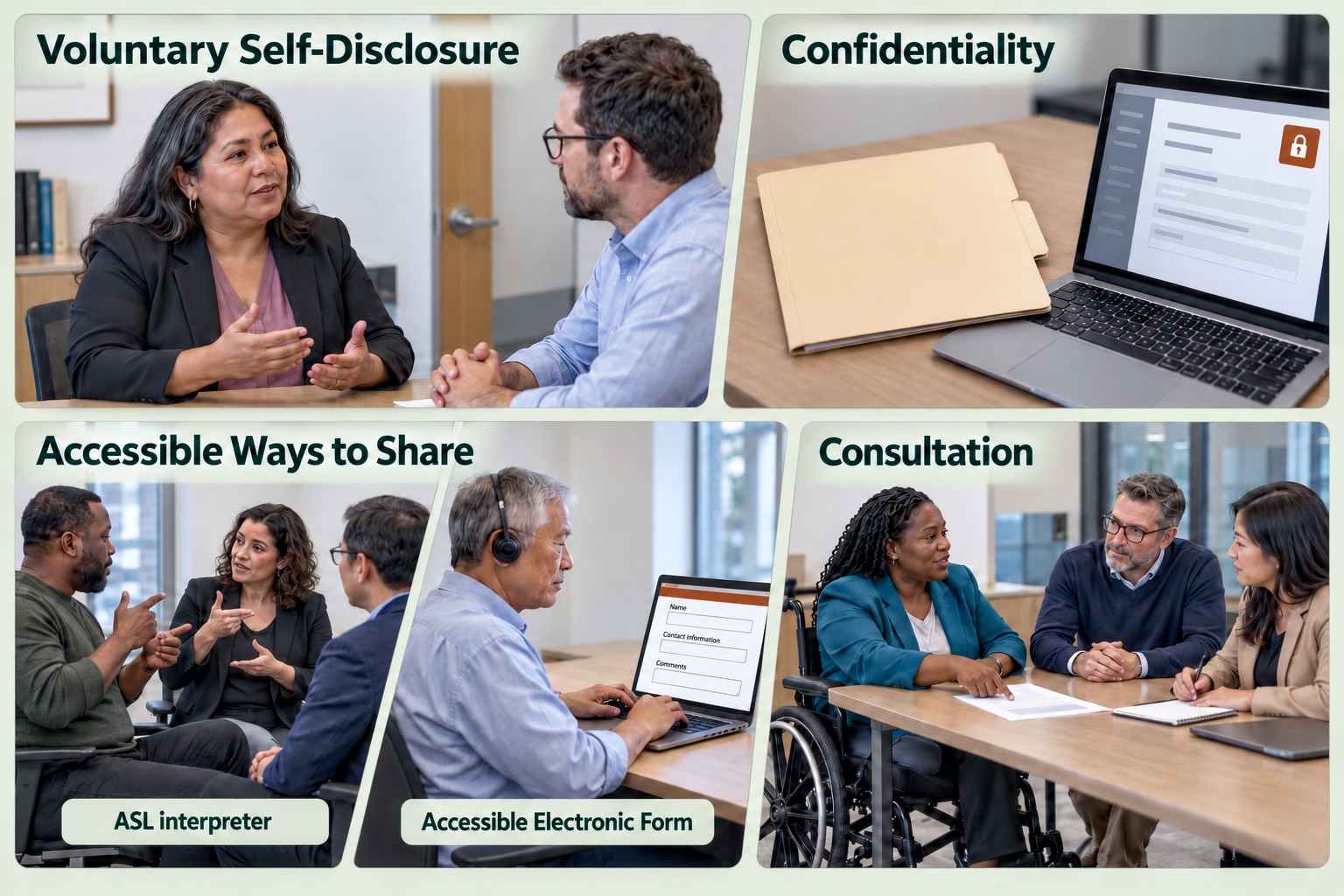
A community cannot remove barriers it does not know about. Learning who is in the community, and what access each member requests, is where that work begins. Done carelessly, the effort feels like surveillance. Done well, it tells members that their participation is wanted and that their knowledge shapes what the community does.
This article describes a respectful method for Community Builders. Members choose whether to share. What they share stays private. Every channel is accessible. People with Disabilities take part in designing and reviewing the whole approach. The method is for voluntary participation in a community.
Start with Barriers, Not Labels
The Social Model of Disability places barriers in environments, policies, communications, and attitudes, not in people. Under that model, the useful question is not “Who is disabled?” It is “What barriers do our members meet, and what access do they request?”
Answering that question is the work of removing barriers.
The scale makes that question worth asking. The U.S. Centers for Disease Control and Prevention reports that more than 1 in 4 U.S. adults have some type of disability. Most communities include People with Disabilities whether or not anyone has said so. Whether to say so is each member’s choice.
The United Nations Convention on the Rights of Persons with Disabilities treats information the same way. Article 31 says disability data should be gathered with protections for confidentiality and privacy, and used to identify and address the barriers People with Disabilities face in exercising their rights.
Why Participation Is a Matter of Justice
People with Disabilities are in every community. The Bahá’í International Community described how societies overlook them in a 1988 statement to the United Nations:
“Until recently, [People with Disabilities] have constituted a minority in obscurity. Unlike certain other groups that fall victim to discrimination, [People with Disabilities] do not comprise a self-contained, close-knit social community. Instead, they populate every social sector, every class, every age group, every ethnic and religious community. And at every level, society has tended to ignore them, believing them incapable of participating in the community, or avoiding them as unpleasant reminders of the fragility of our existence.” -The Bahá’í International Community, Human Rights and Disability (6 August 1988)
Participation is a matter of justice, and exclusion is a failure of the community, not of the member. A community that wants every member to take part has to learn which members are left out and why. That learning puts into practice Unity in Diversity, which treats differences among members as a source of beauty and harmony.
Make Disclosure Voluntary and Private
Invite, Never Require
Invite members to share if they wish, in an environment where they feel safe and are not judged. Disclosure is never required for access. Ask what would remove the barrier. Do not ask for medical details when the request itself is enough to act on.
Say Exactly Who Sees What
A blanket promise of confidentiality is easy to make and hard to keep. Tell members plainly who will see what they share, where it is stored, how long it is kept, and why. Share it only with the people who must act on it. A member who asks for large print materials can be known to the person who prepares materials without every committee knowing.
Offer Several Accessible Channels
Offer more than one way to share information and to request access. Each channel serves particular members and removes a particular barrier.
- A designated contact gives members a person to ask, so no one has to guess who is responsible.
- A face to face conversation serves members who prefer to explain in their own words. An American Sign Language (ASL) interpreter can be arranged on request for Deaf members.
- Email or text serves Deaf and hard of hearing members who do not use a phone.
- An accessible electronic form lets members respond on their own. Labels let screen reader users and speech input users find and activate each field. Clear instructions and grouped fields give People with Cognitive Disabilities a form they can follow. Guidance on accessible forms and the Forms tutorial from the World Wide Web Consortium (W3C) explain how to build one.
- Materials in other formats on request, such as large print for readers with low vision and braille for Blind braille readers.
Provide a clear process for requesting access, and say that requests are welcome. The guide to planning welcoming, accessible gatherings includes an optional checklist in the invitation and stresses keeping the answers confidential and making sure what is promised is available. Name who answers requests and how quickly. Then confirm with the member that the access is in place.
Ask About Barriers in Surveys and Feedback
Surveys can show where barriers are and how many members meet them. Two established question sets show how to ask about functioning instead of diagnoses. The American Community Survey of the U.S. Census Bureau asks about serious difficulty with hearing, seeing, remembering or concentrating, walking or climbing stairs, bathing or dressing, and doing errands alone. It counts a respondent who reports any of the six as having a disability.
The Washington Group Short Set on Functioning was built for national censuses and surveys. It aims to identify people who may face restrictions on participation, and it does not diagnose. It captures most, but not all, people with limitations in basic actions. A survey should also leave room for members to describe barriers in their own words.
Make every question optional. Explain why it is asked and who will see the answers. Make the survey itself accessible. Report results in summary so that no individual can be identified. Boston’s Disability Data Standard was developed in partnership with the city’s Disabilities Commission, the Disability Policy Consortium, and members of the disability community. It is described in Including People With Disabilities in Data Collection.
Also offer a way to give anonymous suggestions and to report barriers. A public accessibility statement tells readers how to report barriers and shows the community’s commitment, as the article What Message do you Intend to be Sending? explains.
Build Awareness and Connection
Awareness campaigns and training give members a shared understanding of disability and of ableism, and they show that sharing is welcome. Use the same sessions to assess how accessible and inclusive the community is now.
Members may also want a Community Resource Group or affinity group. This is a voluntary group where People with Disabilities connect and share experiences. Members choose whether to join, and they lead it themselves.
Consult People with Disabilities in Designing the Methods
Article 4, paragraph 3 of the United Nations Convention directs governments to “closely consult with and actively involve persons with disabilities” in decisions that concern them. The same principle applies to communities. The article Charity vs. Service describes consultation as co-authorship: people who face barriers act as partners in designing solutions and are not only recipients of them.
James I. Charlton explains that the slogan “Nothing About Us Without Us” expresses a claim People with Disabilities have made for themselves:
“For the first time in recorded human history politically active people with disabilities are beginning to proclaim that they know what is best for themselves and their community. This is a militant, revelational claim aptly capsulized in “Nothing About Us Without Us.”” -James I. Charlton, Nothing About Us Without Us: Disability Oppression and Empowerment
Gary Wunder, writing in the Braille Monitor about Blind People and public decisions, describes what this looks like in practice:
“When blind people speak collectively through the National Federation of the Blind, we are not being ungrateful for the help of sighted people. We are exercising the basic human right to define our own needs. Public officials, educators, employers, and service providers should welcome this. They should want policy shaped by those who live with its consequences. They should want programs tested against real experience. They should want blind people at the table: not as decoration, not as testimony after the decision has already been made, but as a dominant force in deciding what the decision should be.” -Gary Wunder, The Golden Rule, the Platinum Rule, and the Right to Speak for Ourselves, Braille Monitor, July 2026
Ask People with Disabilities to review the form, the survey, the privacy statement, and the feedback process before they launch. Give them authority over decisions, not only a chance to comment. Tell them what changed because of their review.
Leadership, Responsibility, and Review
Leaders set the tone. They can state plainly that diversity, including disability, is valued. They can assign named responsibility and time for these methods, and they can put the practices in writing so that they continue when one person moves on. The article on systemic ableism in administrative practices describes underrepresentation in leadership and decision making as a barrier in itself.
Review the methods at set intervals, together with People with Disabilities. Ask whether members use the channels, whether the answers lead to removed barriers, and whether the privacy practices still hold. Publish what changed.
Questions for Reflection
Take these questions to a community reflection gathering. Answer them from evidence and experience, not from good intentions.
- How do members of our community currently tell us about a disability or an access request, who designed each of those channels, and can every member use at least one of them on their own?
- When someone shares information about a disability or an access request, who sees it, where is it kept, and for how long, and could we explain each answer to the person who shared it?
- Can a member receive access without disclosing a diagnosis, and does anyone in our community ask for medical details when the request itself is enough to act on?
- What have we removed, changed, or started doing in the past year because members told us about a barrier, and what has happened to the requests we have not yet acted on?
- Which People with Disabilities took part in designing and reviewing the ways we learn about members’ access requirements, which decisions did they make, and which decisions were made without them?
- When did we last review how we learn about members’ access requirements, what did the review change, and who took part in it?
