
Striving to remove barriers that prevent us from building Vibrant, Diverse, Inclusive, Accessible Communities!
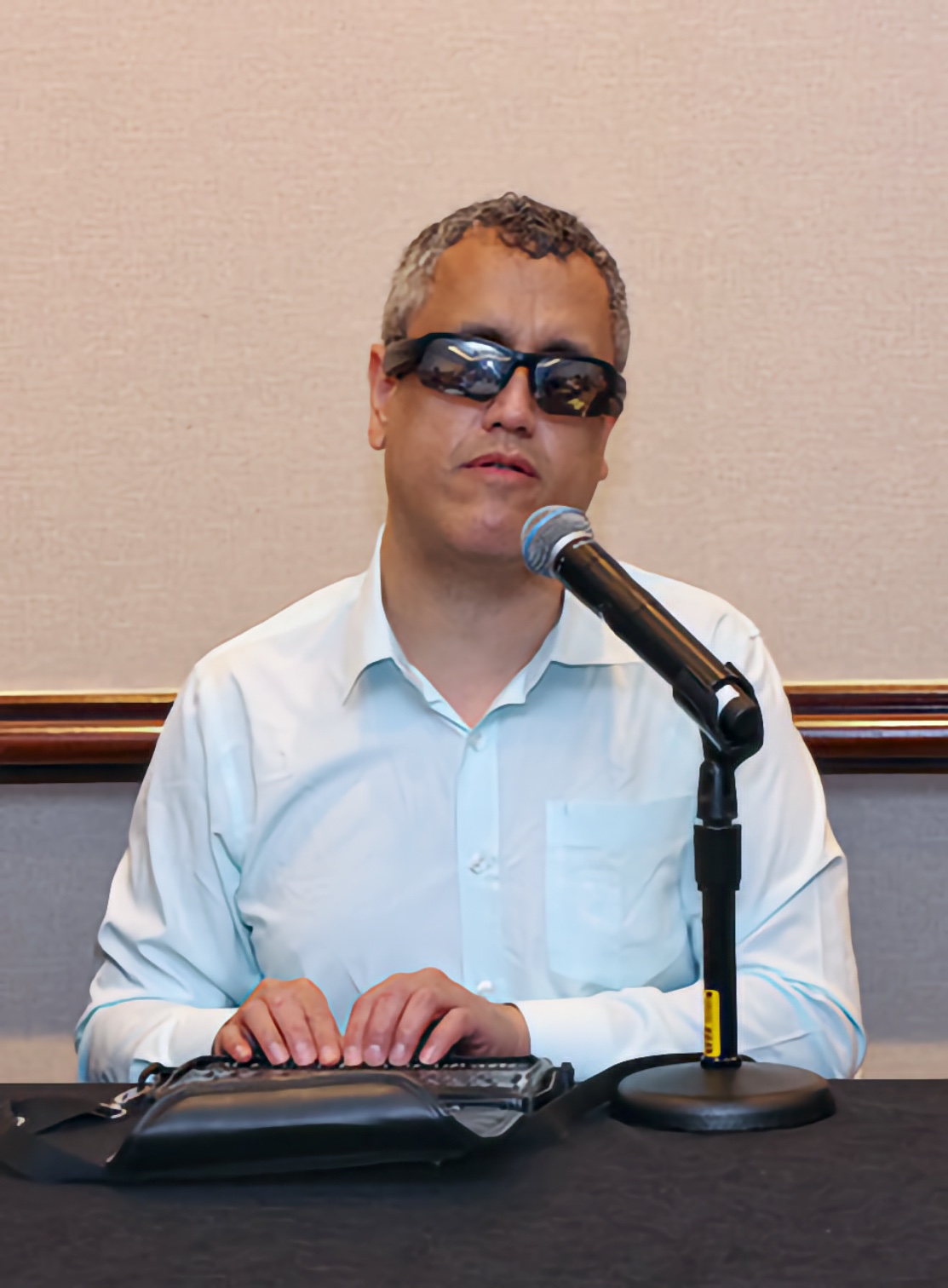
Cary Supalo, a Blind chemist, honorary professor of chemistry at the University of Sydney and founder of Independence Science, traces his love of astronomy to fourth grade. In remarks he gave on a panel about sharing astronomy with Blind and Low Vision audiences at the 2025 national meeting of the American Astronomical Society in Anchorage, Alaska, adapted in the Braille Monitor for National Astronomy Month, he recalls his first planetarium show at a community college in Joliet, Illinois. He could not see much of what was projected on the dome, so he relied on the narration to imagine the stars.
That show led to a tactile model of the planets for his fourth grade science project, built from black burlap, construction paper, cardboard and Styrofoam half spheres, with orange and yellow tissue paper for the sun. A visit to the Adler Planetarium in Chicago the next year, and a fifth grade paper that drew on data from the original Voyager mission, deepened his fascination, and his hometown newspaper quoted him saying he wanted to be an astronomer. From sixth grade on, though, his science classes held very little about space, and he went on to study chemistry.
As an adult he took part with other Blind participants in a simulated Space Shuttle mission at the US Space and Rocket Center in Huntsville, Alabama, where Braille labeled controls and Braille and tactile documents brought the scenarios to life. Today's planetarium shows, he writes, lean on dazzling visuals and set aside the rich narration that once brought the cosmos to life for him, and sound alone can leave a listener one step removed from what is shown. He points to tools that are ready now: properly scaled two and three dimensional tactile models of constellations, raised line drawings, tactile graphics, and refreshable tactile displays that can carry real time data from the National Aeronautics and Space Administration (NASA) and other space agencies to the fingertips of Blind learners.
The stars call to Blind children as they call to sighted children. Supalo writes that many in science, technology, engineering and mathematics still question whether Blind People can understand scientific ideas. He asks Blind scientists to show their colleagues what Blind People can do and to raise their own expectations of how they interpret and communicate science, and he insists that the contributions of Blind scientists and engineers should never be diminished or pushed to the margins as humanity returns to the moon and heads for Mars. When planetarium shows bring back rich spoken description, classrooms offer accessible materials and science programs remove the barriers Blind learners face, Blind children can keep reaching for the stars.
We should ask the planetariums and science centers in our area to offer rich spoken description and tactile models. We should expect Blind students to study astronomy and science alongside their classmates. Science programs open to Blind learners from the start would move us toward Vibrant, Diverse, Inclusive, Accessible Communities for People with Disabilities.
The pull of the stars does not depend on sight.
Read the Full Article: My Walk with Astronomy as a Blind Scientist.
By: Cary Supalo
Questions for Reflection
- Do the planetariums and science centers near us describe their shows aloud and offer tactile models?
- When did astronomy or another science first spark our curiosity, and would a Blind child have had the same chance?
- How do we respond when someone questions whether Blind People can understand science?
- Which tactile tools could our schools and libraries offer Blind students who love the stars?
- How could our community make space science programs open to Blind learners from the start?
