
Striving to remove barriers that prevent us from building Vibrant, Diverse, Inclusive, Accessible Communities!
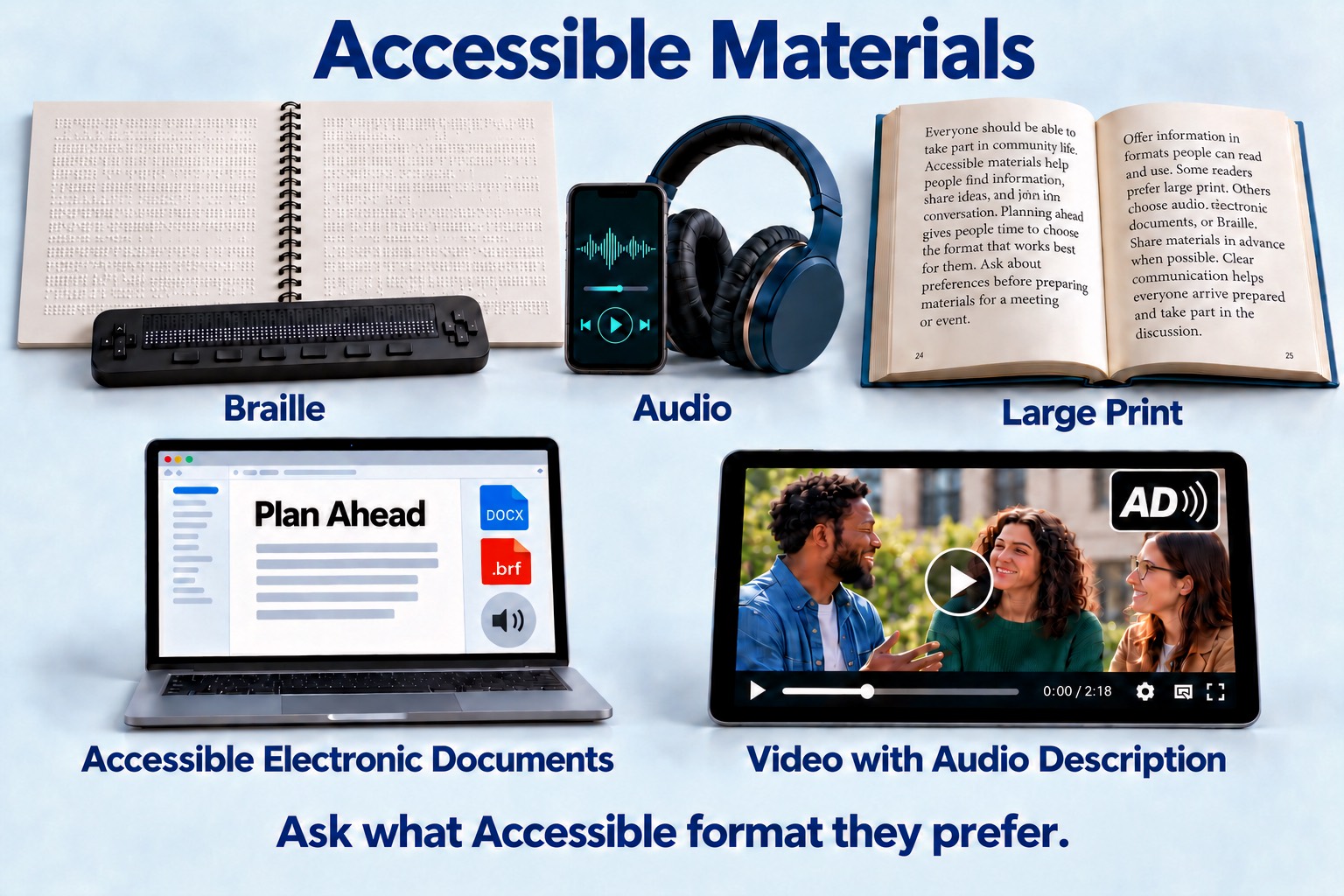
Agendas, handouts, study texts, prayer books: almost every gathering puts printed words into people’s hands. When those words reach Blind participants in the format each person reads, everyone can read, study, and contribute together.
Providing materials in accessible formats is within reach of any host, committee, or study group. This guide shows how: ask first, choose the formats, find a qualified producer, and deliver the materials in time.
Braille Is Literacy
For a Bahá’í Feast celebrated by several Colorado communities, friends were invited to share a video of themselves reading. Yolanda chose the Prayer for the Western States and read it from Braille.
Notice what made this moment possible. An audio recording would have let Yolanda listen to the Prayer. Braille let her read it and share it with everyone. Braille is how Blind People read and write, and with it Yolanda took her place as a reader among her friends.
“Blind people ourselves must continue to boldly assert our worth. We must believe that it is our right, as it is the right of every citizen, to be given the opportunity to learn how to write something down, and read back what we’ve written. Braille is the only equivalent to print that a blind person has. And until society at large agrees to give up reading, blind people must not be fobbed off with the erroneous idea that machines doing the reading for us is good enough.” -Jonathan Mosen MNZM, Safeguarding the Legacy, Investing the Inheritance
Research points the same way, with limits. Surveys of Blind adults in the United States have found higher employment among people who read Braille regularly. A review of that research from Mississippi State University describes the evidence as limited, because the studies show a relationship and do not show a cause.
Start with a Private Conversation
The person who will use the materials knows best what works. So the first step is a conversation, and how you have it matters as much as having it.
- Ask privately. Asking in front of a group singles a person out. A quiet, respectful conversation lets arrangements be made with dignity.
- Ask early. Reach out as soon as you know a Blind participant will attend, so there is time to prepare every piece of material.
- Honor their choice. The format belongs to the person who will use it, never to the person arranging it. Two Blind People may choose different formats for the same document.
- Ask again next time. Preferences can change with the event or the type of material, and some people use more than one format.
The principle is also written into an international treaty. Article 21 of the United Nations Convention on the Rights of Persons with Disabilities calls on governments to accept and facilitate Braille and all other accessible formats of communication that People with Disabilities choose, in official interactions. The guide to planning a welcoming, accessible gathering shows how to ask about access requests and keep the answers confidential.
Good Questions to Ask
- Which format works best for you for these materials?
- For Braille: would you like paper, a BRF file, or both? Contracted or uncontracted Braille?
- For large print: what type size works for you?
- For electronic copies: which file type works best with your screen reader or Braille display?
- How and when would you like to receive them?
If this is new for you, remember that Blind People have arranged accessible formats all their lives. Work it out together.
Know the Formats
Each format removes a barrier for a particular group of readers. Ask each person which one to use.
- Electronic: often the quickest option, and it lets Blind readers use their own screen reader or Braille display. If you already have the material as an accessible Word document or an accessible Portable Document Format (PDF) file, send a copy. A scanned page is a picture of text, which a screen reader cannot read unless it is converted, so build files with real text, headings, and image descriptions. The article on print and PDF design failures explains why. Check ahead of time that the file works with the reader’s screen reader or Braille display, so there are no surprises at the meeting.
- Braille: embossed on paper, or delivered as a BRF (Braille Ready File) that can be emailed and read on a refreshable Braille display.
- Large Print: enlarged type on full size pages, in the type size the reader prefers. It serves readers who have Low Vision and read print at a larger size.
- Audio: a recorded reading of the material. Some readers choose audio, some choose Braille, and some choose both.
- Video: if your program includes video, choose videos with Audio Description, which narrates visual information for Blind and Low Vision viewers, and turn on Audio Description and captions when you play them. Captions give Deaf and hard of hearing viewers access to the spoken words. If no described version exists, describe the visual content yourself in real time. Learn more: Learn about and Use Audio Description in Video for Blind and Low Vision Accessibility.
Which Braille Code?
- Uncontracted Braille spells out every letter of every word, so documents run much longer.
- Contracted Braille uses contractions, where a single cell or a short combination of cells stands for a whole word or a common group of letters. The American Foundation for the Blind counts 180 of them and describes contracted Braille as the standard system for most textbooks and publications.
Since 2016, the main Braille code for reading material in the United States has been Unified English Braille (UEB). Ask your transcriber to produce UEB unless the reader names another code.
Four Steps to Accessible Materials
- Plan ahead. Transcription takes time, and a rushed order delays the reader. The Bahá’í Service for the Blind, for example, asks for two weeks to duplicate and bind an order, and longer for large orders.
- Choose a qualified transcriber. Use a professional who follows current Braille and accessibility standards, and ask what Braille certification the transcriber holds. The directories below are a good place to start.
- Send the material and agree on the details. Email or mail a copy. Confirm the format, Braille code, binding, price, and turnaround time. Each choice affects cost, and a handout used once calls for different choices than a reference book kept for years.
- Arrange delivery. A BRF or other electronic file can be emailed. Braille, large print, and audio recordings can travel by mail without postage. Under United States Postal Service (USPS) Publication 347, individuals, libraries, and noncommercial organizations may mail Braille, large print of 14 point or larger, and sound recordings to eligible readers free of postage, and eligible readers may return them the same way. Eligible readers include people who are Blind or cannot read standard print because of a physical disability. Write FREE MATTER FOR THE BLIND OR PRINT DISABLED in the upper right corner of the address side. Confirm with your transcriber and the reader that the shipment qualifies.
A missing format keeps a Blind participant out of the reading, the study, and the consultation. Removing that barrier begins with these four steps, taken every time.
Where to Find Qualified Transcribers
These maintained directories list producers of Braille, large print, and audio for jobs of any size:
- Directory of Producers of Reading Materials, National Library Service for the Blind and Print Disabled (NLS), Library of Congress, listed by state.
- Accessible Media Producers Database (AMP), American Printing House for the Blind (APH), a free directory of producers of Braille, tactile graphics, large print, electronic files, and audio.
The National Federation of the Blind points to both directories. Neither directory endorses its listings, and APH states that it does not vet them, so compare a few producers and ask each for its certification and sample work before you choose.
Bahá’í Writings and Books: Bahá’í Service for the Blind
Many Bahá’í titles already exist in accessible formats, ready to order or borrow. The Bahá’í Service for the Blind, a committee of the National Spiritual Assembly of the Bahá’ís of the United States, offers:
- Braille titles in UEB, with BRF files uploaded at no charge on request
- Audio books and talks as MP3 Digital Talking Books, available as uploads at no cost on request
- Large print materials in at least 18 point type, with free PDF downloads for titles that offer them
- A lending library with no charge for borrowing
- The American Bahá’í, audio edition
- How to order; orders ship as Free Matter for the Blind, with no postage fee
Make Materials Part of the Plan
Accessible materials are not a favor, and they are not something to arrange only after a Blind participant asks. Access that depends on a host’s convenience is charity rather than service. Access that is built into the plan from the first invitation, and carried out with the people who use it, is service. The materials are one part of that plan, alongside the invitation, the venue, and the program.
“The legacy bequeathed to us by Louis Braille is that his code not only makes writing and reading accessible, his code is the key to equality of opportunity. It hasn’t made all those preconceptions about blindness evaporate, but when we can write something down and read it back, when we know how to spell, when we can discern the way a document is laid out, when we can create priceless memories that will last a lifetime by reading bedtime stories to our children or grandchildren, we have equipped ourselves with a skill that significantly narrows the chasm of opportunity.” -Jonathan Mosen MNZM, Safeguarding the Legacy, Investing the Inheritance
Learn more about Braille and its history: Safeguarding the legacy, investing the inheritance: A tribute to the transformative impact of Louis Braille’s invention on the lives of Blind People
Questions for Reflection
Bring these questions to a community reflection gathering. Answer them with evidence from your own materials, and with the Blind People who read them.
- Think of the last agenda, handout, or study text your community printed. Who received it in Braille, large print, audio, or an accessible electronic file, who chose that format, and how do you know the choice was theirs?
- When and how does your community ask each Blind participant, privately and early, which formats work best for each kind of material? Where are the answers kept, who can see them, and when do you ask again?
- How much time passes between the day a document is final and the day a Blind participant receives it in the chosen format? Whose schedule sets that time, and what does the delay take from that participant’s part in the study or consultation?
- Which costs of producing accessible formats does your community budget for, and which fall on the Blind participants themselves? Where is that written down, and who decided?
- When your group studies or consults together, can every participant follow the same passage at the same moment? How would you find out, and whom would you ask?
- Who is responsible for finding transcribers, checking their work, and learning whether an accessible edition of a title already exists? Which Blind People have reviewed that work, and what did they change?
