
Striving to remove barriers that prevent us from building Vibrant, Diverse, Inclusive, Accessible Communities!
What Advocacy Is
Advocacy is speaking up and taking action so that something changes. Disability Rights Wisconsin defines it as “speaking up and acting on behalf of yourself or others in order to make a desired change or outcome.” The Center for Excellence in Disabilities at West Virginia University puts it simply: “Advocacy involves promoting the interests or cause of someone or a group of people.”
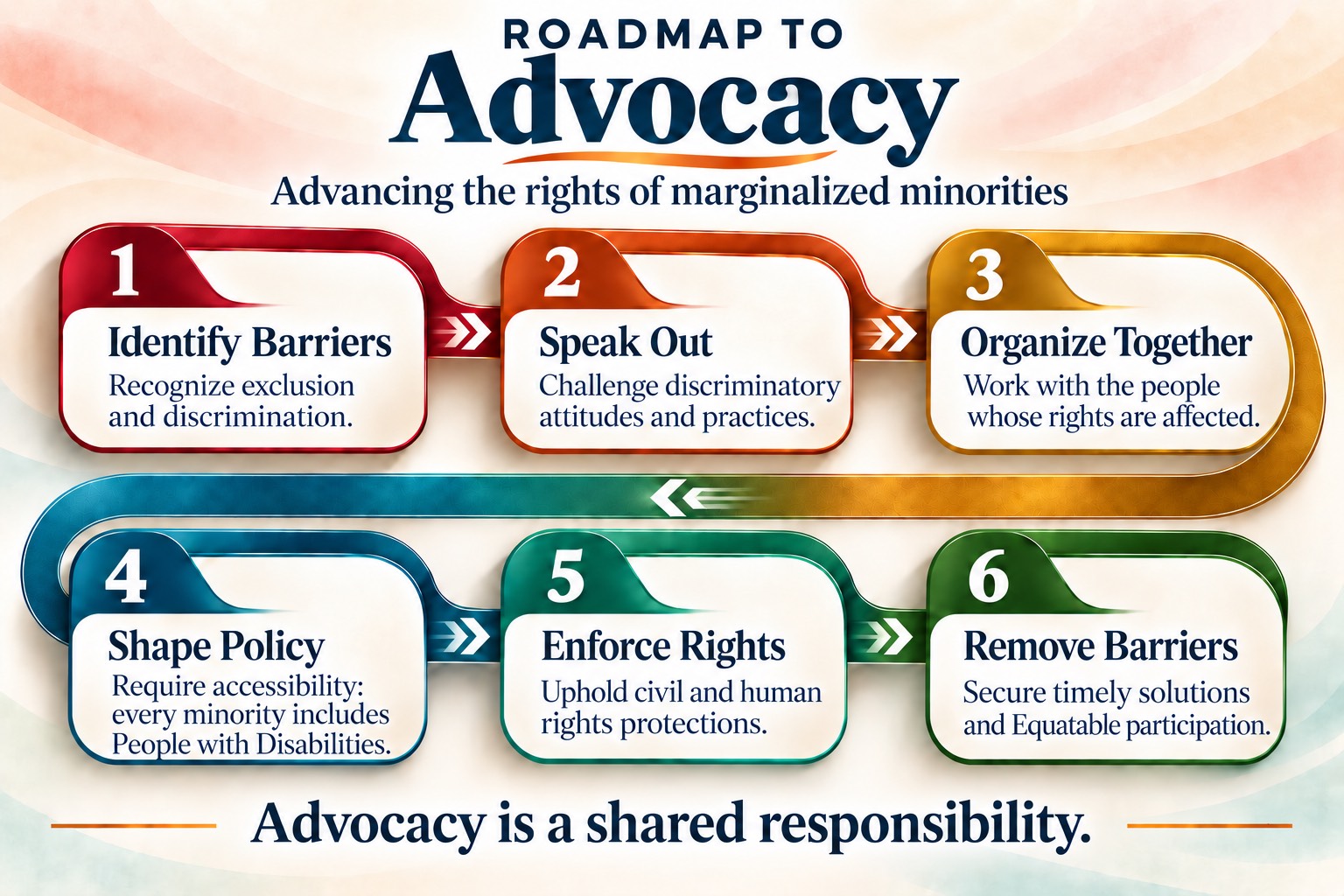
For Community Builders, advocacy means noticing who is left out of our activities, learning why from the people affected, and acting with them until the barrier is removed. Answering that question is the work of removing barriers. It is service, not a favor we grant, as Charity vs. Service explains. It is part of building a community where People with Disabilities belong as full participants and contributors.
Three Ways to Advocate
The West Virginia University center describes three forms of advocacy. Each of us can practice at least one of them.
- Self-advocacy is “an individual’s ability to effectively communicate, convey, negotiate or assert his or her own interests, desires, needs, and rights.”
- Individual advocacy focuses on one or two people. It can be informal, through family and friends, or formal, through staff of an advocacy organization.
- Systems advocacy “is about changing policies, laws or rules that impact how someone lives their life.”
The three forms build on each other. A person who learns to ask for an accessible menu gains the skills to change a policy later. Systems advocacy then removes the same barrier for the next person, so no one has to ask again.
Nothing About Us Without Us
The disability rights movement sums up its central principle in the slogan “Nothing About Us Without Us.” In his book of that title, James I. Charlton explains that it expresses the conviction of People with Disabilities that they know what is best for themselves and their community. Disability rights leader Ed Roberts, who led efforts at Berkeley to remove inaccessible curbs, stated the lesson plainly:
“If we have learned one thing from the civil rights movement in the U.S., it’s that when others speak for you, you lose.” -Ed Roberts, quoted in James I. Charlton, Nothing About Us Without Us (1998)
For allies, this sets the order of the work. Ask People with Disabilities where the barriers are. Follow their lead on solutions. Use your position to bring their voices into decisions, not to speak in their place. The Charity vs. Service article describes this as listening first and working out solutions together with the people affected.
Advocacy in Action
Haben Girma and the Cafeteria Menu
Haben Girma, the first Deafblind graduate of Harvard Law School, tells a story from her college years. The cafeteria menu was not accessible to her, and the staff who agreed to email it to her kept forgetting. She raised it with the college, then wrote to the cafeteria manager:
“I explained that, since I paid to eat at the cafeteria like all the other students, I needed access to the menu so I could fully use the services I was paying for. The manager responded, saying that the cafeteria was very busy, that they were doing me a big favor, and that I should stop complaining and be more appreciative. I don’t know about you, but if Station Four has chocolate cake and no one tells me, I’m definitely not feeling appreciative!” -Haben Girma, The Courage to Fight for Chocolate Cake
She then cited Title III of the Americans with Disabilities Act (ADA) and told the manager she would sue if the cafeteria refused. The next day the manager apologized and promised her menus for each meal.
Two lessons stand out. The barrier was the inaccessible menu, not her blindness. Locating the barrier in the environment rather than in the person is the central idea of the Social Model of Disability. And goodwill alone was inconsistent, while a right she could name produced a lasting change. Haben draws the larger lesson for every advocate:
“Advocating for seemingly trivial things like the right to eat chocolate cake develops an inner courage, and that courage will serve you in the quest for greater rights. Remember that advocating for others starts with learning to advocate for yourself.” -Haben Girma, The Courage to Fight for Chocolate Cake
Hear Haben tell the story in her own words in the video below.
The Section 504 Sit-Ins
Systems advocacy can change a nation. In 1977, disability rights activists held sit-ins at federal buildings across the United States to demand enforcement of Section 504 of the Rehabilitation Act. The sit-in in San Francisco lasted 26 days, and the government signed the Section 504 regulations on April 28, 1977. The University of Washington’s ADA resource page tells more of this history.
Why Goodwill Is Not Enough
About 1.3 billion people, or 1 in 6 people worldwide, experience significant disability, according to the World Health Organization. Even so, most community activities are still arranged around the preferences of the majority. When planners leave People with Disabilities out of their thinking, barriers appear in websites, videos, events, and documents, and they stay there.
Goodwill matters, but it depends on who is in charge and how busy they are. Haben’s cafeteria manager was busy. Rights, written policies, accessibility standards such as the Web Content Accessibility Guidelines (WCAG), and clearly assigned responsibility keep access in place after the person who cared moves on. Advocacy is how those protections are won and how they are kept. A public accessibility statement is one practical place to start, as What Message do you Intend to be Sending? explains.
Why It Matters: Guidance from the Bahá’í Writings
Shoghi Effendi described protecting minorities as a first duty of every Bahá’í community:
“Every organized community enlisted under the banner of Bahá’u’lláh should feel it to be its first and inescapable obligation to nurture, encourage, and safeguard every minority belonging to any faith, race, class, or nation within it.” -Shoghi Effendi, The Advent of Divine Justice
People with Disabilities are part of every community. Applying this guidance means a community does not wait for them to ask. It looks for barriers, listens, and acts.
Bahá’u’lláh calls each person to stand with those who are oppressed:
“Be as a lamp unto them that walk in darkness, a joy to the sorrowful, a sea for the thirsty, a haven for the distressed, an upholder and defender of the victim of oppression.” -Bahá’u’lláh, Gleanings from the Writings of Bahá’u’lláh, CXXX
Be an Upholder and Defender of the Victims of Oppression introduces advocates who have lived this call, including Haben Girma, Judy Heumann, and Ed Roberts.
The Universal House of Justice wrote the following passage about racism in a 2020 letter to the Bahá’ís of the United States. The passage addresses racism, not disability. Its description of how prejudice is removed also guides how we respond to systemic ableism, the exclusion of People with Disabilities built into attitudes, policies, and practices:
“Racism is a profound deviation from the standard of true morality. It deprives a portion of humanity of the opportunity to cultivate and express the full range of their capability and to live a meaningful and flourishing life, while blighting the progress of the rest of humankind. It cannot be rooted out by contest and conflict. It must be supplanted by the establishment of just relationships among individuals, communities, and institutions of society that will uplift all and will not designate anyone as “other”.” -The Universal House of Justice, 22 July 2020 – To the Bahá’ís of the United States
In this article’s reading, the passage shapes how we advocate. The aim is not to defeat anyone. The aim is just relationships, with People with Disabilities, community members, and institutions working together so that no one is treated as “other.” Advocacy that names barriers clearly and without hostility invites others into that work.
How to Become a Strong Advocate
No title or office is required to advocate. Disability Rights Wisconsin’s two steps, identify and define the problem, then act, give a good starting framework. The steps below build on them.
- Listen first. Ask People with Disabilities what barriers they meet in your activities, and take what they tell you seriously.
- Identify and define. State the barrier, who it affects, the change you are asking for, and who has the authority to make it.
- Learn the rights and standards. Learn the laws that apply where you live, such as the ADA in the United States, and international standards such as WCAG. See where to get training in the International Accessibility Standards.
- Speak up promptly and respectfully. Describe the barrier, its effect, and the change requested. Disability Rights Wisconsin recommends respect, self-awareness, and clear communication.
- Tell the story. A concrete example, like a missing menu, shows the effect of a barrier better than a general complaint.
- Work with others. Connect with People with Disabilities, disability organizations, and others who share the goal, and share what you learn. Raise Awareness about Accessibility offers videos to start the conversation.
- Follow through. Confirm that the barrier was removed, ask the people affected whether the solution works, and press for a written policy so the change lasts.
Every role offers a way to begin:
- Friends and neighbors can ask before they plan, and stand beside someone who raises a barrier.
- Hosts and organizers can plan access from the start, using tips for welcoming, accessible gatherings.
- People who create content can follow WCAG and add captions and Audio Description to videos. Captions give Deaf and hard of hearing viewers access to spoken content. Audio Description gives Blind and low vision viewers access to important visual information.
- Members of institutions can adopt written accessibility policies, publish an accessible way to report barriers, and assign responsibility for timely responses.
- People with Disabilities lead this work as self-advocates and as advocates for others, and communities gain when that leadership shapes their planning.
Silence and Delay Keep Barriers in Place
When a barrier is known and no one speaks up, silence lets it stay. When a fix is promised and postponed, People with Disabilities remain excluded in the meantime. The legal saying “justice delayed is justice denied” applies here. Captions or an accessible document that arrive next year still leave people out this year. Prompt action, and a clear place to report problems, keep a small barrier from becoming lasting exclusion.
Questions for Reflection
- When a Person with a Disability in our community reports a barrier, what happens next: who receives the report, how quickly do we respond, and how do we confirm with that person that the barrier was removed?
- Looking at our gatherings, communications, and materials over the past year, which decisions included People with Disabilities in the planning, and which were made without them?
- Are we arranging things to fit the preferences of the majority while generally ignoring the problems and barriers this creates for minority groups?
- Where have we known about a barrier and stayed silent, and what kept us from speaking up or acting promptly?
- In our own roles, as friends, hosts, committee members, or members of an institution, what can each of us already do to remove a barrier, and what do we still have to learn about the rights and standards that apply to our activities?
- Which of our access practices depend on the goodwill of one person, and what written policies, procedures, and assigned responsibilities would keep access in place when that person moves on?
- When someone advocates for access, do we respond with thanks for the information and a plan to act, or with reminders of how busy we are, and how would the person raising it describe our response?
