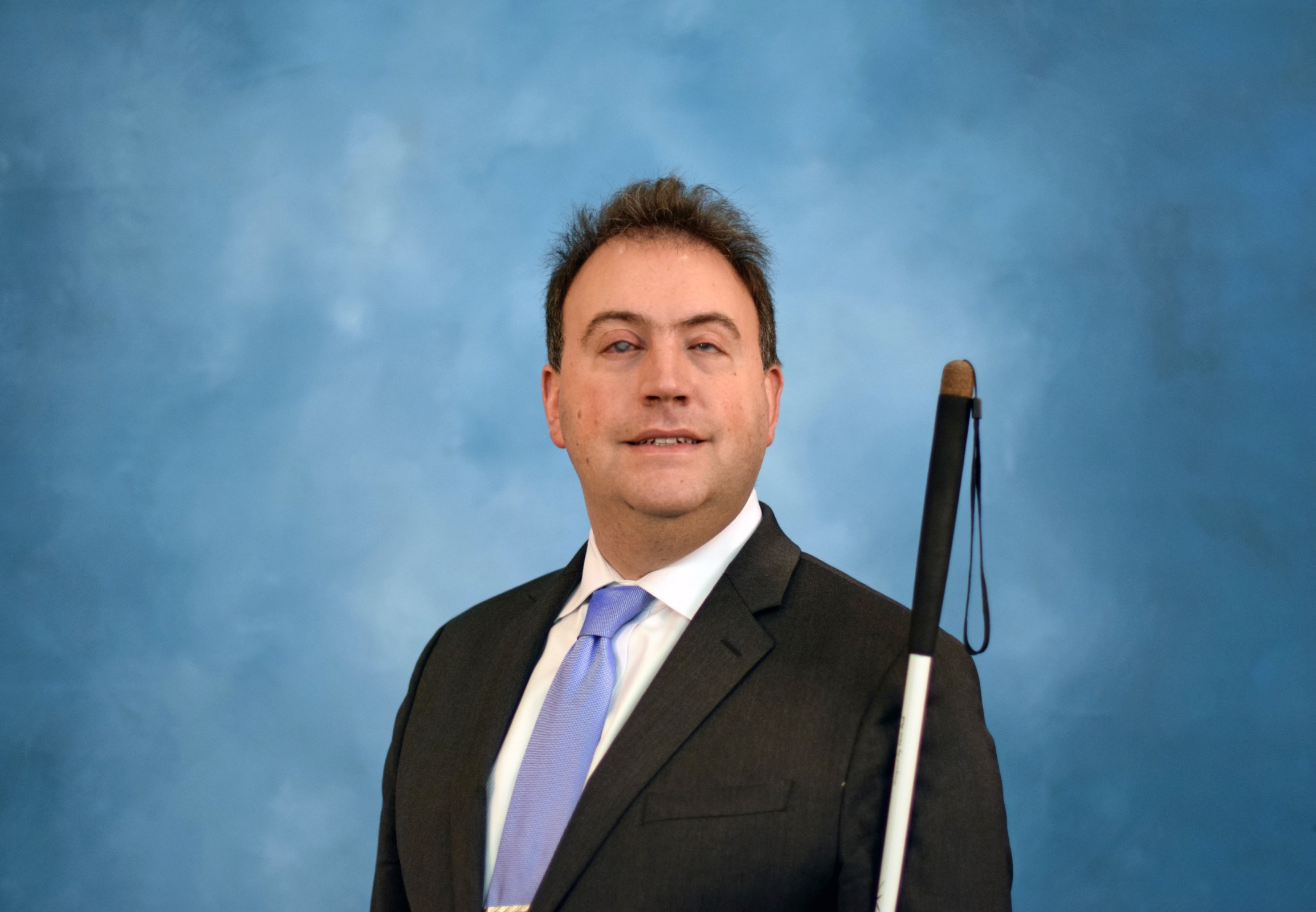
Mark A. Riccobono, President of the National Federation of the Blind, delivered the 2026 banquet address in Austin, Texas, calling for more Blind voices to carry the movement's theme forward.
Speaking at the 2026 banquet of the National Federation of the Blind (NFB) in Austin, Texas, President Mark A. Riccobono named a distortion that has shaped how society sees Blind People for centuries: the belief that blindness is one tragic quality explaining an entire person. Riccobono built his address around music, comparing that distortion to flattening a rich composition into a single dull note. Every Blind Person, he argued, carries a full identity assembled from ability, ambition, and lived experience, and blindness is one thread within that identity rather than the whole of it. He described how the industry organized around blindness treats Blind People as broken and sets out to fix them, and how that message reaches newly Blind adults and families raising Blind children long before accurate information does. Riccobono spoke from his own first twenty years, when the constant claim that sight was required for success kept him from pursuing the skills and tools he had every right to expect.
The counterforce, Riccobono explained, is what happens when Blind People find one another. He compared it to resonance in acoustics, where one vibrating object awakens a capacity already present in another. A Blind college student doubting a career path meets a Blind professional a decade into that same field. Parents raising a Blind child meet Blind adults living full lives. The capacity was always there, and contact with other Blind People activates it. Dr. Newel Perry spent forty three years teaching Blind students in California, and his student Dr. Jacobus tenBroek organized the NFB in November 1940, when Blind People were kept apart from one another, denied any say in their own futures, and told repeatedly what they would never do. Riccobono was emphatic that this movement has never asked its members to think alike or live alike. They differ by race, faith, gender, age, sexual orientation, national origin, and countless other characteristics that intersect, and that variety is the source of its strength rather than a problem to manage. Unity, he said, has never required sameness.
Riccobono then turned the same word, creative, on discrimination itself. Blind People solve problems constantly, building networks of drivers where transportation is inaccessible, devising workarounds for handwritten materials and inaccessible collaboration software at work, developing nonvisual methods for teaching music, fishing, trail running, and building with construction toys, and inventing a combined car seat and stroller so Blind parents can travel with their children independently. Discrimination, he showed, is just as inventive. A Blind professional heading toward the staff entrance she uses every week is redirected by strangers certain she has gone astray. A Blind couple's offer on a home was turned down because a representative decided Blind buyers could not grasp their own paperwork, and that same woman later sat in a dental office while staff debated whether she could authorize her own treatment. A Blind mother is stopped at the playground gate by people who cannot picture why she would be there. Riccobono himself was seized by a shuttle driver who then lectured him on owing gratitude for unwanted handling. At a restaurant during a national convention, Blind diners received lidded foam cups while sighted diners received glasses. Every one of these rests on the assumption that blindness cancels competence.
Riccobono closed with the image of a fugue, a form in which one voice introduces a theme and later voices take it up, each developing it differently while the original idea remains unmistakable. For more than eighty five years the movement's theme, that blindness is respectable and that Blind People speak for themselves, has been handed down through teachers, families, and successive leaders, and he called for more voices because equality has not yet arrived. Community Builders should sit with what this address documents: in nearly every incident, a Blind Person had to interrupt, correct, or educate someone after the exclusion had already happened. Barriers persist in our own communities largely because accessibility is treated as a reaction rather than a plan, and because the people who understand the barriers best are consulted last or never. That is reversible this week. Before the next event, class, meeting, or mailing is finalized, ask the Blind People in your community what would remove the barriers, then write those answers into the design rather than waiting for someone to be turned away first. Planning ahead and consulting the people most affected is how we remove the barriers that keep Blind People out of community life, and it is how Vibrant, Diverse, Inclusive, Accessible Communities are actually built.
Learn about topics related to People with Disabilities, Accessibility, Anti-Ableism, Removing Barriers, and the Disability Community? Tap the Explore button to discover something new and intriguing with each tap!