A Black man in sunglasses sits in a wheelchair on grass, shown on a computer monitor beside a tag labeled ALT Text.

ALT text gives Blind People and People with Low Vision the meaning of an image that sighted readers take in at a glance. This guide applies WCAG Success Criterion 1.1.1, which calls for a text alternative that serves the equivalent purpose, to everyday publishing: why a name alone is not enough, which information belongs in the ALT text and which in the caption, how to describe people and their visible diversity with respect, and how to tailor a description to the place an image appears. Worked examples cover photographs, book covers, logos, and mastheads, and reflection questions invite Community Builders to examine their own practice.

Share or Print with:

Share

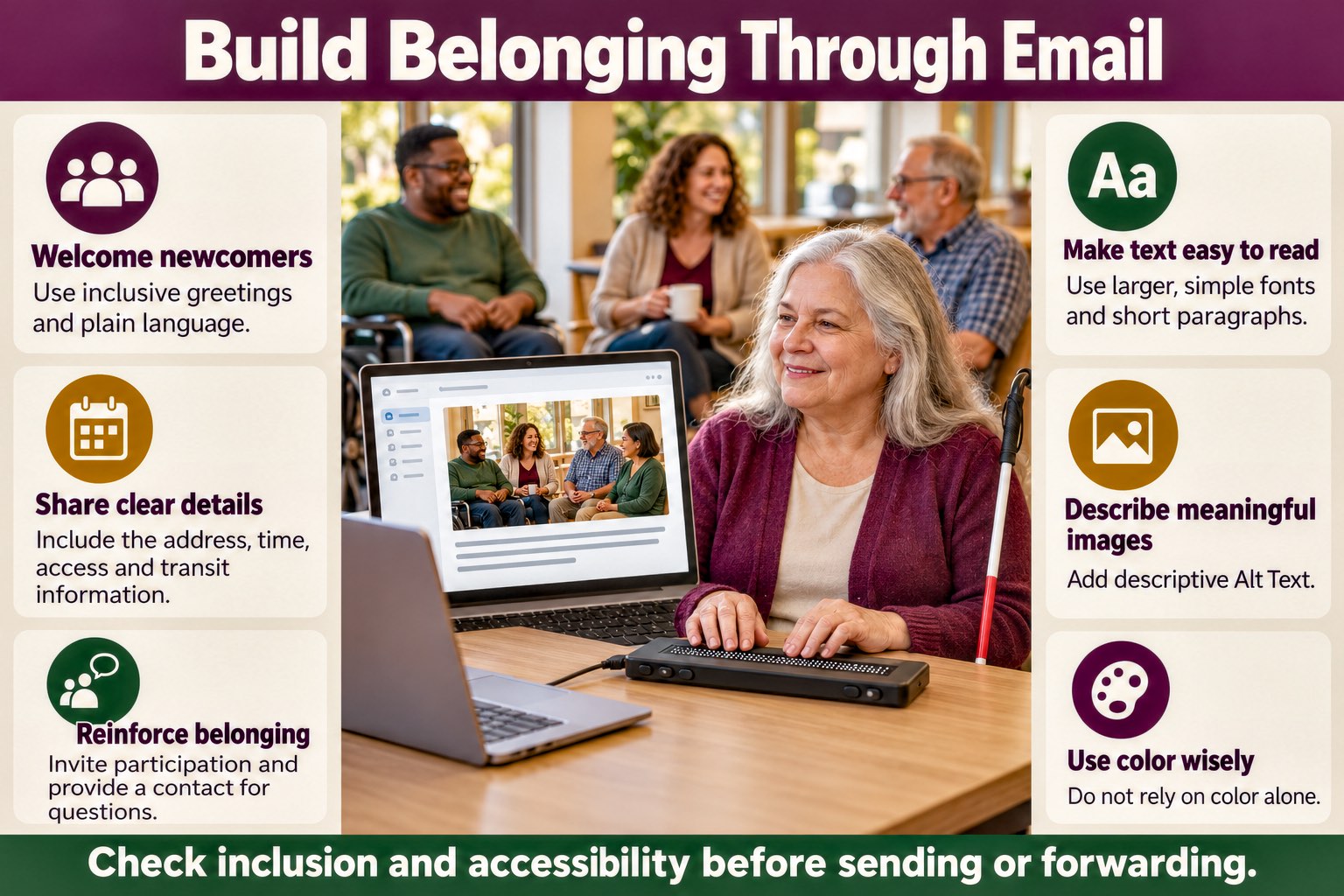
An older woman uses a Braille display beside a laptop showing a community gathering photo. A white cane rests beside her, and three people, including a wheelchair user, sit behind her. Six illustrated panels cover welcoming newcomers, sharing clear details, reinforcing belonging, readable text, image descriptions, and color use. A bottom banner reads, “Check inclusion and accessibility before sending or forwarding.”

Every community email either builds belonging or creates otherness. This article invites senders to write messages that welcome readers and that Blind and DeafBlind People can read: inclusive greetings, plain language, access features stated up front, explicit location and public transit details, a description for every image, readable fonts, size, and color, and links and subject lines that explain themselves, all grounded in the international accessibility standards, the Web Content Accessibility Guidelines (WCAG) 2.2, and in Section508.gov guidance. It also invites everyone who writes for a community to own what they create, and it closes with seven questions for reflection.

Share or Print with:

Share
Catarina Rivera, a woman with long, curly dark hair, wearing a beige trench coat over a patterned black and beige top, smiles at the camera. The blurred background includes a photo booth, festive lights, and modern buildings.
Catarina Rivera, an influential disability advocate, confidently stands in an urban setting. Known for her impactful work, Rivera uses her platform to promote disability pride and advocate for inclusive practices.

July is Disability Pride Month, marking a significant milestone in recognizing the disabled community and celebrating the signing of the Americans with Disabilities Act (ADA) in 1990. Despite over 30 years since its passage, there is still work to be done in how we support and discuss People with Disabilities. Advocate Catarina Rivera emphasizes the importance of embracing "disability pride" rather than just "awareness." This powerful perspective challenges limited thinking and promotes a sense of worth and value within the disabled community. 

Share or Print with:

Share

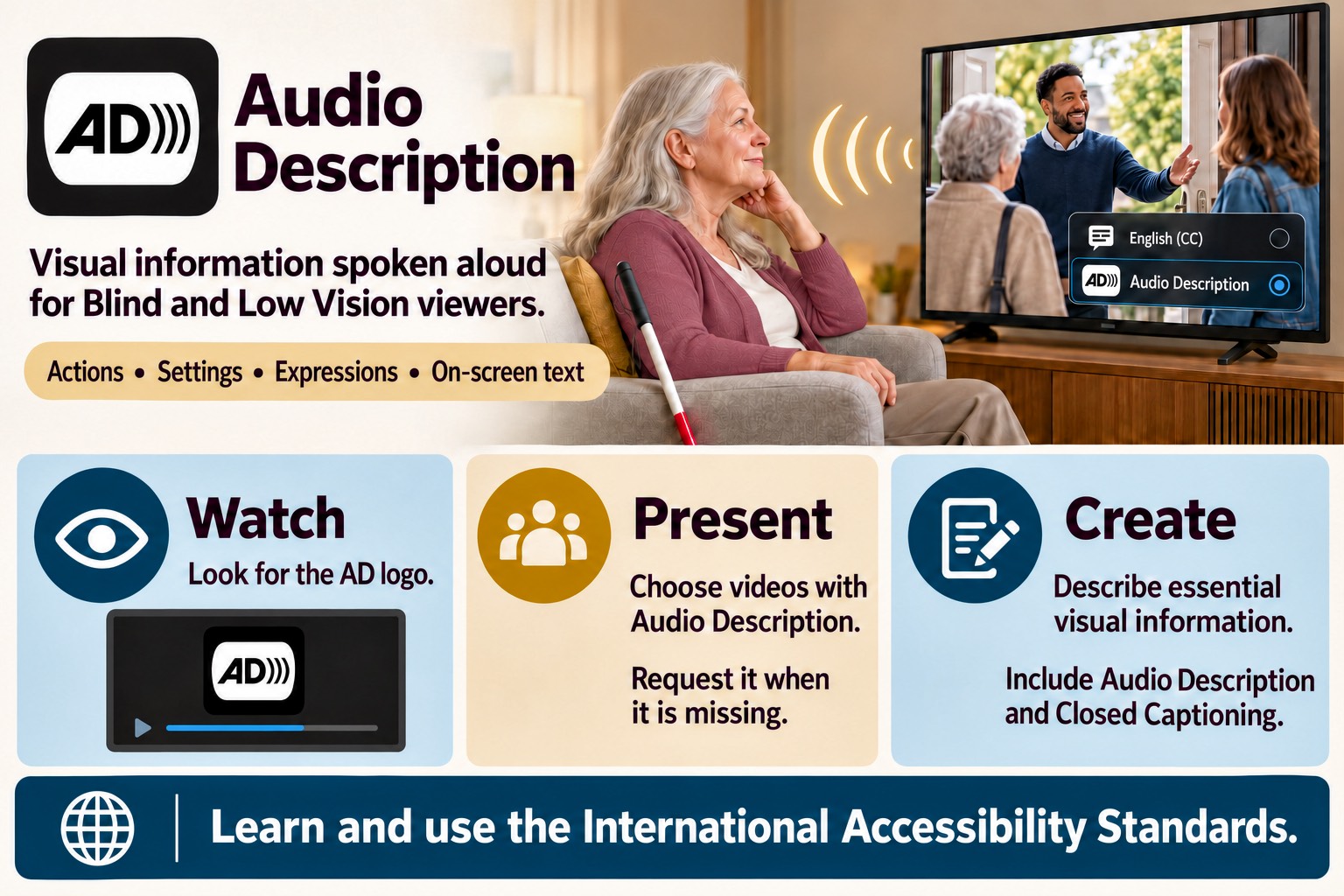
Blind woman watching TV with Audio Description selected, beside the AD logo. Three panels explain how to find, request, and create videos with Audio Description and Closed Captioning.

Audio Description gives Blind and Low Vision viewers the visual information in a video, as captions give Deaf and Hard of Hearing viewers the spoken content. This article explains what Audio Description is, where to find described films and series, how to check and ask for it when you show video, and how to plan it when you make your own, with questions for Community Builders to examine their own practice.

Share or Print with:

Share

Nasa Added Amazing Alt Text Image Descriptions to James Webb Space Telescope Photos

There was a ton of excitement when the James Webb Space Telescope (JWST) was launched into space last month. What made the excitement exponentially larger was when NASA made the first few photos received from JWST public. The pictures were gorgeous and stunning, and the world was captivated by the sheer beauty of our universe as shown by these photos.

These stunning photos, which are a feast for our eyes, were accompanied by something that made sure blind people enjoyed these photos as much as sighted people did – alt text! Now, the alt text attached to these images were not just 1-2 sentences giving a vague description of the images. These were descriptive, poetic, and scientifically accurate. It is clear that the team that wrote them (STCI – Space Telescope Science Institute) put a lot of thought and care into them. 

Take a look at the first few photos from JWST below and their image descriptions. You can also access these descriptions on the JWST website under “Image Description” on the left menu (pdf). The images also have alt text that will be read out loud by your screen reader.

Share or Print with:

Share
Teal banner with five diverse disabled people beside the words - October Disability Awareness.
October invites school communities to center disability inclusion and focus on removing barriers.

October is presented as a time for school leaders to celebrate disability diversity and recommit to inclusive school culture. The piece highlights both visible and non-apparent disabilities and encourages a month-long focus on belonging, with an emphasis that accessibility is critical to community life.

A central thread is National Disability Employment Awareness Month, which the author connects to daily leadership practice. Concrete actions include inclusive hiring, ensuring accessible classrooms with adaptive technology, expanding career readiness and work-based learning for students with disabilities, and educating the whole community through workshops and discussions—all framed through a lens of removing barriers rather than “fixing” people.

Share or Print with:

Share

Community Access Barrier

A community cannot be united while barriers keep some of its members from participating. Drawing on Bahá’í teachings and ‘Abdu’l-Bahá’s example, this article connects the work of confronting racism, gender inequality, and other forms of exclusion with building lasting peace. It calls for practical action—including accessible gatherings, services, and information—so People with Disabilities and other marginalized members can contribute fully, shape community life, and experience belonging grounded in justice and respect.

Share or Print with:

Share

The Shining Lamp is committed to providing an accessible digital experience for People with Disabilities. Guided by principles of justice, equity, and unity in diversity inspired by the Bahá'í Faith, we are committed to removing barriers caused by Ableism so that Blind/Low Vision users, people who rely on assistive technology, and others with disabilities can participate in our community. Accessibility is not optional or charitable—it is essential to human dignity, belonging, and inclusion.

Standards Used

We follow the Web Content Accessibility Guidelines (WCAG) 2.2, Level AA (W3C Recommendation, first published 5 October 2023, updated 12 December 2024). Whenever content or features are added or modified, we review them against WCAG 2.2 AA and apply current best practices in accessible and Inclusive Design.

WCAG 2.2 remains the current and most recent W3C-recommended standard. It is also an approved international standard, ISO/IEC 40500:2025.

Our policies and procedures are developed in active collaboration with People with Disabilities, who participate in their content and creation. We make our accessibility policies public in the interest of transparency and accountability.

Testing and Compatibility

Our testing approach combines automated checks, manual reviews, and lived-experience feedback. We regularly involve Blind People who are experienced screen reader users to review our content and identify accessibility problems or areas for improvement.

Share or Print with:

Share

by Tolu AdegbiteTolu Adegbite

Why it’s important in 3 examples

Designers and developers have huge power in shaping societal norms (when was the last time you met a couple in their 20s who didn’t meet on a dating app?). We also have a huge impact in creating a story and crafting a sort of reality for people that consume the content we put out into the world. Alt text forms part of that storytelling of a designed reality.

 ...

If you are white, you may not think about or talk about race often.

If you are a person of color, and especially if you are Black (like myself), you probably think and talk about race all the time.

Our assumptions about race impact our world view so much that it can be easy to overlook unless we are confronted by it .I have to think about race often because it affects me often, and I have to grapple with the fact that the way I am perceived, my career success, my safety, and many of the interactions I have with other people, are impacted by my race.

Share or Print with:

Share

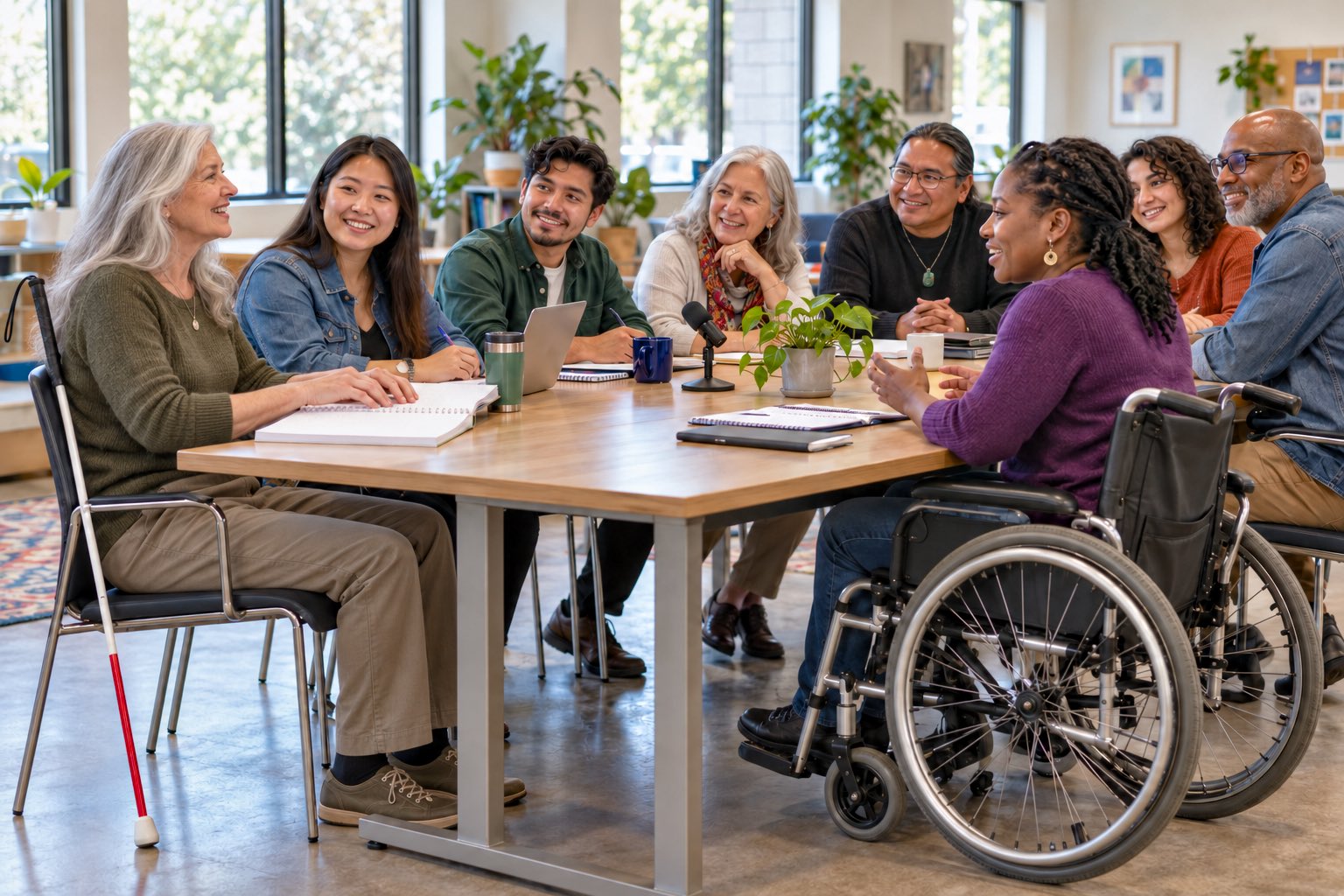
Adults of different races and ages share a lively discussion around a table in a sunlit room. An older blind white woman reads Braille, while a Black woman using a wheelchair gestures as others smile and listen.

Learn how to plan welcoming, inclusive, accessible gatherings by addressing accessibility at every stage, from invitations and registration to venues, presentations, and activities. This guide outlines practical steps for removing barriers, providing accessible materials and communication, keeping participants’ requests confidential, and confirming that requested arrangements are in place. Planning ahead and following through creates a culture of respect, belonging, and equatable participation for People with Disabilities.

Share or Print with:

Share

Explore More Compelling Insights:

Learn about topics related to People with Disabilities, Accessibility, Anti-Ableism, Removing Barriers, and the Disability Community? Tap the Explore button to discover something new and intriguing with each tap!