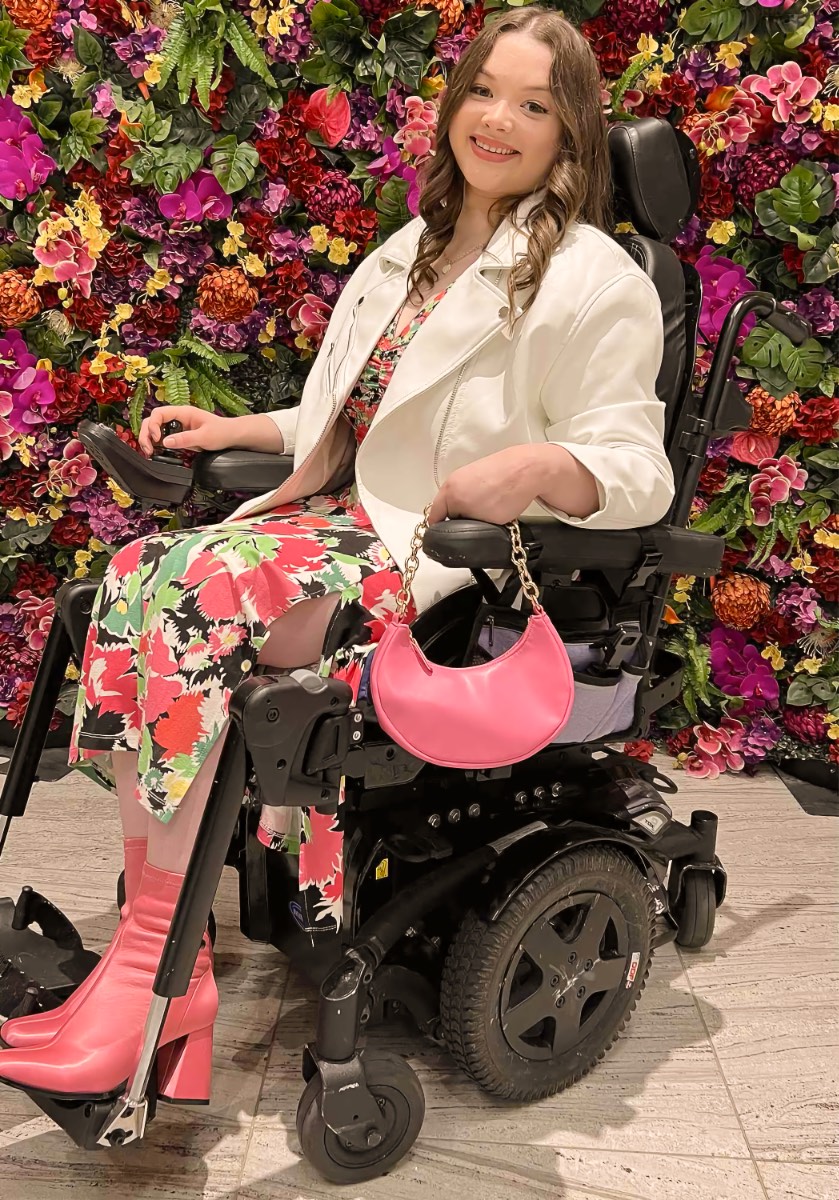
Amy Pohl, 33, is a disability rights advocate who documents daily life as a person who uses a wheelchair full time for nearly four million followers on TikTok and Instagram. She says the barriers she meets outside her home, and not her body, are what disable her. Photo courtesy of Amy Pohl.
Amy Pohl is not disabled inside her own home. She wakes, moves through her day, and the word does not apply. It applies the moment she goes out the door. Nothing about her differs between those two settings. What changes is the environment she enters, and she is blunt about the cause: not her body, the outside world. Stepped entrances stop her more than anything else, and she names them as her most persistent barrier. A stepped entrance is not a fact about a person. It is a fact about a building. Somebody decided it, and somebody can undecide it. What changes is the environment, never the person moving through it.
Pohl says communities get some things right and many things wrong, and she names the wrong precisely: People with Disabilities are left until last when a building or a piece of new infrastructure is planned. That is a sequencing decision, made by people with the authority to make it differently, repeated project after project. Her comparison closes the argument. The Coliseum has been opened to People who use wheelchairs, so a development going up from nothing has no excuse left to offer. Access is available at the first drawing and cheapest there. Treating its absence as an oversight is how the same choice gets made again without anyone examining it, and access has never arrived by waiting for goodwill to deliver it.
The third barrier is public assumption, and Pohl answers it daily in front of an audience. People take it for granted that a person comes with one disability, and that the visible one accounts for everything. She corrects that directly: a person can have more than one, and the obvious one is not always the one that matters. Beneath it sits a larger assumption, that a disabled life is a diminished life. She answers by showing hers. She has sailed, ziplined, ridden horses and quad bikes, and skied on snow and water. Her point is not that any of this is remarkable, but that the routes exist and turn ordinary once somebody builds them. She calls herself a normal person and says her life was good before she became disabled and is good now. Nobody should be defined by the disability people can see.
Pohl says having a community matters, and she built hers on a screen. Nearly four million people follow her across TikTok and Instagram, where she posts her ordinary day and shows the realities of using a wheelchair full time. Four million strangers learned what stops her by watching her live an ordinary day. The surroundings she actually lives in never asked. That is what Community Builders should sit with, because access is not a service purchased or handed to somebody else. Each of us owns it, and it is settled in decisions made together with People with Disabilities rather than reported to them afterward. Notice where she puts the barrier. Not at an occasion, not at a gathering, but everywhere outside her house, on any day, in the form of steps. So stop treating access as a question that surfaces when something is scheduled. Ask the People with Disabilities already in your community what stopped them this week, in the ordinary places your community meets, and repair the way in as seriously as the room. Removing barriers across the ordinary life of a community, rather than one occasion at a time, is what builds Vibrant, Diverse, Inclusive, Accessible Communities for People with Disabilities.
“We talk a lot about resilience in the disabled community, and yes, disabled people can be incredibly resilient. But we should also ask why we are required to be so resilient just to get the opportunity to work, support ourselves and use the skills we fought so hard to build.” -Zarin Hamid, My disability wasn’t the problem. The assumptions about it were.
Explore More Compelling Insights:
Learn about topics related to People with Disabilities, Accessibility, Anti-Ableism, Removing Barriers, and the Disability Community? Tap the Explore button to discover something new and intriguing with each tap!