Striving to remove barriers that prevent us from building Vibrant, Diverse, Inclusive, Accessible Communities!
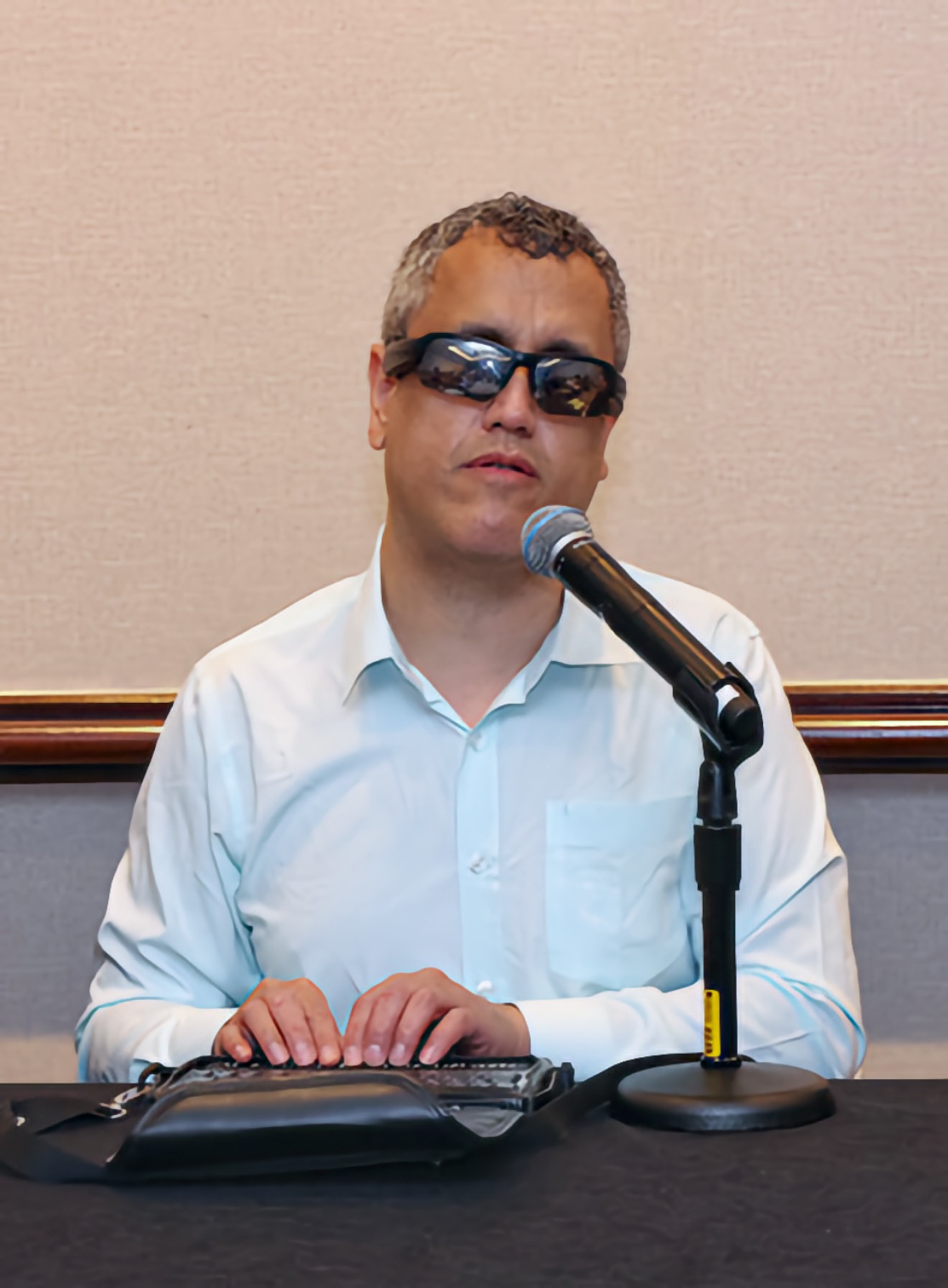
Cary Supalo's lifelong fascination with astronomy began in fourth grade, when his first planetarium show at a community college in Joliet, Illinois, introduced him to the cosmos through spoken description that he used to picture the stars in his mind. For that year's science project he built a tactile model of the planets by attaching Styrofoam half spheres, cardboard, and construction paper to a black burlap backing, with yellow and orange tissue paper serving as the sun, and he estimated the distances from the sun outward to each planet. The following year a visit to the Adler Planetarium in Chicago expanded his understanding of other moons, major constellations such as Orion and the two Dippers, and questions about whether water or ice could exist elsewhere in the solar system, followed by a fifth grade paper on the Milky Way drawn from original Voyager mission data. His hometown newspaper even featured him declaring his goal of becoming an astronomer. But beginning in sixth grade, astronomy was essentially absent from his curriculum, replaced by general, life, and physical science, and then by biology, chemistry, and physics in high school, severing him from the astronomical path he loved. When Blind children have access to accessible materials for Blind people in educational settings, they can enter and stay engaged with astronomy as Supalo once did.
As an adult, Supalo attended a half day program in Huntsville, Alabama at the United States Space and Rocket Center, where he and other Blind participants engaged in a simulated Space Shuttle mission. The shuttle simulator featured Braille labeled controls, and Braille and tactile documents supported the scenarios being investigated, bringing them to life in a way visual displays alone could not. For Supalo, the experience sustained his long held dream of travelling to the stars, even as he recognized that the simulation was make believe. The contrast between this program's design and the typical science, technology, engineering, and mathematics (STEM) experience exposes the ongoing absence of accessible STEM programs for Blind learners across the educational and scientific landscape.
Today's planetarium shows, Supalo observes, push Blind audiences to the margins because they emphasize spectacular visual effects while reducing the descriptive narration that he once relied on to engage with astronomical content. Audio sonification uses sound to convey astronomical information and can provide a qualitative sense of phenomena, but it still keeps the Blind observer one step removed from the visual content being presented. More effective alternatives exist now and are ready to be deployed: scaled physical models representing constellations and other celestial features in both two and three dimensions, along with raised line drawings, tactile graphics, and refreshable tactile displays (RTDs). RTDs carry real time information from the National Aeronautics and Space Administration (NASA) and other space agencies to Blind learners' fingertips through touch. Restoring rich descriptive narration for Blind audiences, together with tactile materials, would transform astronomy education from a visual only experience back into something Blind children can fully engage with.
Blind scientists and engineers must be empowered to contribute meaningfully to astronomy and the broader STEM enterprise, not simply inspired by it. According to Supalo, the STEM field often questions whether Blind people can truly understand scientific and astronomical concepts, and Blind scientists themselves shoulder the responsibility of correcting that misperception. He urges the Blind community to raise expectations about their own capabilities and about how they make sense of scientific information and share it with sighted colleagues, and he insists that the work of Blind scientists and engineers should be neither reduced nor pushed aside as humanity pushes further into lunar and Martian exploration. Standing against the marginalization of Blind scientists and engineers in STEM is the work of every Community Builder committed to building Vibrant, Diverse, Inclusive, Accessible Communities where People with Disabilities are recognized as essential contributors and where no Blind child is excluded from humanity's shared journey to understand the cosmos.
Read the Full Article: My Walk with Astronomy as a Blind Scientist.
By: Cary Supalo
