Striving to remove barriers that prevent us from building Vibrant, Diverse, Inclusive, Accessible Communities!
At the 2026 gathering of the National Federation of the Blind (NFB) in Austin, Texas, the NFB Blind Survivors Group spent the night of July 6 turning a planned presentation on personal safety and healthy relationships into an open conversation. Christine Faltz Grassman, who leads the group, guided the evening with Heather Kent, Marcy Carpenter, Samantha Flax, and Kat Bottner as trauma informed facilitators. Erica Sanchez-Kress and Amy Wilson came from the Safety Positive Foundation, which grounds safety education in skills, health, and agency instead of fear. The room took on questions with no tidy answers. How do we teach a child about consent without teaching her to fear the world? How do we raise a worry with a convention roommate we have only just met? How do we stand beside a relative in later life who is becoming Blind without taking over choices that are theirs? The aim was never a rulebook. It was practical tools in the hands of Blind People, with their independence and dignity kept intact. Participants set aside the question of what someone should have done, because it drifts so quickly into blame, and kept arriving at the same truth: respecting a person's choices and standing beside her are not opposites.
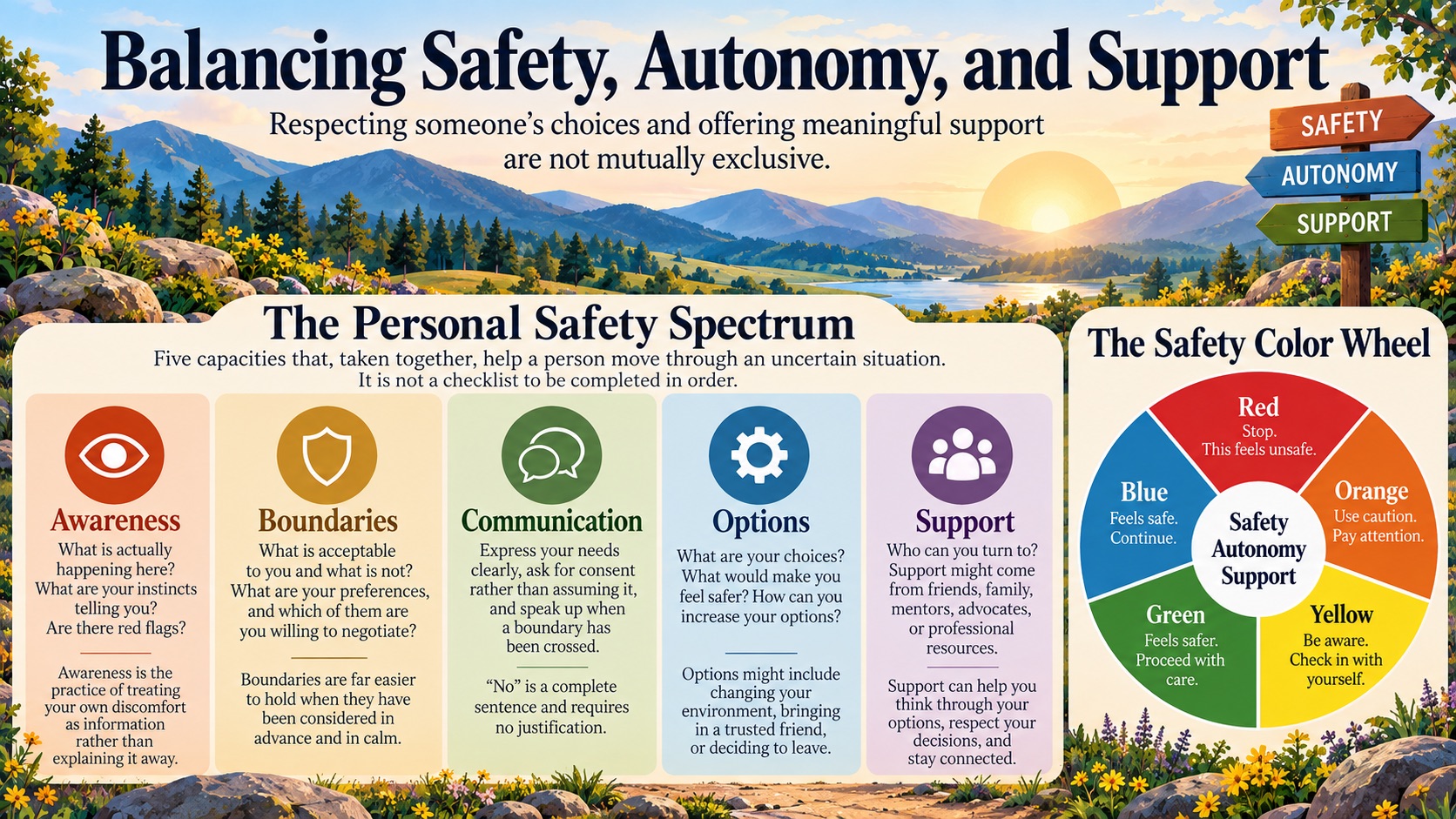
The first tool, the Personal Safety Spectrum, names five capacities that work long before anything becomes a crisis. Awareness means treating our own discomfort as information, even when the person causing it is well liked, holds authority, or is offering a hand. That matters because Blind People are routinely expected to accept offered guidance with gratitude, so turning down one particular offer can feel socially awkward. Boundaries hold best when they are set in calm: how much physical guidance we want from someone we just met, or whether a roommate may have guests overnight, is far easier to settle before convention than in the middle of the night. Communication means asking for consent, never assuming it, and knowing that "No" stands on its own without any reason attached. It runs both ways, too: we ask what the other person prefers rather than choosing for her, and that is the gap that separates offering an arm from grabbing one. Trusted networks come next, built before anyone is in trouble, with people who will meet us in a hotel lobby or answer a call at an absurd hour without demanding a reason. Advocacy and action close the spectrum, whether that means a formal report to an organization under its code of conduct or something quieter, like moving to a different room, walking away from a friendship, or keeping someone close until the evening ends.
Next came the Safety Color Wheel, which starts from a hard truth: harm seldom shows up all at once. It drifts, and the wheel hands us words for that drift. Green means feeling safe, heard, and free to disagree without paying a price for it. Yellow is the moment something feels off before anyone can name it, and it asks us to pause and trust that feeling instead of arguing ourselves out of it. Orange means a pattern is forming, with guilt, isolation, intimidation, manipulation, or boundaries crossed again and again. That stage is frequently the smartest moment to reach out, while choices are still open and someone we trust can see the pattern clearly. Red means threats, stalking, violence, coercion, or exploitation, and safety comes before anything else. Each color names a situation, never a verdict on someone's character, and a relationship can move back from yellow into green when someone voices a concern and is truly heard. Most of life sits in the middle bands, and that is where these talks matter most and feel hardest to begin. Reaching out, the group insists, is strength, not weakness.
Standing beside a friend never means deciding for her. The group hopes this evening carries into chapters, divisions, affiliates, families, workplaces, and communities, and it offers to bring the program to chapter and division meetings and to affiliate conventions. It will also share information on survivor concerns, talk through the NFB Code of Conduct, and connect members with resources, including the Joyful Heart Foundation's plain language materials and its nationwide directory of services, and the state by state directory that the National Adult Protective Services Association keeps for older adults and for adults with disabilities. In Austin, the room learned that talking about personal safety is really talking about respecting each other's humanity, and that balancing safety, autonomy, and partnership strengthens each person and the whole Federation. We already hold that inclusion is a shared job each of us owns, worked out with People with Disabilities from the start, and that asking beats assuming. Yet this workshop shows how often Blind People are still expected to accept whatever is offered, and how quietly an offer can become control.
Left unspoken, a boundary gets settled at eleven o'clock, with a stranger already in the doorway. Ahead of any event we plan, we can ask each Blind attendee how much physical guidance they want and what they expect from a roommate, then accept a plain "No" as a full answer. Where an arm is offered and never taken, and yellow gets said out loud before it turns orange, we are shaping Vibrant, Diverse, Inclusive, Accessible Communities for People with Disabilities.
Asking first is how we stand beside each other without ever deciding for each other.
Read the Full Article: Balancing Safety, Autonomy, and Support.
By: Christine Faltz Grassman, Esq.
