
Striving to remove barriers that prevent us from building Vibrant, Diverse, Inclusive, Accessible Communities!
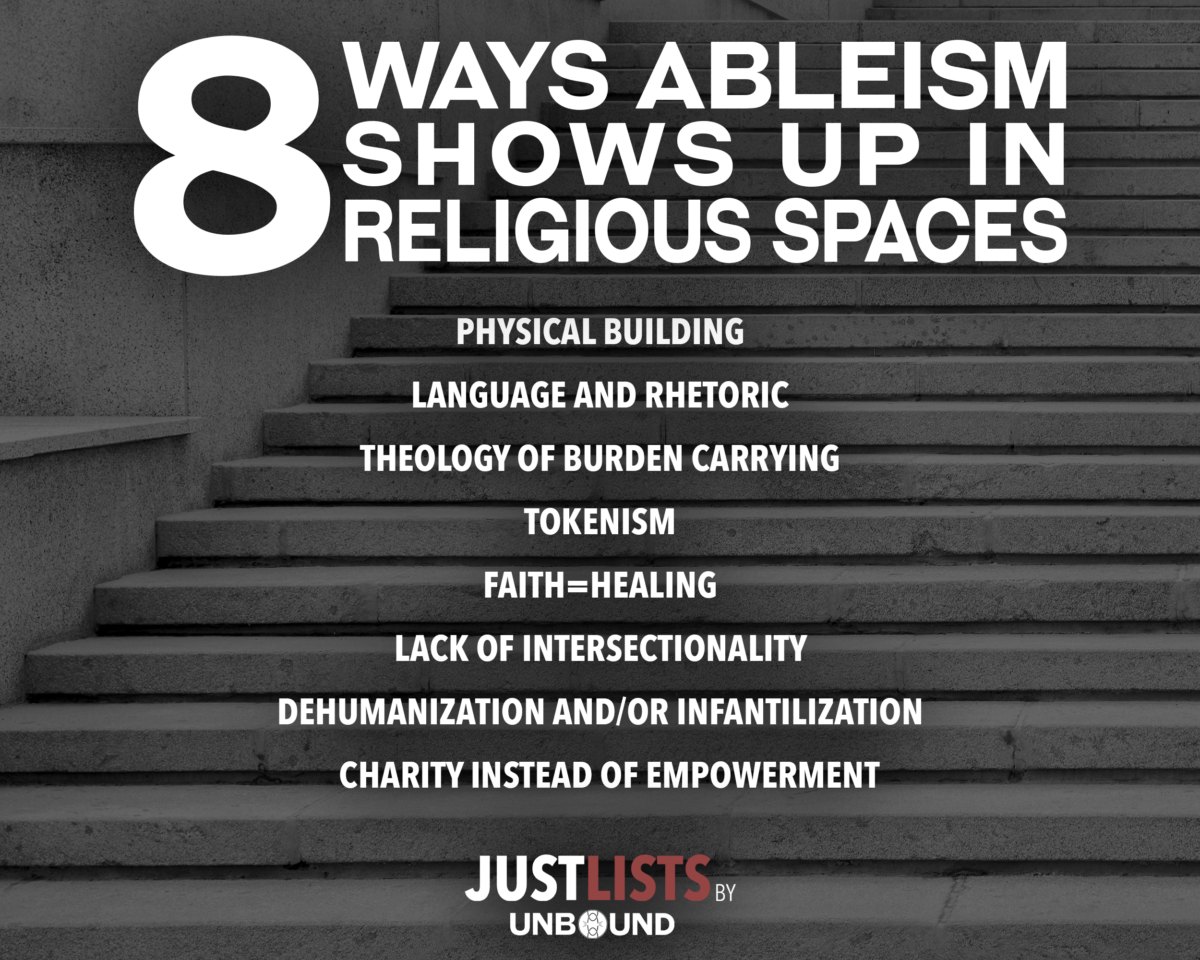
A Just List from the Unbound Team names eight ways ableism appears in faith communities. Churches often call inclusion foundational, yet People with Disabilities get overlooked, forgotten, and pushed aside by the institution and its ministries. That gap between promise and practice is ableism, which means discrimination and oppression directed at People with Disabilities. The first way is the building itself. Many gathering spaces offer no access at all, and where some exists it sits out of view, with ramps off to one side and spaces in the back. Ideas about how a building should look keep beating full inclusion, and that hurts, demeans, and shuts out the very people it should welcome. The list asks how a community can bring access into the open and shape space that offers real hospitality to People with Disabilities.
Ableism also lives in the words a congregation prays, sings, and hears. Prayers, songs, sermons, and even scripture lean on the language of sense and on walking with Christ as a picture of discipleship. Subtle as it is, that language leaves out members who do not see, hear, walk, or speak the way the words assume. Theology that frames a person's disability as a burden to carry does damage of its own. Whatever stands in a person's way stands there because society never adjusted, and the fault is never the person's. Healing stories in scripture also get bent into a teaching that anyone with enough faith will be healed, and that teaching leaves people with disappointment and trauma. The list asks how a community can change its language and its ideas about healing.
Three more ways come down to how a community sees the people in it. Tokenism is a symbolic effort, such as bringing in a few members from underrepresented groups to create a look of equality, and the list warns that religious institutions often do this to People with Disabilities. A lack of intersectionality sees a person only as a disability instead of a whole embodiment, and that hides the different perspectives a full person brings. Dehumanization and infantilization treat people with disabilities like children or as less than human, demote their personhood, and cast them as unable to contribute. The list says this shows up in interactions and even in pastoral care.
A welcome means little when the building, the prayers, and the care all say something else. The eighth way on the list is charity standing where empowerment should be. Handouts and financial gifts are fine in themselves, the list allows, yet it names relationships that begin where people already stand as the true start of empowerment, and it asks what it would take for congregations to put power in the hands of People with Disabilities. Access is owed as a right, never handed out as a favor, and those who run into a barrier are the ones to shape how it is removed. The friction is plain: a community can announce a welcome and still plan around People with Disabilities instead of with them.
Where a gathering space is picked for our events, its ramp should stand at the front in full view, never over to the side or in the back. Letting a building's looks decide where access goes would wound and shut out the very people it is for. Access in plain view would open the way to Vibrant, Diverse, Inclusive, Accessible Communities for People with Disabilities.
Putting the ramp where the welcome is spoken is how a promise starts to be true.
Read the Full Article: 8 Ways Ableism Shows Up in Religious Spaces.
By: Unbound Team
Also See:
- What is ableism, and what is its impact?
- Horror movies have an ableism problem. Isn’t it time we found new ‘monsters’?
- Ableism 101: What it is, what it looks like, and what we can do to to fix it
- Intersections Between Racism and Ableism
- How to talk about disability sensitively and avoid ableist tropes
- I was nine when I learned what ableism is
- Anti-Ableism Fast Facts - Ways to Combat Ableism:
- Becoming Anti-Ableist: A Disability Justice- Informed Approach to Supporting the Disability Community
- Inclusion Is Not Something You Earn
Questions for Reflection
- Where is the accessible entrance in each space we use, and is it at the front where the welcome is spoken?
- Which words in our prayers, songs, and talks assume everyone sees, hears, walks, or speaks the same way, and how could we change them?
- How do we talk about healing, and has that talk ever left a Person with a Disability feeling blamed?
- Are People with Disabilities in our community in roles with real decision making power, or only in symbolic ones?
- Does our care for People with Disabilities take the form of charity, or of relationships that put power in their hands?
- How will we check that our welcome matches our buildings, our prayers, and our care?
