
Striving to remove barriers that prevent us from building Vibrant, Diverse, Inclusive, Accessible Communities!
Baha'i Quotes and References Related to Community Building
These passages from the Universal House of Justice, the international governing council of the Bahá’í Faith, speak to building communities in which every person belongs and to removing the barriers of prejudice that divide people.
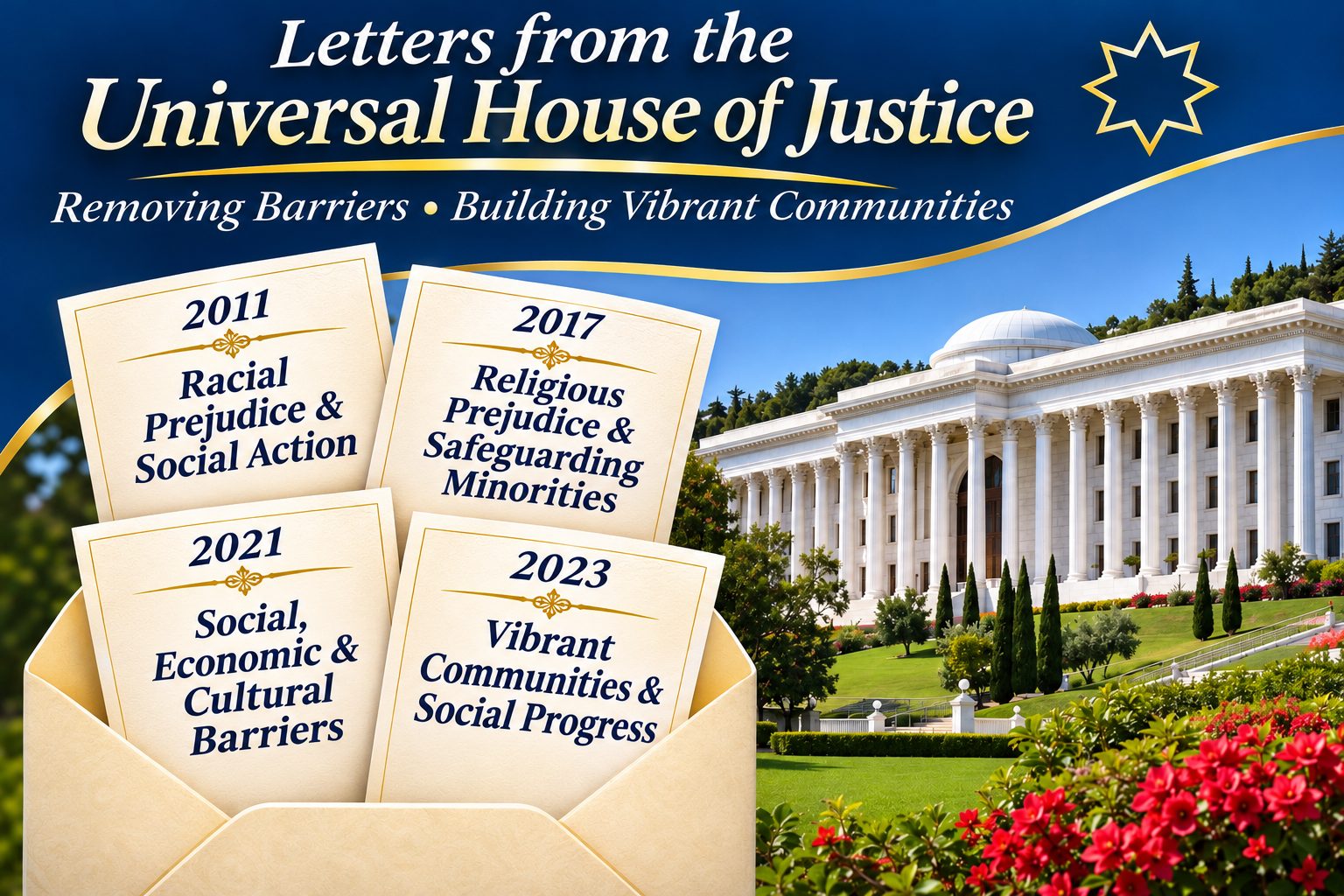
In an environment of love and trust born of common belief, practice, and mission, individuals of different races will have the intimate connection of heart and mind upon which mutual understanding and change depend. As a result of their training and deepening, a growing number of believers will draw insights from the Writings to sensitively and effectively address issues of racial prejudice that arise within their personal lives and families, among community members, and in social settings and the workplace. As programs of growth advance and the scope and intensity of activities grow, the friends will be drawn into participation in conversations and, in time, initiatives for social action at the grassroots where issues pertaining to freedom from prejudice naturally emerge, whether directly or indirectly.
Universal House of Justice to an individual believer, 10 April 10 2011, from bahaiquotes.com, Community Building
Letter from the Universal House of Justice - 27 December 2017
In the affairs of the Bahá’í community, Bahá’ís are learning to transcend traditional barriers that divide people in the wider society and exacerbate tensions among people from different religious backgrounds. Shoghi Effendi explained that “every organized community enlisted under the banner of Bahá’u’lláh should feel it to be its first and inescapable obligation to nurture, encourage, and safeguard every minority belonging to any faith, race, class, or nation within it.” One example is the way in which all minorities, including those from a religious minority background, are encouraged in their participation. “If any discrimination is at all to be tolerated”, Shoghi Effendi has for instance stated when discussing the corrosive effects of prejudice, “it should be a discrimination not against, but rather in favour of the minority, be it racial or otherwise.” The practice of Bahá’í elections is symbolic of this commitment to encouraging minorities—when a tie vote arises and one of those involved belongs to a minority group in that society, that person is unhesitatingly accorded the priority without the necessity of another vote to break the tie.
Letter from the Universal House of Justice - 30 December 2021
As the intensity of community-building work in a cluster increases, the friends there inevitably become more conscious of social, economic, or cultural barriers that are impeding people’s spiritual and material progress. Children and junior youth lacking support in their education, pressures on girls resulting from traditional customs related to early marriage, families needing help with navigating unfamiliar systems of healthcare, a village struggling for want of some basic necessity, or long-standing prejudices arising from a legacy of hostility between different groups—when a Bahá’í community’s efforts in the field of expansion and consolidation bring it into contact with these situations and many others, it will be drawn to respond to such realities as its circumstances permit. In reflecting on such situations it becomes evident that, within clusters, expansion and consolidation, social action, and contributing to prevalent discourses are dimensions of a single, unified, outward-looking endeavour carried out at the grassroots of society. All these efforts are pursued according to a common framework for action, and this above all else brings coherence to the overall pattern of activity.
Letter from the Universal House of Justice, 30 December 2021
Letter from The Universal House of Justice 28 November 2023
This community—the people of Bahá, ardent lovers of ‘Abdu’l-Bahá—now millions strong, has today spread to some one hundred thousand localities in 235 countries and territories. It has emerged from obscurity to occupy its place on the world stage. It has raised a network of thousands of institutions, from the grassroots to the international level, uniting divers peoples in the common purpose of giving expression to Bahá’u’lláh’s teachings for spiritual transformation and social progress. In many a region, its pattern of building vibrant local communities has embraced thousands—and in some, tens of thousands—of souls. In such settings, a new way of life is taking shape, distinguished by its devotional character; the commitment of youth to education and service; purposeful conversation among families, friends, and acquaintances on themes of spiritual and social import; and collective endeavours for material and social progress. The Sacred Writings of the Faith have been translated into more than eight hundred languages. The raising of national and local Mashriqu’l-Adhkárs heralds the appearance of thousands of future centres dedicated to worship and service. The world spiritual and administrative centre of the Faith has been established across the twin holy cities of ‘Akká and Haifa. And despite the community’s current, all too obvious limitations when viewed in relation to its ideals and highest aspirations—as well as the distance separating it from the attainment of its ultimate objective, the realization of the oneness of humankind—its resources, its institutional capacity, its ability to sustain systematic growth and development, its engagement with like-minded institutions, and its involvement in and constructive influence on society stand at an unprecedented height of historical achievement.
Letter from the Universal House of Justice, 28 November 2023
We should nurture, encourage and safeguard every minority in our community, People with Disabilities among them. We should become conscious of the social, economic and cultural barriers that hold people back, and respond to them as our circumstances permit. Giving priority to those who are usually left out would move us toward Vibrant, Diverse, Inclusive, Accessible Communities for People with Disabilities.
Questions for Reflection
- Shoghi Effendi wrote that every community should “nurture, encourage, and safeguard every minority” within it. Who are the minorities in our community, People with Disabilities among them, and how do we nurture, encourage and safeguard them?
- The 2021 letter says that as community building grows, the friends become more conscious of social, economic or cultural barriers. Which barriers have we become conscious of, and which have we not yet noticed?
- The 2011 letter speaks of “the intimate connection of heart and mind upon which mutual understanding and change depend.” Where do we make room for that connection among people of different backgrounds?
- In Bahá’í elections, a tie is settled in favor of a person from a minority group. Which of our everyday practices give priority to people who are usually left out?
- Which conversations and actions in our neighborhood touch on freedom from prejudice, and who is missing from them?
