
Striving to remove barriers that prevent us from building Vibrant, Diverse, Inclusive, Accessible Communities!
by Alex Chen
What is an image description?
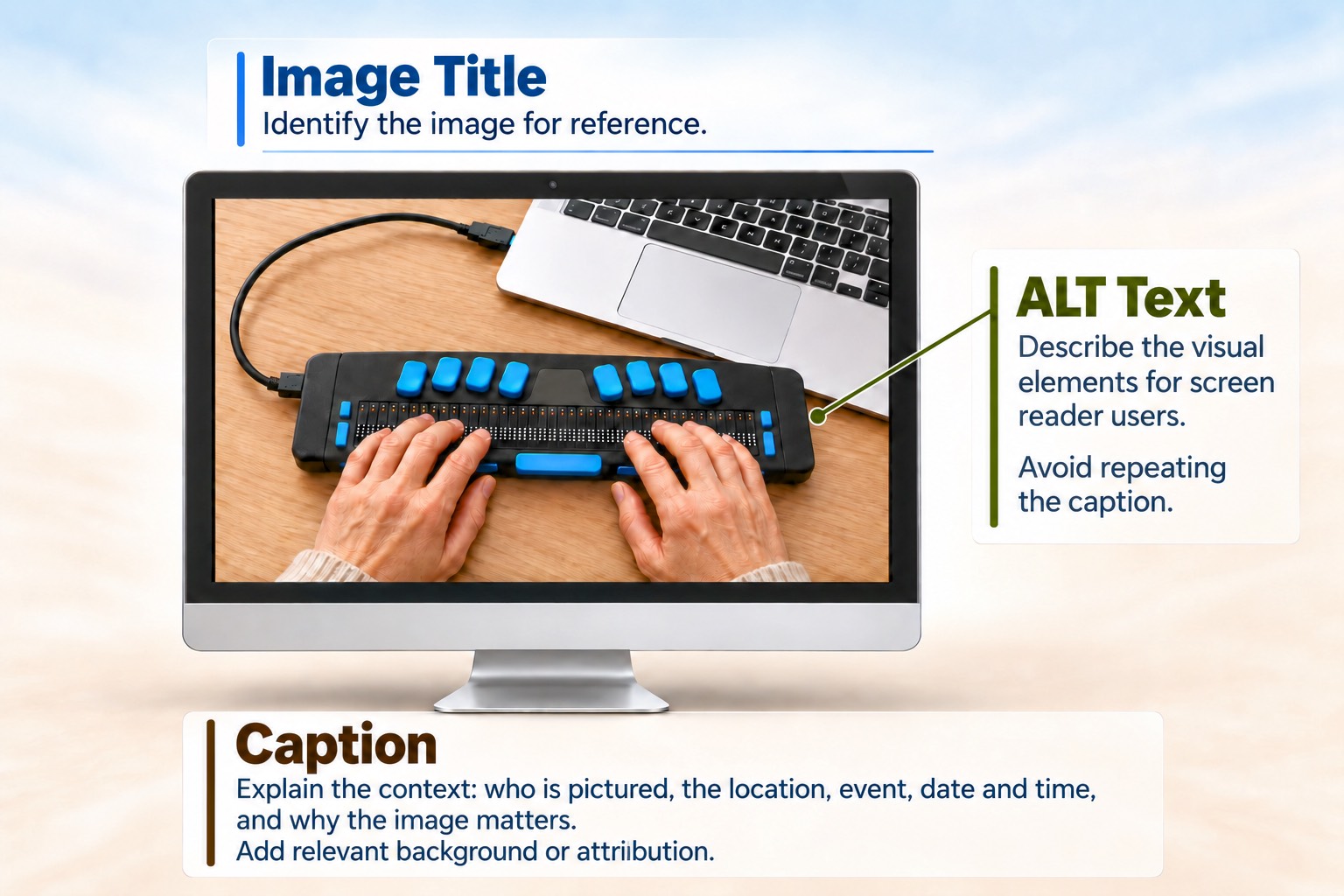
An image description is a written caption that describes the essential information in an image.
Image descriptions can define photos, graphics, gifs, and video — basically anything containing visual information. Providing descriptions for imagery and video are required as part of WCAG 2.2 (for digital ADA compliance).
It’s sometimes referred to as alt text since the alt attribute is a common place to store them. The alt attribute appears in the HTML code like this:
<img src=”link” alt=”text goes here”>
While ALT Text and image descriptions are sometimes used synonymously, they’re not actually the same thing. Alt text refers to the text specifically added to the alt attribute, and is often short and brief. Image descriptions can be found in the alt text, caption, or body of the webpage and are often more detailed.
...
Additionally, image descriptions are a gesture of care and an essential part of accessibility. Without them, content would be completely unavailable to Blind/low vision folks. By writing image descriptions, we show support of cross-disability solidarity and cross-movement solidarity.
How to write a good image description
Object-action-context
Something that I learned from talking to Bex is that there is a storytelling aspect to writing descriptions. It doesn’t necessarily make sense to go from left to right describe everything in an image because that might lose the central message or create a disorienting feeling. For that reason, I came up with a framework that I recommend called object-action-context.
The object is the main focus. The action describes what’s happening, usually what the object is doing. The context describes the surrounding environment.
I recommend this format because it keeps the description objective, concise, and descriptive.
It should be objective so that people using the description can form their own opinions about what the image means. It should be concise so that it doesn’t take too long for people to absorb all the content, especially if there are multiple images. And it should be descriptive enough that it describes all the essential aspects of the image.
What counts as “essential” can sometimes be subjective. In my research, some people preferred very brief descriptions while others preferred a great deal of visual detail (like Robin and Bex). My best advice in this area is to be as descriptive as your audience needs. You know your audience and your content best. If your work is highly visual and your audience is interested, then add more detail. If you and your audience care more about the non-visual content, then keep it on the shorter side.
We should write an image description for every image we share, so that its content reaches Blind and Low Vision people. We should describe the object, the action and the context, and keep each description objective and concise. Asking our own audience how much detail they want would move us toward Vibrant, Diverse, Inclusive, Accessible Communities for People with Disabilities.
READ this full Article for complete examples, including; Describing race and gender; Describing complicated diagrams:
Read the Full Article: How to write an image description.
By: Alex Chen
Questions for Reflection
- Which images on our website, flyers and social media have no description, and who will write them?
- Do our image descriptions follow object, action and context, so a reader gets the central message first?
- Are our descriptions objective, leaving readers to form their own opinions about what an image means?
- Do we ask our audience how much visual detail they want in a description?
- Who in our community writes image descriptions, and how did they learn?

Also See:
- Nasa Added Amazing Alt Text Image Descriptions to James Webb Space Telescope Photos
- Ensuring Inclusive and Accessible Content: Effective Use of ALT Text and Descriptive Elements in Images
- How to Write Meaningful and Inclusive Descriptive ALT Text for Images
- The case for describing race in alternative text attributes