
Striving to remove barriers that prevent us from building Vibrant, Diverse, Inclusive, Accessible Communities!
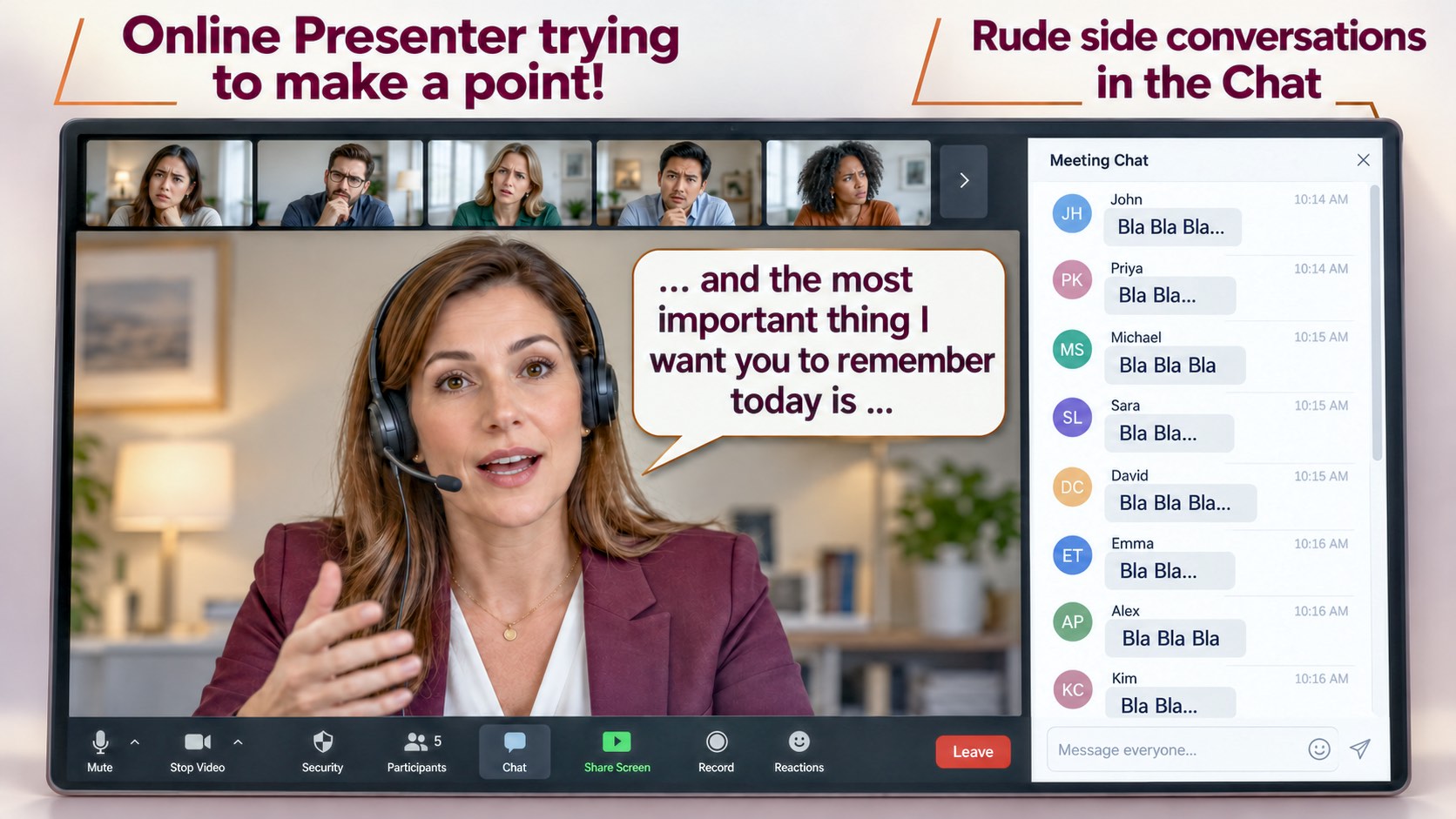
Many of us have seen this moment. A speaker begins a presentation, and a message appears on screen for everyone: “Hello from Florida! How is the weather where you are? Who is this speaker? Has anyone heard of him?” A few friends reply, and within a minute the chat has become a second conversation running beside the one the audience came to hear.
Side conversations in the chat during a presentation are rude, and they are distracting. They also create a specific barrier for Blind People who attend with a screen reader. Hosts who are learning to run accessible online meetings and presentations will find that chat is one of the first things to settle.
Talking over the speaker
Imagine the same scene in a meeting room. Someone leans over in the middle of the talk to ask a neighbor who the speaker is, and others whisper back. Most communities would not accept that behavior in a room. Online it arrives as text, so it feels quieter, yet the effect on the speaker and the audience is the same.
One writer who examined his own habits reached a plain conclusion: typing commentary in the chat while someone presents is a way of talking over them. The messages he had meant as friendly affirmations were full sentences, and a colleague presenting twice lost their place.
Sometimes the chat relates to what the speaker is saying, but often it does not. Even when it does, it competes with the speaker for attention. Most conferences already set aside time for questions and comments. That time works because the speaker knows it is coming and takes part in it. A chat that runs unplanned during the talk offers none of that.
Why a screen reader makes the interruption worse
A screen reader is software that reads on screen text aloud, so that Blind People can use a computer by keyboard and speech. When chat is open, new messages can be spoken at the same moment the presenter is speaking. The University of California, Irvine, guidance on accessible Zoom meetings states that chat is disruptive for screen reader users because, with speech turned on, it is read out loud over other talk.
A guide to accessible online events adds that Zoom’s default is an alert for each new chat message, which many users find distracting, and that screen reader users can turn that alert off in the Zoom app’s accessibility settings. That is a personal workaround. A Blind participant should not have to give up chat alerts to hear the speaker.
This is the social model of disability in practice. The barrier does not come from the participant. It comes from how the event is run, which is why the host’s settings matter most.
Chat also excludes people who join by phone. Guidance from the University of Virginia Library and from the University of Colorado Boulder both note that participants who call in to a meeting cannot see or contribute to the chat.
Why we cannot simply ignore the chat
It is easy to assume that listeners can read the chat and still follow the speaker. Research on task switching points the other way. In a study reported in a 2001 American Psychological Association news release, Joshua Rubinstein, David Meyer, and Jeffrey Evans measured how people moved between tasks. For every type of task, participants lost time when they switched, and the loss grew as tasks became more complex or less familiar. The researchers concluded that multitasking may seem more efficient on the surface but may actually take more time in the end.
Following a presentation while reading a chat is a version of this switching. Each glance at the chat is a switch, and a chat that scrolls during a presentation invites many of them.
What hosts can do before the event starts
Hosts hold the controls, so the most reliable remedy is a decision made before the presentation begins. As described on Zoom’s support pages in October 2026, a Zoom host has these options:
- Turn chat off. The Meeting chat setting can be switched off by an account administrator, a group administrator, or an individual user in their Zoom settings. Turning it off removes the Chat option from participant controls.
- Limit who participants can chat with. During a meeting, the host opens the chat, selects More, and sets “Participant can chat with” to No one, Host and co-hosts, Meeting group chat, or Meeting group chat & anyone directly. Choosing Host and co-hosts lets participants send questions to the host, who can read them aloud or pass them to the speaker.
- Turn off private chat. The Direct messages setting under Meeting chat stops participants from messaging one another privately. Participants can still message the host.
Zoom updates its menus from time to time, so check its pages on enabling or disabling meeting chat and on disabling private chat for the current steps. If your community uses a different platform, ask its provider where the equivalent chat controls are.
Settle chat in the same planning conversation where you decide on schedule, materials, and access requests. The guide to planning welcoming, accessible gatherings explains how to begin early and how to ask participants privately what will work for them.
Share information so no one depends on the chat
Chat is not a fair place to put anything essential. The University of Colorado Boulder advises repeating important questions or points made in the chat out loud so everyone knows what was said. The University of Virginia Library advises sending links and materials to all participants before the session. With both steps, Blind participants hear the information, people on the phone hear it, and nobody has to watch a chat to take part.
Announce at the start how and when questions will be taken, and tell the speaker the plan. Questions then reach the presenter in a way every participant can follow.
A quieter chat gives the speaker and every attendee a clearer presentation. For Blind People who use screen readers and for people who join by phone, it removes a specific barrier to taking part.
Questions for Community Builders
Take these questions to a gathering of your community’s planners and hosts. Answer them from what actually happens at your events, not from what you intend.
- At our last online presentation, what appeared in the chat while the speaker was talking, and who in our community could not follow the speaker because of it?
- Have we asked Blind People in our community, privately and without assuming the answer, how chat affects their participation, and what changed because of what they told us?
- Who decides the chat settings before each online gathering, where is that decision written down, and would a new host know to make it?
- When we invite questions during a presentation, how do people who join by phone, or who cannot use chat, take part on equal terms with everyone else?
- When important information appears only in the chat, how does it reach participants who are not reading the chat, and who is responsible for sending it ahead or saying it aloud?
- Which habits at our online events, such as greetings, side remarks, or reactions in the chat, have become normal without anyone choosing them, and whom do they favor?
